


List of Registered Historic Places in Ramsey County, Minnesota

Encyclopedia
National Register of Historic Places
The National Register of Historic Places is the United States government's official list of districts, sites, buildings, structures, and objects deemed worthy of preservation...
including three National Historic Landmarks. These properties are recognized by the United States government for their historical significance. A supplementary list includes four additional sites that were formerly listed on the National Register or are listed in adjacent counties.
Ramsey County
Ramsey County, Minnesota
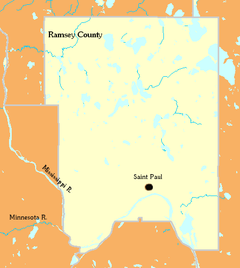
Ramsey County is a county located in the U.S. state of Minnesota, founded in 1849. As of 2010, the population was 508,640. Its county seat is St. Paul, which is also Minnesota's state capital. The county is named for Alexander Ramsey , the first governor of the Minnesota Territory...
is a county located in the southeastern part of the U.S. state
U.S. state
A U.S. state is any one of the 50 federated states of the United States of America that share sovereignty with the federal government. Because of this shared sovereignty, an American is a citizen both of the federal entity and of his or her state of domicile. Four states use the official title of...
of Minnesota
Minnesota
Minnesota is a U.S. state located in the Midwestern United States. The twelfth largest state of the U.S., it is the twenty-first most populous, with 5.3 million residents. Minnesota was carved out of the eastern half of the Minnesota Territory and admitted to the Union as the thirty-second state...
, bounded in some places by the Mississippi River
Mississippi River
The Mississippi River is the largest river system in North America. Flowing entirely in the United States, this river rises in western Minnesota and meanders slowly southwards for to the Mississippi River Delta at the Gulf of Mexico. With its many tributaries, the Mississippi's watershed drains...
, by Hennepin County, Anoka County, Washington County
Washington County, Minnesota
Washington County is a county established in 1849 in the U.S. state of Minnesota. As of 2010, the population was 238,136. Its county seat is Stillwater.-History:...
, and Dakota County
Dakota County, Minnesota
Dakota County is the third most populous county in the U.S. state of Minnesota. The county is bordered by the Minnesota and Mississippi Rivers on the north, and the state of Wisconsin on the east. Dakota County comprises the southeast portion of seven-county Minneapolis-St. Paul, the thirteenth...
. All of the county seat, Saint Paul
Saint Paul, Minnesota
Saint Paul is the capital and second-most populous city of the U.S. state of Minnesota. The city lies mostly on the east bank of the Mississippi River in the area surrounding its point of confluence with the Minnesota River, and adjoins Minneapolis, the state's largest city...
is in the county, including Saint Paul's "West Side" neighborhood, which is south of the Mississippi River.
Current listings
The county's historic places include houses, places of worship, commerce, and education, and community centers and infrastructure. Several districts encompass several structures of related historic significance. Some of the oldest structures in the state are in Ramsey County, representing the earliest of non-nativeNative Americans in the United States
Native Americans in the United States are the indigenous peoples in North America within the boundaries of the present-day continental United States, parts of Alaska, and the island state of Hawaii. They are composed of numerous, distinct tribes, states, and ethnic groups, many of which survive as...
residents in the state. As the northernmost natural port on the Upper Mississippi River
Upper Mississippi River
The Upper Mississippi River is the portion of the Mississippi River upstream of Cairo, Illinois, United States. From the headwaters at Lake Itasca, Minnesota, the river flows approximately 2000 kilometers to Cairo, where it is joined by the Ohio River to form the Lower Mississippi...
, Saint Paul grew, handling both river and rail freight and passenger traffic. Even as Minneapolis (in Hennepin County) eventually surpassed Saint Paul in the volume of commerce, Saint Paul remained relevant as the state capitol and associated government services and employment kept the county growing. Several of the sites are specifically related to the various first-generation immigrant populations that made Ramsey County their new home in America
United States
The United States of America is a federal constitutional republic comprising fifty states and a federal district...
, especially Germans, Czechs, Scandinavia
Scandinavia
Scandinavia is a cultural, historical and ethno-linguistic region in northern Europe that includes the three kingdoms of Denmark, Norway and Sweden, characterized by their common ethno-cultural heritage and language. Modern Norway and Sweden proper are situated on the Scandinavian Peninsula,...
ns, and Austro-Hungarians
Austria-Hungary
Austria-Hungary , more formally known as the Kingdoms and Lands Represented in the Imperial Council and the Lands of the Holy Hungarian Crown of Saint Stephen, was a constitutional monarchic union between the crowns of the Austrian Empire and the Kingdom of Hungary in...
, which together comprised the majority of residents in the first century of the county's history.
|--
! | 1
| Arlington Hills Library
Arlington Hills Library
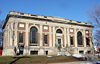
The Arlington Hills Library is a 1916 Beaux Arts library building designed by Cameron and Company. It is one of three Carnegie Libraries in Saint Paul, Minnesota. It is listed on the National Register of Historic Places....
|
|
| 1105 Greenbrier Street
44°58′28"N 93°4′16"W
| Saint Paul
Saint Paul, Minnesota
Saint Paul is the capital and second-most populous city of the U.S. state of Minnesota. The city lies mostly on the east bank of the Mississippi River in the area surrounding its point of confluence with the Minnesota River, and adjoins Minneapolis, the state's largest city...
| 1916 Beaux Arts library
Library
In a traditional sense, a library is a large collection of books, and can refer to the place in which the collection is housed. Today, the term can refer to any collection, including digital sources, resources, and services...
building designed by Cameron and Company; a Carnegie Library
Carnegie Library
Carnegie Library, Carnegie Public Library, Carnegie Free Library, Carnegie Free Public Library, Andrew Carnegie Library, Andrew Carnegie Free Library or Carnegie Library Building may refer to any of the following Carnegie libraries:- California :*Carnegie Library , listed on the National Register...
|--
!
| John M. Armstrong House
John M. Armstrong House
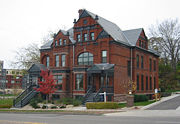
The John M. Armstrong House is in Saint Paul, Minnesota. John Milton Armstrong, son of John Armstrong, Jr. hired architect Edward P. Bassford to design this side-by-side duplex in 1886 as income-producing residential housing...
|
|
| 225 Eagle Parkway
44°56′28"N 93°6′3"W
| Saint Paul
Saint Paul, Minnesota
Saint Paul is the capital and second-most populous city of the U.S. state of Minnesota. The city lies mostly on the east bank of the Mississippi River in the area surrounding its point of confluence with the Minnesota River, and adjoins Minneapolis, the state's largest city...
| John Milton Armstrong, son of John Armstrong, Jr. (April 20, 1793 – December 22, 1865) hired architect Edward Payson Bassford to design this side-by-side duplex
Duplex (building)
The term duplex can be used to describe several different dwelling unit configurations:A duplex house is defined as a dwelling having apartments with separate entrances for two families. This includes two-story houses having a complete apartment on each floor and also side-by-side apartments on a...
in 1886 as income-producing residential housing. The red brick house was originally located at 233-235 West Fifth Street, but was moved to its present location on Eagle Parkway in November 2001.
|--
!
| Assumption School
Assumption School (Minnesota)
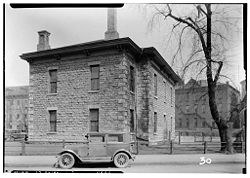
The Assumption School building, located at 68 Exchange Street, in Saint Paul in the U.S. state of Minnesota was built in 1864 of local quarter-cut limestone. It had a central cupola, which has been replaced. The school is affiliated with the nearby Church of the Assumption....
|
|
| 68 Exchange Street
44°56′51"N 93°6′0"W
| Saint Paul
Saint Paul, Minnesota
Saint Paul is the capital and second-most populous city of the U.S. state of Minnesota. The city lies mostly on the east bank of the Mississippi River in the area surrounding its point of confluence with the Minnesota River, and adjoins Minneapolis, the state's largest city...
| built in 1864 of local quarter-cut limestone
Limestone
Limestone is a sedimentary rock composed largely of the minerals calcite and aragonite, which are different crystal forms of calcium carbonate . Many limestones are composed from skeletal fragments of marine organisms such as coral or foraminifera....
, it is affiliated with the nearby Church of the Assumption
|--
!
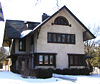
| Dr. Ward Beebe House
Dr. Ward Beebe House
The Dr. Ward Beebe House also known as the John Leuthold residence, is a three-story stucco prairie house built by Dr. Ward and Bess Beebe and designed by Purcell and Elmslie in 1912. Purcell and Elmslie were prolific designers of prairie style homes. It is located in the West Summit Avenue...
|
|
| 2022 Summit Avenue
44°56′28"N 93°11′9"W
| Saint Paul
Saint Paul, Minnesota
Saint Paul is the capital and second-most populous city of the U.S. state of Minnesota. The city lies mostly on the east bank of the Mississippi River in the area surrounding its point of confluence with the Minnesota River, and adjoins Minneapolis, the state's largest city...
| also known as the John Leuthold residence, this three-story stucco prairie house was built by Dr. Ward and Bess Beebe and designed by Purcell and Elmslie in 1912
|--
!
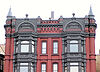
| Blair Flats
Blair Flats
Blair Flats, also known as the Blair Arcade Building, is a Victorian residential building designed by Hermann Kretz and William H. Thomas in 1887; it is located in Saint Paul, Minnesota in the Historic Hill District; construction materials are sandstone-and-brick; it has been used as apartments,...
|
|
| 165 Western Avenue
44°56′47"N 93°6′58"W
| Saint Paul
Saint Paul, Minnesota
Saint Paul is the capital and second-most populous city of the U.S. state of Minnesota. The city lies mostly on the east bank of the Mississippi River in the area surrounding its point of confluence with the Minnesota River, and adjoins Minneapolis, the state's largest city...
| Victorian
Victorian architecture
The term Victorian architecture refers collectively to several architectural styles employed predominantly during the middle and late 19th century. The period that it indicates may slightly overlap the actual reign, 20 June 1837 – 22 January 1901, of Queen Victoria. This represents the British and...
building designed by Hermann Kretz and William H. Thomas in 1887; construction materials are sandstone-and-brick; has been used as apartments, hotel, and condominiums
|--
!
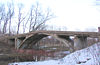
| Bridges No. L-5853 and 92247
Bridges No. L-5853 and 92247
Bridges No. L-5853 and 92247 are two side-by side bridges in Saint Paul, Minnesota. They were built in 1904 over the Como-Harriet streetcar line, connecting the nearby Twin City Rapid Transit Company station to the line running west to Minneapolis; Bridge No. 92247 carries traffic on Lexington...
|
|
| Lexington Avenue in Como Park
44°58′42"N 93°8′47"W
| Saint Paul
Saint Paul, Minnesota
Saint Paul is the capital and second-most populous city of the U.S. state of Minnesota. The city lies mostly on the east bank of the Mississippi River in the area surrounding its point of confluence with the Minnesota River, and adjoins Minneapolis, the state's largest city...
| two side-by side bridges built in 1904 under which the Como-Harriet streetcar ran, connecting to the nearby Twin City Rapid Transit Company station, just to the southeast; Bridge No. 92247 carried traffic on Lexington Avenue over the tracks and Bridge No. L-5853 carried pedestrians; the latter is an example of an early reinforced concrete arch bridge, using the Melan reinforcing system
Josef Melan
Josef Melan was an Austrian engineer. He is regarded as one of the most important pioneers of reinforced concrete bridge-building at the end of the 19th century. Josef Melan is credited as the inventor of the Melan System, a method for the construction of reinforced bridges...
by the William S. Hewett & Company of Minneapolis
|--
!
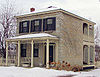
| Joseph Brings House
Joseph Brings House
The Joseph Brings House also known as the Johan and Maria Magdalena Schilliger House, originally located at 314 Smith Avenue North, Saint Paul, Minnesota, United States, the home was built between 1859 and 1862 by John Schilliger, and purchased by Brings in 1863; a cooper, Joseph Brings was born...
|
|
| 178 Goodrich Avenue
44°56′15.5"N 93°6′27.5"W
| Saint Paul
Saint Paul, Minnesota
Saint Paul is the capital and second-most populous city of the U.S. state of Minnesota. The city lies mostly on the east bank of the Mississippi River in the area surrounding its point of confluence with the Minnesota River, and adjoins Minneapolis, the state's largest city...
| also known as the Johan and Maria Magdalena Schilliger House, originally located at 314 Smith Avenue North, the home was built between 1859 and 1862 by John Schilliger, and purchased by Brings in 1863; a cooper
Cooper (profession)
Traditionally, a cooper is someone who makes wooden staved vessels of a conical form, of greater length than breadth, bound together with hoops and possessing flat ends or heads...
, Joseph Brings (1820–1899) was born in Germany
Germany
Germany , officially the Federal Republic of Germany , is a federal parliamentary republic in Europe. The country consists of 16 states while the capital and largest city is Berlin. Germany covers an area of 357,021 km2 and has a largely temperate seasonal climate...
and came to Saint Paul in 1857; 83004868
|--
!
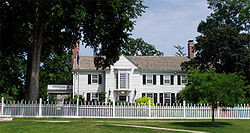
| Markell and Edward Brooks, Sr. House
Eastcliff (mansion)
Eastcliff is a 20-room house overlooking the Mississippi River in St. Paul, Minnesota, which serves as the official residence of the president of the University of Minnesota system. It was first built in 1922 by local lumber magnate Edward Brooks, Sr., and donated to the university by the Brooks...
|
|
| 176 Mississippi River Boulevard North
44°56′47"N 93°11′54"W
| Saint Paul
Saint Paul, Minnesota
Saint Paul is the capital and second-most populous city of the U.S. state of Minnesota. The city lies mostly on the east bank of the Mississippi River in the area surrounding its point of confluence with the Minnesota River, and adjoins Minneapolis, the state's largest city...
| better known as Eastcliff, the Brooks house is a 20-room house overlooking the Mississippi River
Mississippi River
The Mississippi River is the largest river system in North America. Flowing entirely in the United States, this river rises in western Minnesota and meanders slowly southwards for to the Mississippi River Delta at the Gulf of Mexico. With its many tributaries, the Mississippi's watershed drains...
, that serves as the official residence of the president of the University of Minnesota system
University of Minnesota system
The University of Minnesota is a large university with several campuses spread throughout the U.S. state of Minnesota. There are five primary campuses in the Twin Cities, Duluth, Crookston, Morris, and Rochester. A campus was open in Waseca for a time. The university also operates several...
|--
!
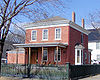
| Benjamin Brunson House
Benjamin Brunson House
The Benjamin Brunson House is one of the oldest houses remaining in Saint Paul, Minnesota it was built ca. 1856 in the area known as "railroad island," being surrounded by tracks. It is listed on the National Register of Historic Places....
|
|
| 485 Kenny Rd.
44°57′27"N 93°4′48"W
| Saint Paul
Saint Paul, Minnesota
Saint Paul is the capital and second-most populous city of the U.S. state of Minnesota. The city lies mostly on the east bank of the Mississippi River in the area surrounding its point of confluence with the Minnesota River, and adjoins Minneapolis, the state's largest city...
| one of the oldest houses remaining in Saint Paul, it was built ca. 1856 in the area known as "railroad island," being surrounded by tracks
|--
!
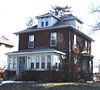
| Casiville Bullard House
Casiville Bullard House
The Casiville Bullard House in Saint Paul, Minnesota is listed on the National Register of Historic Places. The skilled African-American stonemason and bricklayer, Tennessee-born Casiville Bullard, built this American Foursquare home for himself in 1910....
|
|
| 1282 Folsom Street
44°58′47.7"N 93°7′56.7"W
| Saint Paul
Saint Paul, Minnesota
Saint Paul is the capital and second-most populous city of the U.S. state of Minnesota. The city lies mostly on the east bank of the Mississippi River in the area surrounding its point of confluence with the Minnesota River, and adjoins Minneapolis, the state's largest city...
| the skilled African-American stonemason and bricklayer, Tennessee
Tennessee
Tennessee is a U.S. state located in the Southeastern United States. It has a population of 6,346,105, making it the nation's 17th-largest state by population, and covers , making it the 36th-largest by total land area...
-born Casiville Bullard, built this American Foursquare
American Foursquare
The American Foursquare or American Four Square is an American house style popular from the mid-1890s to the late 1930s. A reaction to the ornate and mass produced elements of the Victorian and other Revival styles popular throughout the last half of the 19th century, the American Foursquare was...
home for himself in 1910
|--
!
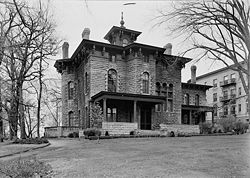
| Burbank-Livingston-Griggs House
Burbank-Livingston-Griggs House
The Burbank-Livingston-Griggs House is one of the first examples of Italianate or Tuscan order architecture in Saint Paul in the U.S. state of Minnesota. The house, located at 432 Summit Avenue is listed on the National Register of Historic Places. It was designed by Chicago architect Otis L....
|
|
| 432 Summit Avenue
44°56′28"N 93°7′5"W
| Saint Paul
Saint Paul, Minnesota
Saint Paul is the capital and second-most populous city of the U.S. state of Minnesota. The city lies mostly on the east bank of the Mississippi River in the area surrounding its point of confluence with the Minnesota River, and adjoins Minneapolis, the state's largest city...
| one of the first examples of Italianate or Tuscan order
Tuscan order
Among canon of classical orders of classical architecture, the Tuscan order's place is due to the influence of the Italian Sebastiano Serlio, who meticulously described the five orders including a "Tuscan order", "the solidest and least ornate", in his fourth book of Regole generalii di...
architecture in Saint Paul, the house was designed by Chicago
Chicago
Chicago is the largest city in the US state of Illinois. With nearly 2.7 million residents, it is the most populous city in the Midwestern United States and the third most populous in the US, after New York City and Los Angeles...
architect Otis L. Wheelock and built 1862-1865 for James C. Burbank, a wealthy owner of the Minnesota Stage Company, which held a state-wide monopoly controlling 1600 miles (2,574.9 km) of stage-lines by 1865
|--
!
| Pierce and Walter Butler House
Pierce and Walter Butler House
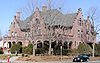
The Pierce and Walter Butler House is a side-by-side duplex, in the West Summit Avenue Historic District of Saint Paul, Minnesota, built in 1900 by Clarence H. Johnston, Sr. for United States Supreme Court justice Pierce Butler and his brother, Walter Butler....
|
|
| 1345-1347 Summit Avenue
44°56′31"N 93°9′25"W
| Saint Paul
Saint Paul, Minnesota
Saint Paul is the capital and second-most populous city of the U.S. state of Minnesota. The city lies mostly on the east bank of the Mississippi River in the area surrounding its point of confluence with the Minnesota River, and adjoins Minneapolis, the state's largest city...
| a side-by-side duplex
Duplex (building)
The term duplex can be used to describe several different dwelling unit configurations:A duplex house is defined as a dwelling having apartments with separate entrances for two families. This includes two-story houses having a complete apartment on each floor and also side-by-side apartments on a...
, also in the West Summit Avenue Historic District, built in 1900 by Clarence H. Johnston, Sr.
Clarence H. Johnston, Sr.
Clarence H. Johnston Sr. was an American architect, active in Saint Paul and in Morris, Minnesota. In 1877, Johnston entered the Massachusetts Institute of Technology as a special architectural student. Four years later, he went abroad, traveling in Europe and Asia Minor...
for United States Supreme Court justice Pierce Butler
Pierce Butler (justice)
Pierce Butler was an American jurist who served as an Associate Justice of the Supreme Court of the United States from 1923 until his death in 1939...
and his brother, Walter Butler
|--
!
| C.S.P.S. Hall
|
|
| 381-383 Michigan Street
44°56′7"N 93°6′58"W
| Saint Paul
Saint Paul, Minnesota
Saint Paul is the capital and second-most populous city of the U.S. state of Minnesota. The city lies mostly on the east bank of the Mississippi River in the area surrounding its point of confluence with the Minnesota River, and adjoins Minneapolis, the state's largest city...
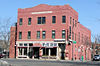
| Czech-Slovak Protective Society Hall - a recreation center and meeting house used for social events; important to the cultural preservation of Czech and Slovak
Slovaks
The Slovaks, Slovak people, or Slovakians are a West Slavic people that primarily inhabit Slovakia and speak the Slovak language, which is closely related to the Czech language.Most Slovaks today live within the borders of the independent Slovakia...
immigrants
|--
!
| Central Presbyterian Church
Central Presbyterian Church (St. Paul, Minnesota)
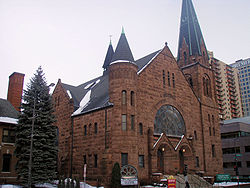
Central Presbyterian Church is a church in downtown Saint Paul, Minnesota. The congregation was founded in 1852 and built its first building in 1854, which was later enlarged during the 1870s. The rapidly growing congregation outgrew the building, so they built a new church building in 1889...
|
|
| 500 Cedar Street
44°56′59"N 93°5′46"W
| Saint Paul
Saint Paul, Minnesota
Saint Paul is the capital and second-most populous city of the U.S. state of Minnesota. The city lies mostly on the east bank of the Mississippi River in the area surrounding its point of confluence with the Minnesota River, and adjoins Minneapolis, the state's largest city...
| a Richardsonian Romanesque
Richardsonian Romanesque
Richardsonian Romanesque is a style of Romanesque Revival architecture named after architect Henry Hobson Richardson, whose masterpiece is Trinity Church, Boston , designated a National Historic Landmark...
church building designed by Warren H. Hayes
Warren H. Hayes
Warren Howard Hayes was a leading designer of churches in the United States and Canada during the late 19th century. Hayes' work holds a significant place in its association with the "Social Gospel" movement...
; built of coarsely carved Lake Superior
Lake Superior
Lake Superior is the largest of the five traditionally-demarcated Great Lakes of North America. It is bounded to the north by the Canadian province of Ontario and the U.S. state of Minnesota, and to the south by the U.S. states of Wisconsin and Michigan. It is the largest freshwater lake in the...
brownstone
Brownstone
Brownstone is a brown Triassic or Jurassic sandstone which was once a popular building material. The term is also used in the United States to refer to a terraced house clad in this material.-Types:-Apostle Island brownstone:...
|--
!
| Church of St. Agnes-Catholic
|
|
| 548 Lafond Avenue
44°57′35"N 93°7′24"W
| Saint Paul
Saint Paul, Minnesota
Saint Paul is the capital and second-most populous city of the U.S. state of Minnesota. The city lies mostly on the east bank of the Mississippi River in the area surrounding its point of confluence with the Minnesota River, and adjoins Minneapolis, the state's largest city...
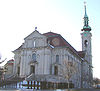
| onion-domed church building designed by George Ries, built 1901-1912 for the German
German language
German is a West Germanic language, related to and classified alongside English and Dutch. With an estimated 90 – 98 million native speakers, German is one of the world's major languages and is the most widely-spoken first language in the European Union....
-speaking Austro-Hungarian
Austria-Hungary
Austria-Hungary , more formally known as the Kingdoms and Lands Represented in the Imperial Council and the Lands of the Holy Hungarian Crown of Saint Stephen, was a constitutional monarchic union between the crowns of the Austrian Empire and the Kingdom of Hungary in...
population of immigrants
|--
!
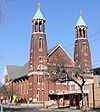
| Church of St. Bernard-Catholic
|
|
| 197 Geranium Avenue West
44°58′34"N 93°6′27"W
| Saint Paul
Saint Paul, Minnesota
Saint Paul is the capital and second-most populous city of the U.S. state of Minnesota. The city lies mostly on the east bank of the Mississippi River in the area surrounding its point of confluence with the Minnesota River, and adjoins Minneapolis, the state's largest city...
| church building designed by John Jager, built 1905-1914 in the Prairie School
Prairie School
Prairie School was a late 19th and early 20th century architectural style, most common to the Midwestern United States.The works of the Prairie School architects are usually marked by horizontal lines, flat or hipped roofs with broad overhanging eaves, windows grouped in horizontal bands,...
and Art Nouveau
Art Nouveau
Art Nouveau is an international philosophy and style of art, architecture and applied art—especially the decorative arts—that were most popular during 1890–1910. The name "Art Nouveau" is French for "new art"...
styles
|--
!
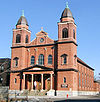
| Church of St. Casimir-Catholic
|
|
| 937 Jessamine Avenue East
44°58′30"N 93°3′40"W
| Saint Paul
Saint Paul, Minnesota
Saint Paul is the capital and second-most populous city of the U.S. state of Minnesota. The city lies mostly on the east bank of the Mississippi River in the area surrounding its point of confluence with the Minnesota River, and adjoins Minneapolis, the state's largest city...
| church building built in 1904 in the Beaux Arts style
|--
!
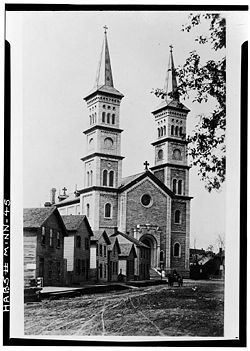
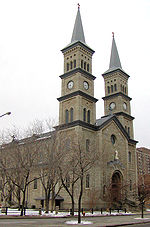
| Church of the Assumption-Catholic
|
|
| 51 9th Street West
44°56′51"N 93°5′57"W
| Saint Paul
Saint Paul, Minnesota
Saint Paul is the capital and second-most populous city of the U.S. state of Minnesota. The city lies mostly on the east bank of the Mississippi River in the area surrounding its point of confluence with the Minnesota River, and adjoins Minneapolis, the state's largest city...
| the oldest existing church in Saint Paul; built in a plain Romanesque
Romanesque architecture
Romanesque architecture is an architectural style of Medieval Europe characterised by semi-circular arches. There is no consensus for the beginning date of the Romanesque architecture, with proposals ranging from the 6th to the 10th century. It developed in the 12th century into the Gothic style,...
style of Lake Superior
Lake Superior
Lake Superior is the largest of the five traditionally-demarcated Great Lakes of North America. It is bounded to the north by the Canadian province of Ontario and the U.S. state of Minnesota, and to the south by the U.S. states of Wisconsin and Michigan. It is the largest freshwater lake in the...
limestone
Limestone
Limestone is a sedimentary rock composed largely of the minerals calcite and aragonite, which are different crystal forms of calcium carbonate . Many limestones are composed from skeletal fragments of marine organisms such as coral or foraminifera....
by a German
German American
German Americans are citizens of the United States of German ancestry and comprise about 51 million people, or 17% of the U.S. population, the country's largest self-reported ancestral group...
Catholics
Roman Catholic Church
The Catholic Church, also known as the Roman Catholic Church, is the world's largest Christian church, with over a billion members. Led by the Pope, it defines its mission as spreading the gospel of Jesus Christ, administering the sacraments and exercising charity...
, and is said to have been modeled after the Ludwigskirche in Munich
Munich
Munich The city's motto is "" . Before 2006, it was "Weltstadt mit Herz" . Its native name, , is derived from the Old High German Munichen, meaning "by the monks' place". The city's name derives from the monks of the Benedictine order who founded the city; hence the monk depicted on the city's coat...
|--
!
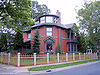
| Cyrus B. Cobb House
Cyrus B. Cobb House
The Cyrus B. Cobb House is a home built ca. 1885-1889 in White Bear Lake, Minnesota. The solid brick house was designed in the Queen Anne architectural style. It is listed on the National Register of Historic Places....
|
|
| 2199 1st Street
45°4′57"N 93°0′27"W
| White Bear Lake
White Bear Lake, Minnesota
White Bear Lake is a city in Ramsey and Washington counties in the U.S. state of Minnesota. The population was 23,797 at the 2010 census. The city is located on White Bear Lake, one of the largest lakes in the Minneapolis-St...
| a home built ca. 1885-1889, the solid brick house was designed in the Queen Anne architectural style
|--
!
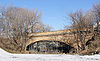
| Colorado Street Bridge
Colorado Street Bridge (Saint Paul, Minnesota)
The Colorado Street Bridge also known as Bridge No. L-8803 is a masonry and brick arch bridge in Saint Paul, Minnesota's West Side neighborhood. It is wide and consists of a single oblique span of that was built with the arch courses running parallel to the abutments, leading to a weaker...
|
|
| East side of South Wabasha Street near Terrace Park
44°56′5"N 93°5′3"W
| Saint Paul
Saint Paul, Minnesota
Saint Paul is the capital and second-most populous city of the U.S. state of Minnesota. The city lies mostly on the east bank of the Mississippi River in the area surrounding its point of confluence with the Minnesota River, and adjoins Minneapolis, the state's largest city...
| also known as Bridge No. L-8803, a false skew arch
Skew arch
A skew arch is a method of construction that enables an arch bridge to span an obstacle at some angle other than a right angle. This results in the faces of the arch not being perpendicular to its abutments and its plan view being a parallelogram, rather than the rectangle that is the plan view of...
bridge, designed in 1888 by Andreas W. Munster; now restricted to pedestrian traffic
|--
!
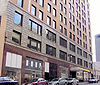
| Commerce Building
|
|
| 8 Fourth Street East
44°56′42"N 93°5′35"W
| Saint Paul
Saint Paul, Minnesota
Saint Paul is the capital and second-most populous city of the U.S. state of Minnesota. The city lies mostly on the east bank of the Mississippi River in the area surrounding its point of confluence with the Minnesota River, and adjoins Minneapolis, the state's largest city...
| 12-story office building built in 1912 is now mixed commercial, office, and residential; 07000645
|--
!
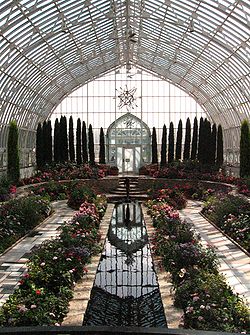
| Como Park Conservatory
|
|
| Como Park
44°58′53"N 93°9′3"W
| Saint Paul
Saint Paul, Minnesota
Saint Paul is the capital and second-most populous city of the U.S. state of Minnesota. The city lies mostly on the east bank of the Mississippi River in the area surrounding its point of confluence with the Minnesota River, and adjoins Minneapolis, the state's largest city...
| the 1913 conservatory
Conservatory (greenhouse)
A conservatory is a room having glass roof and walls, typically attached to a house on only one side, used as a greenhouse or a sunroom...
is home to thousands of species of flora
Flora
Flora is the plant life occurring in a particular region or time, generally the naturally occurring or indigenous—native plant life. The corresponding term for animals is fauna.-Etymology:...
|--
!
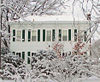
| William and Catherine Davern Farm House
William and Catherine Davern Farm House
The William and Catherine Davern Farm House is an Italianate farmhouse built in 1862 in Saint Paul, Minnesota; it is one of a small number of surviving farmhouses in Saint Paul. William Davern was a member of the first territorial legislature. The house is listed on the National Register of...
|
|
| 1173 Davern Street South
44°54′21"N 93°10′22"W
| Saint Paul
Saint Paul, Minnesota
Saint Paul is the capital and second-most populous city of the U.S. state of Minnesota. The city lies mostly on the east bank of the Mississippi River in the area surrounding its point of confluence with the Minnesota River, and adjoins Minneapolis, the state's largest city...
| Italianate farmhouse built in 1862; William Davern was a member of the first territorial
Minnesota Territory
The Territory of Minnesota was an organized incorporated territory of the United States that existed from March 3, 1849, until May 11, 1858, when the eastern portion of the territory was admitted to the Union as the State of Minnesota.-History:...
legislature
|--
!
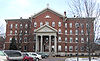
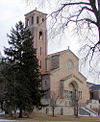
| Derham Hall and Our Lady of Victory Chapel, College of Saint Catherine
Derham Hall and Our Lady of Victory Chapel, College of Saint Catherine
Derham Hall and Our Lady of Victory Chapel are educational and religious buildings part of the St. Catherine University in Saint Paul, Minnesota....
|
|
| 2004 Randolph Avenue
44°55′32"N 93°11′4"W
| Saint Paul
Saint Paul, Minnesota
Saint Paul is the capital and second-most populous city of the U.S. state of Minnesota. The city lies mostly on the east bank of the Mississippi River in the area surrounding its point of confluence with the Minnesota River, and adjoins Minneapolis, the state's largest city...
| educational and religious buildings part of the College of St. Catherine
College of St. Catherine
St. Catherine University is a private Catholic university for women located in Saint Paul, Minnesota, United States. There is also a campus in Minneapolis. Enrollment is 5,246 students. With approximately 2,900 bachelor's students, it is the largest university for women in the United States. Its...
|--
!
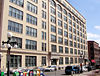
| Finch, Vanslyck, and McConville Dry Goods Company Building
Finch, Vanslyck, and McConville Dry Goods Company Building
The Finch, Vanslyck and McConville Dry Goods Company Building is a classical revival industrial building designed by James E. Denson, built by George Grant Construction Company, in 1911 and 1923; it is part of Lowertown Historic District in Saint Paul, Minnesota; it fronts Mears Park and is...
|
|
| 366 Wacouta Street
44°56′59"N 93°5′13"W
| Saint Paul
Saint Paul, Minnesota
Saint Paul is the capital and second-most populous city of the U.S. state of Minnesota. The city lies mostly on the east bank of the Mississippi River in the area surrounding its point of confluence with the Minnesota River, and adjoins Minneapolis, the state's largest city...
| classical revival industrial building designed by James E. Denson, built by George Grant Construction Company, 1911, 1923; part of Lowertown Historic District; fronts Smith Park (now Mears Park)
|--
!
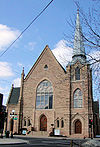
| First Baptist Church of Saint Paul
First Baptist Church of Saint Paul
The First Baptist Church of St. Paul is an historic church building in Saint Paul, Minnesota. When it opened on May 31, 1875, it was the largest and most costly church in Saint Paul, described in the Pioneer Press as "the finest piece of architecture west of Chicago". It is listed on the National...
|
|
| 499 Wacouta Street
44°57′9"N 93°5′24.5"W
| Saint Paul
Saint Paul, Minnesota
Saint Paul is the capital and second-most populous city of the U.S. state of Minnesota. The city lies mostly on the east bank of the Mississippi River in the area surrounding its point of confluence with the Minnesota River, and adjoins Minneapolis, the state's largest city...
| when it opened on May 31, 1875, it was the largest and most costly church in Saint Paul, described in the Pioneer Press
St. Paul Pioneer Press
The St. Paul Pioneer Press is a newspaper based in St. Paul, Minnesota, primarily serving the Twin Cities metropolitan area. Circulation is heaviest in the eastern metro region, including Ramsey, Dakota, and Washington counties, along with western Wisconsin, eastern Minnesota and Anoka County,...
as "the finest piece of architecture west of Chicago"
|--
!
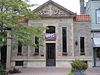
| First National Bank of White Bear
First National Bank of White Bear
The First National Bank of White Bear in White Bear Lake, Minnesota is a classical revival bank building designed by Clark E. Van Kirk, unique for the area with a red tile roof; designed in 1921. It is listed on the National Register of Historic Places....
|
|
| 4744 Washington Avenue
45°5′6"N 93°0′30"W
| White Bear Lake
White Bear Lake, Minnesota
White Bear Lake is a city in Ramsey and Washington counties in the U.S. state of Minnesota. The population was 23,797 at the 2010 census. The city is located on White Bear Lake, one of the largest lakes in the Minneapolis-St...
| classical revival bank building designed by Clark E. Van Kirk, unique for the area with a red tile roof; designed in 1921
|--
! | 28
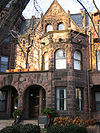
| F. Scott Fitzgerald House
F. Scott Fitzgerald House
The F. Scott Fitzgerald House, also known as Summit Terrace, in Saint Paul, Minnesota is part of a rowhouse designed by William H. Willcox and Clarence H. Johnston, Sr.. The house, at 599 Summit Avenue, is listed as a National Historic Landmark for its association with author F. Scott Fitzgerald...
|
|
| 599 Summit Avenue
44°56′29.5"N 93°7′30.5"W
| Saint Paul
Saint Paul, Minnesota
Saint Paul is the capital and second-most populous city of the U.S. state of Minnesota. The city lies mostly on the east bank of the Mississippi River in the area surrounding its point of confluence with the Minnesota River, and adjoins Minneapolis, the state's largest city...
| F. Scott Fitzgerald
F. Scott Fitzgerald
Francis Scott Key Fitzgerald was an American author of novels and short stories, whose works are the paradigm writings of the Jazz Age, a term he coined himself. He is widely regarded as one of the greatest American writers of the 20th century. Fitzgerald is considered a member of the "Lost...
's home designed by William H. Willcox
William H. Willcox
William H. Willcox was an American architect and surveyor who practised in Brooklyn and New York , Chicago, Illinois , Nebraska , St...
and Clarence H. Johnston, Sr.
Clarence H. Johnston, Sr.
Clarence H. Johnston Sr. was an American architect, active in Saint Paul and in Morris, Minnesota. In 1877, Johnston entered the Massachusetts Institute of Technology as a special architectural student. Four years later, he went abroad, traveling in Europe and Asia Minor...
|--
!
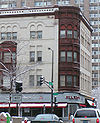
| Fitzpatrick Building
Fitzpatrick Building
The Fitzpatrick Building in Saint Paul, Minnesota is a 1890 Queen Anne style commercial building featuring corner turret and pressed-metal relief. It is listed on the National Register of Historic Places....
|
|
| 465-467 Wabasha Street North
44°56′53.5"N 93°5′50"W
| Saint Paul
Saint Paul, Minnesota
Saint Paul is the capital and second-most populous city of the U.S. state of Minnesota. The city lies mostly on the east bank of the Mississippi River in the area surrounding its point of confluence with the Minnesota River, and adjoins Minneapolis, the state's largest city...
| 1890 Queen Anne style commercial building featuring corner turret and pressed-metal relief
|--
!
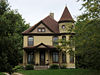
| Foss House
Foss House
The Foss House is a home in New Brighton, Minnesota built by Ingebor and Peder Foss. It is a large 1896 Victorian house featuring a corner tower. It is listed on the National Register of Historic Places....
|
|
| 321 Silver Lake Rd.
45°2′40"N 93°13′2"W
| New Brighton
New Brighton, Minnesota
As of the census of 2000, there were 22,206 people, 9,013 households, and 5,903 families residing in the city. The population density was 3,343.9 people per square mile . There were 9,121 housing units at an average density of 1,373.5 per square mile...
| a large 1896 Victorian
Victorian architecture
The term Victorian architecture refers collectively to several architectural styles employed predominantly during the middle and late 19th century. The period that it indicates may slightly overlap the actual reign, 20 June 1837 – 22 January 1901, of Queen Victoria. This represents the British and...
house featuring corner tower, built by Ingebor and Peder Foss in then rural New Brighton
|--
!
| Germania Bank Building
Germania Bank Building
The Germania Bank Building is an 1889 Richardsonian Romanesque office tower in Saint Paul, Minnesota built of sandstone, designed by J. Walter Stevens and draftsman Harvey Ellis. It is listed on the National Register of Historic Places....
|

|
| 6 5th Street West
44°56′44"N 93°5′40"W
| Saint Paul
Saint Paul, Minnesota
Saint Paul is the capital and second-most populous city of the U.S. state of Minnesota. The city lies mostly on the east bank of the Mississippi River in the area surrounding its point of confluence with the Minnesota River, and adjoins Minneapolis, the state's largest city...
| 1889 Richardson Romanesque office tower built of sandstone
Sandstone
Sandstone is a sedimentary rock composed mainly of sand-sized minerals or rock grains.Most sandstone is composed of quartz and/or feldspar because these are the most common minerals in the Earth's crust. Like sand, sandstone may be any colour, but the most common colours are tan, brown, yellow,...
designed by J. Walter Stevens
|--
!
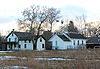
| Heman Gibbs Farmstead
|
|
| 2097 Larpentuer Avenue
44°59′32"N 93°11′18"W
| Falcon Heights
Falcon Heights, Minnesota
As of the census of 2000, there were 5,572 people, 2,103 households, and 1,434 families residing in the city. The population density was 2,487.9 people per square mile . There were 2,136 housing units at an average density of 953.7 per square mile...
| home of Heman Gibbs and Jane DeBow, first built in 1854; the existing farmhouse includes the small, original cabin
|--
!
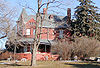
| Giesen-Hauser House
Giesen-Hauser House
The Giesen-Hauser House in Saint Paul, Minnesota is listed on the National Register of Historic Places. The 1891 Queen Anne style sandstone and brick house, designed by Albert Zschoke is also known as Gregory & Nancy Ward Residence....
|
|
| 827 Mound Street
44°57′3"N 93°3′43"W
| Saint Paul
Saint Paul, Minnesota
Saint Paul is the capital and second-most populous city of the U.S. state of Minnesota. The city lies mostly on the east bank of the Mississippi River in the area surrounding its point of confluence with the Minnesota River, and adjoins Minneapolis, the state's largest city...
| 1891 Queen Anne style sandstone and brick house, designed by Albert Zschoke; also known as Gregory & Nancy Ward Residence
|--
!
| S. Edward Hall House
S. Edward Hall House
The S. Edward Hall House in Saint Paul, Minnesota was the home of S. Edward Hall , an African American businessman and founder of the Saint Paul chapter of the NAACP. It is listed on the National Register of Historic Places....
|

|
| 996 Iglehart Avenue
44°56′57.5"N 93°8′32.5"W
| Saint Paul
Saint Paul, Minnesota
Saint Paul is the capital and second-most populous city of the U.S. state of Minnesota. The city lies mostly on the east bank of the Mississippi River in the area surrounding its point of confluence with the Minnesota River, and adjoins Minneapolis, the state's largest city...
| home of S. Edward Hall (1878–1975), an African American
African American
African Americans are citizens or residents of the United States who have at least partial ancestry from any of the native populations of Sub-Saharan Africa and are the direct descendants of enslaved Africans within the boundaries of the present United States...
businessman and founder of the Saint Paul chapter of the NAACP; 91000440
|--
!
| Hamm Building
Hamm Building
The Hamm Building is a 1915 limestone, terra cotta, and brick commercial building in Saint Paul, Minnesota; its ornamentation is exceptional. It is listed on the National Register of Historic Places. Being in the heart of Saint Paul's theatre district, the Capitol Theatre was built into the Hamm...
|

|
| 408 Saint Peter Street
44°56′48"N 93°5′46"W
| Saint Paul
Saint Paul, Minnesota
Saint Paul is the capital and second-most populous city of the U.S. state of Minnesota. The city lies mostly on the east bank of the Mississippi River in the area surrounding its point of confluence with the Minnesota River, and adjoins Minneapolis, the state's largest city...
| 1915 limestone, terra cotta, and brick commercial building; ornamentation is exceptional
|--
!
| Harriet Island Pavilion
Harriet Island Pavilion
The Harriet Island Pavilion, currently known as the Clarence W. Wigington Pavilion, is a park pavilion on Harriet Island just across the Mississippi River from downtown Saint Paul, Minnesota. It was designed by Clarence W. Wigington, the nation's first black municipal architect, and renamed for...
|

|
| 75 Water Street
44°56′15"N 93°5′50"W
| Saint Paul
Saint Paul, Minnesota
Saint Paul is the capital and second-most populous city of the U.S. state of Minnesota. The city lies mostly on the east bank of the Mississippi River in the area surrounding its point of confluence with the Minnesota River, and adjoins Minneapolis, the state's largest city...
| designed by Clarence W. Wigington
Clarence W. Wigington
Clarence Wesley "Cap" Wigington was an African-American architect who grew up in Omaha, Nebraska. After winning three first prizes in charcoal, pencil, and pen and ink at an art competition during the Trans-Mississippi Exposition in 1899, Wigington went on to become a renowned architect across...
, the nation's first black municipal architect, and renamed for Wigington after a 2000 restoration
|--
!
| Edward and Elizabeth Heimbach House and Carriage House
Edward and Elizabeth Heimbach House and Carriage House
The Edward and Elizabeth Heimbach House and Carriage House is an 1890 high Victorian style two story, brick house in Saint Paul, Minnesota in the West Side neighborhood; the house has an octagonal tower and dome and a detached carriage house...
|

|
| 64 Delos Street West
44°56′02"N 93°5′16"W
| Saint Paul
Saint Paul, Minnesota
Saint Paul is the capital and second-most populous city of the U.S. state of Minnesota. The city lies mostly on the east bank of the Mississippi River in the area surrounding its point of confluence with the Minnesota River, and adjoins Minneapolis, the state's largest city...
| 1890 high Victorian
Victorian architecture
The term Victorian architecture refers collectively to several architectural styles employed predominantly during the middle and late 19th century. The period that it indicates may slightly overlap the actual reign, 20 June 1837 – 22 January 1901, of Queen Victoria. This represents the British and...
style two story, 2556 square feet (237.5 m²) brick house; the house has an octagonal tower and dome and a detached carriage house
|--
!
| Highland Park Tower
Highland Park Tower
The Highland Park Water Tower is a water tower in the Highland Park area of Saint Paul, Minnesota. It was designed by Clarence W. Wigington, the nation's first African-American municipal architect. The tower was listed on the National Register of Historic Places in 1986.The octagonally-shaped...
|

|
| 1570 Highland Pkwy.
44°55′3.4"N 93°10′0"W
| Saint Paul
Saint Paul, Minnesota
Saint Paul is the capital and second-most populous city of the U.S. state of Minnesota. The city lies mostly on the east bank of the Mississippi River in the area surrounding its point of confluence with the Minnesota River, and adjoins Minneapolis, the state's largest city...
| octagonally-shaped tower, designed by Clarence W. Wigington
Clarence W. Wigington
Clarence Wesley "Cap" Wigington was an African-American architect who grew up in Omaha, Nebraska. After winning three first prizes in charcoal, pencil, and pen and ink at an art competition during the Trans-Mississippi Exposition in 1899, Wigington went on to become a renowned architect across...
— 134 feet (40.8 m) high and holds 200,000 gallons of water in a steel tank; it is topped with an arched observation deck
|--
! | 39
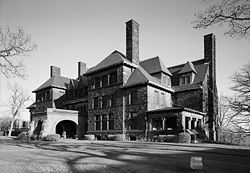
| James J. Hill House
James J. Hill House
The James J. Hill House, in Saint Paul, Minnesota, was built by railroad magnate James J. Hill. The house, completed in 1891, is near the eastern end of Summit Avenue near the Cathedral of Saint Paul. The house, for its time, was very large and was the "showcase of St. Paul" until James J. Hill's...
|
|
| 240 Summit Avenue
44°56′42"N 93°6′32"W
| Saint Paul
Saint Paul, Minnesota
Saint Paul is the capital and second-most populous city of the U.S. state of Minnesota. The city lies mostly on the east bank of the Mississippi River in the area surrounding its point of confluence with the Minnesota River, and adjoins Minneapolis, the state's largest city...
| with 36,000 square feet (3,344 square meters) of living area, the house is the largest residence in Minnesota
Minnesota
Minnesota is a U.S. state located in the Midwestern United States. The twelfth largest state of the U.S., it is the twenty-first most populous, with 5.3 million residents. Minnesota was carved out of the eastern half of the Minnesota Territory and admitted to the Union as the thirty-second state...
|--
!
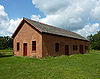
| James J. Hill's North Oaks Farm, Blacksmith Shop and Machine Shop
James J. Hill's North Oaks Farm, Blacksmith Shop and Machine Shop
At James J. Hill's North Oaks Farm Blacksmith and Machine Shop horses were shod and hinges and wagon wheels were constructed for use on the farm. The buildings are located in North Oaks, Minnesota and are Registered Historic Places....
|
|
| Red Barn Road and Hill Farm Circle
45°5′33"N 93°6′30"W
| North Oaks
North Oaks, Minnesota
North Oaks is a suburb north of Saint Paul in Ramsey County in the U.S. state of Minnesota. The population was 4,469 at the 2010 census.Formerly a gated community that now posts private access signage, all land is owned by homeowners with the North Oaks Home Owners Association maintaining all...
| here horses were shod and hinges and wagon wheels were constructed for use on the farm; 98000312
|--
!
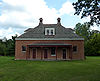
| James J. Hill's North Oaks Farm, Dairy Building
James J. Hill's North Oaks Farm, Dairy Building
In the James J. Hill's North Oaks Farm Dairy Building, railroad magnate James J. Hill installed a DeLaval separator and barrel churns, which automated the production of butter, using centrifugal force powered by a steam engine. The building, listed on the National Register of Historic Places, is...
|
|
| Red Barn Road and Hill Farm Circle
45°5′33"N 93°6′30"W
| North Oaks
North Oaks, Minnesota
North Oaks is a suburb north of Saint Paul in Ramsey County in the U.S. state of Minnesota. The population was 4,469 at the 2010 census.Formerly a gated community that now posts private access signage, all land is owned by homeowners with the North Oaks Home Owners Association maintaining all...
| in the dairy building, Hill installed a DeLaval
DeLaval
DeLaval is a Swedish company, split in 1991 from Alfa Laval, which was founded in 1883 by Gustaf de Laval and Oscar Lamm. The company is a leading producer of dairy and farming machinery...
separator and barrel churns, which automated the production of butter, using centrifugal force powered by a steam engine; the operation was a forerunner of the modern commercial butter-making industry; 97000441
|--
!
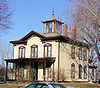
| Jacob Hinkel House
Jacob Hinkel House
The Jacob Hinkel House is a house listed on the National Register of Historic Places in Saint Paul, Minnesota built by ice-dealer, Jacob Hinkle in 1873 two miles north of downtown, in a rural area in what was New Canada township; the rural route was named after Horace J. Brainerd an influential...
|
|
| 531 Brainerd Avenue
44°58′49"N 93°4′42"W
| Saint Paul
Saint Paul, Minnesota
Saint Paul is the capital and second-most populous city of the U.S. state of Minnesota. The city lies mostly on the east bank of the Mississippi River in the area surrounding its point of confluence with the Minnesota River, and adjoins Minneapolis, the state's largest city...
| built by ice-dealer, Jacob Hinkle in 1873 two miles (3 km) north of downtown, in a rural area in what was New Canada township; the rural route was named after Horace J. Brainerd (1825–1902) an influential property-owner and politician
|--
! | 43
| Historic Hill District
|

|
| Irregular pattern from Pleasant and Grand Avenues to Holly and Marshall Avenues, from Lexington Parkway to 4th and Pleasant Streets
44°56′37"N 93°7′7"W
| Saint Paul
Saint Paul, Minnesota
Saint Paul is the capital and second-most populous city of the U.S. state of Minnesota. The city lies mostly on the east bank of the Mississippi River in the area surrounding its point of confluence with the Minnesota River, and adjoins Minneapolis, the state's largest city...
| the prestigious high-elevation area northwest of downtown, extending west to Lexington Avenue; known for having a number of historic houses, churches, synagogues, and schools
|--
!
| E. H. Hobe House-Solheim
E. H. Hobe House-Solheim
The E. H. Hobe House or Solheim was built in 1897 by Engelbrecht H. Hobe, a lumber dealer and Vice-Consul to the Norwegian-Swedish Kingdom. The Victorian home was visited by Swedish King Gustav V and Crown Prince Olav and Princess Märtha of Norway. The Bald Eagle Lake estate was designed by...
|

|
| 5590 Bald Eagle Boulevard West
45°7′9"N 93°1′33"W
| White Bear Lake
White Bear Lake, Minnesota
White Bear Lake is a city in Ramsey and Washington counties in the U.S. state of Minnesota. The population was 23,797 at the 2010 census. The city is located on White Bear Lake, one of the largest lakes in the Minneapolis-St...
| Victorian
Victorian architecture
The term Victorian architecture refers collectively to several architectural styles employed predominantly during the middle and late 19th century. The period that it indicates may slightly overlap the actual reign, 20 June 1837 – 22 January 1901, of Queen Victoria. This represents the British and...
home designed by Minneapolis architect Carl F. Struck in the mid-1890s; home of the, Norwegian
Norway
Norway , officially the Kingdom of Norway, is a Nordic unitary constitutional monarchy whose territory comprises the western portion of the Scandinavian Peninsula, Jan Mayen, and the Arctic archipelago of Svalbard and Bouvet Island. Norway has a total area of and a population of about 4.9 million...
consul
|--
!
| Holman Field Administration Building
Holman Field Administration Building
The Holman Field Administration Building is a Kasota limestone building designed by Clarence Wigington and built in 1939 by WPA employees. It serves as the control building for the St. Paul Downtown Airport in Saint Paul in the U.S. state of Minnesota. The airport was named for Charles W. Holman,...
|

|
| 644 Bayfield Street
44°56′31"N 93°3′53"W
| Saint Paul
Saint Paul, Minnesota
Saint Paul is the capital and second-most populous city of the U.S. state of Minnesota. The city lies mostly on the east bank of the Mississippi River in the area surrounding its point of confluence with the Minnesota River, and adjoins Minneapolis, the state's largest city...
| a Kasota limestone
Kasota limestone
Kasota limestone or simply, 'Kasota stone,' is a dolomitic limestone found in southern Minnesota. This sedimentary rock is part of the Oneota Dolostone Formation of southern Minnesota and is approximately 450 million years old...
building designed by Clarence Wigington and built in 1939 by WPA
Works Progress Administration
The Works Progress Administration was the largest and most ambitious New Deal agency, employing millions of unskilled workers to carry out public works projects, including the construction of public buildings and roads, and operated large arts, drama, media, and literacy projects...
employees
|--
!
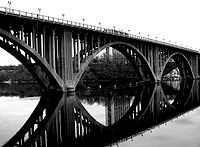
| Intercity Bridge
Intercity Bridge
The Intercity Bridge, more commonly known as the Ford Parkway Bridge , is a reinforced concrete arch bridge that spans the Mississippi River between Minneapolis, Minnesota and St. Paul, Minnesota. It connects 46th Street in Minneapolis with Ford Parkway in Saint Paul...
|
|
| Ford Pkwy. over Mississippi River
44°55′4.3"N 93°12′4.9"W
| Saint Paul
Saint Paul, Minnesota
Saint Paul is the capital and second-most populous city of the U.S. state of Minnesota. The city lies mostly on the east bank of the Mississippi River in the area surrounding its point of confluence with the Minnesota River, and adjoins Minneapolis, the state's largest city...
| more commonly known as the Ford Parkway Bridge (and sometimes referred to as the 46th Street Bridge), is a reinforced concrete arch bridge
Arch bridge
An arch bridge is a bridge with abutments at each end shaped as a curved arch. Arch bridges work by transferring the weight of the bridge and its loads partially into a horizontal thrust restrained by the abutments at either side...
that spans the Mississippi River
Mississippi River
The Mississippi River is the largest river system in North America. Flowing entirely in the United States, this river rises in western Minnesota and meanders slowly southwards for to the Mississippi River Delta at the Gulf of Mexico. With its many tributaries, the Mississippi's watershed drains...
between Minneapolis
Minneapolis, Minnesota
Minneapolis , nicknamed "City of Lakes" and the "Mill City," is the county seat of Hennepin County, the largest city in the U.S. state of Minnesota, and the 48th largest in the United States...
and Saint Paul
Saint Paul, Minnesota
Saint Paul is the capital and second-most populous city of the U.S. state of Minnesota. The city lies mostly on the east bank of the Mississippi River in the area surrounding its point of confluence with the Minnesota River, and adjoins Minneapolis, the state's largest city...
; the bridge is historically significant as one of the largest reinforced concrete bridges ever built in Minnesota. It was built in 1925-1927 by James O. Heyworth, Inc. and was designed by Martin Sigvart Grytbak
Martin Sigvart Grytbak
Martin Sigvart Grytbak was one of four innovative and influential Norwegian-American engineers that were involved in the design of the great bridges of the Twin Cities. The others are Kristoffer Olsen Oustad, Andreas W...
.
|--
!
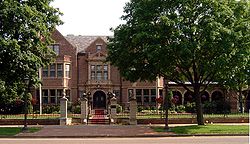
| Horace Hills Irvine House
|
|
| 1006 Summit Avenue
44°56′28"N 93°8′33"W
| Saint Paul
Saint Paul, Minnesota
Saint Paul is the capital and second-most populous city of the U.S. state of Minnesota. The city lies mostly on the east bank of the Mississippi River in the area surrounding its point of confluence with the Minnesota River, and adjoins Minneapolis, the state's largest city...
| the official home
Official residence
An official residence is the residence at which heads of state, heads of government, gubernatorial or other senior figures officially reside...
of the governor of Minnesota
Governor of Minnesota
The Governor of Minnesota is the chief executive of the U.S. state of Minnesota, leading the state's executive branch. Forty different people have been governors of the state, though historically there were also three governors of Minnesota Territory. Alexander Ramsey, the first territorial...
, slightly over 16,000 square feet (1,500 m²) in size, it was designed by Minneapolis
Minneapolis, Minnesota
Minneapolis , nicknamed "City of Lakes" and the "Mill City," is the county seat of Hennepin County, the largest city in the U.S. state of Minnesota, and the 48th largest in the United States...
architect William Channing Whitney
William Channing Whitney
William Ellery Channing Whitney was an American architect who practised in Minneapolis, Minnesota.Born in Harvard, Massachusetts, the son of Benjamin F. Whitney, he was educated at Lawrence Academy at Groton, Connecticut, and Massachusetts Institute of Technology and received his B.S. from the...
for Saint Paul lumberman Horace Hills Irvine and his family; the 20 room English Tudor
Tudor style architecture
The Tudor architectural style is the final development of medieval architecture during the Tudor period and even beyond, for conservative college patrons...
house has nine bedrooms, eight bathrooms, and nine fireplaces
|--
! | 48
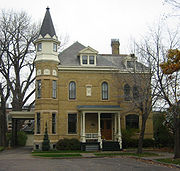
| Irvine Park Historic District
Irvine Park Historic District
Irvine Park is a neighborhood just west of downtown Saint Paul, Minnesota that contains a number of historic homes. The neighborhood was platted by John Irvine and Henry Mower Rice in 1849. At the center of the neighborhood is Irvine Park, a New England-style public square...
|
|
| Roughly bounded by Irvine Park, West 7th, Walnut, and Sherman
44°56′27"N 93°6′10"W
| Saint Paul
Saint Paul, Minnesota
Saint Paul is the capital and second-most populous city of the U.S. state of Minnesota. The city lies mostly on the east bank of the Mississippi River in the area surrounding its point of confluence with the Minnesota River, and adjoins Minneapolis, the state's largest city...
| the low-elevation neighborhood just west of downtown Saint Paul that contains a number of historic homes; it was plat
Plat
A plat in the U.S. is a map, drawn to scale, showing the divisions of a piece of land. Other English-speaking countries generally call such documents a cadastral map or plan....
ted by John Irvine and Henry Mower Rice in 1849. At the center of the neighborhood is Irvine Park, a New England
New England
New England is a region in the northeastern corner of the United States consisting of the six states of Maine, New Hampshire, Vermont, Massachusetts, Rhode Island, and Connecticut...
-style public square
Public Square
Public Square is the central plaza in downtown Cleveland, Ohio, United States. It takes up four city blocks; Superior Avenue and Ontario Street cross through it. Cleveland's three tallest buildings, Key Tower, 200 Public Square and the Terminal Tower, face the square...
|--
! | 49
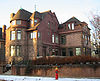
| Frank B. Kellogg House
Frank B. Kellogg House
The Frank B. Kellogg House is a house in Saint Paul, Minnesota. The house is listed as a National Historic Landmark for its association with Senator Frank B. Kellogg, co-author of the Kellogg-Briand Pact. Kellogg Boulevard in downtown Saint Paul is also named for him.From 1889 until his death,...
|
|
| 633 Fairmount Avenue
44°56′14"N 93°7′36"W
| Saint Paul
Saint Paul, Minnesota
Saint Paul is the capital and second-most populous city of the U.S. state of Minnesota. The city lies mostly on the east bank of the Mississippi River in the area surrounding its point of confluence with the Minnesota River, and adjoins Minneapolis, the state's largest city...
| home of Frank B. Kellogg
Frank B. Kellogg
Frank Billings Kellogg was an American lawyer, politician and statesman who served in the U.S. Senate and as U.S. Secretary of State. He co-authored the Kellogg-Briand Pact, for which he was awarded the Nobel Peace Prize for 1929..- Biography :Kellogg was born in Potsdam, New York, and his family...
, co-author of the Kellogg-Briand Pact
Kellogg-Briand Pact
The Kellogg–Briand Pact was an agreement signed on August 27, 1928, by the United States, France, the United Kingdom, Italy, Japan, Weimar Germany and a number of other countries.The pact renounced war , prohibiting the use of war...
|--
!
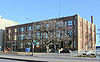
| Krank Manufacturing Company building
|
|
| 1855 University Avenue West
44°57′25"N 93°10′45"W
| Saint Paul
Saint Paul, Minnesota
Saint Paul is the capital and second-most populous city of the U.S. state of Minnesota. The city lies mostly on the east bank of the Mississippi River in the area surrounding its point of confluence with the Minnesota River, and adjoins Minneapolis, the state's largest city...
| 1926 industrial building with glazed terra cotta panels featuring brightly carved floral and classical motifs
|--
!
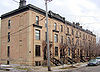
| Lauer Flats
Lauer Flats
Lauer Flats are 1887 residential townhouses designed by Henry and Charles Lauer in Greek Revival style, located in Saint Paul, Minnesota. They are listed on the National Register of Historic Places....
|
|
| 226 Western Avenue South
44°56′4"N 93°6′56.3"W
| Saint Paul
Saint Paul, Minnesota
Saint Paul is the capital and second-most populous city of the U.S. state of Minnesota. The city lies mostly on the east bank of the Mississippi River in the area surrounding its point of confluence with the Minnesota River, and adjoins Minneapolis, the state's largest city...
| 1887 residential townhouses designed by Henry and Charles Lauer in Greek Revival style
|--
!
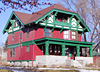
| Olaf Lee House
Olaf Lee House
The Olaf Lee House is a house listed on the National Register of Historic Places in Saint Paul, Minnesota built in 1905, designed by Clarence Johnston, significant for sophisticated Swiss Chalet and craftsman design....
|
|
| 955 Jessie Street North
44°58′12"N 93°4′40"W
| Saint Paul
Saint Paul, Minnesota
Saint Paul is the capital and second-most populous city of the U.S. state of Minnesota. The city lies mostly on the east bank of the Mississippi River in the area surrounding its point of confluence with the Minnesota River, and adjoins Minneapolis, the state's largest city...
| 1905 house designed by Clarence Johnston, significant for sophisticated Swiss Chalet and craftsman
American Craftsman
The American Craftsman Style, or the American Arts and Crafts Movement, is an American domestic architectural, interior design, landscape design, applied arts, and decorative arts style and lifestyle philosophy that began in the last years of the 19th century. As a comprehensive design and art...
design
|--
!
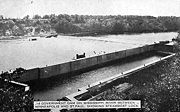
| Lock and Dam No. 2
Meeker Island Lock and Dam
The Meeker Island Lock and Dam was the first lock and dam facility built on the Upper Mississippi River. After a construction period lasting eight years, the site was only in operation for five years from 1907 to 1912 when the growing interest in hydroelectric power led to design and construction...
|
|
| Mississippi River North of Lake Street/Marshall Avenue
44°57′14"N 93°12′28"W
| Saint Paul
Saint Paul, Minnesota
Saint Paul is the capital and second-most populous city of the U.S. state of Minnesota. The city lies mostly on the east bank of the Mississippi River in the area surrounding its point of confluence with the Minnesota River, and adjoins Minneapolis, the state's largest city...
| Although listed in Hennepin County, this site spans the river, placing portions of it in Ramsey County.
|--
! | 54
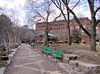
| Lowertown Historic District
|
|
| Roughly bounded by Kellogg Boulevard, Broadway, 7th and Jackson Streets
44°56′58"N 93°5′16"W
| Saint Paul
Saint Paul, Minnesota
Saint Paul is the capital and second-most populous city of the U.S. state of Minnesota. The city lies mostly on the east bank of the Mississippi River in the area surrounding its point of confluence with the Minnesota River, and adjoins Minneapolis, the state's largest city...
| originally the lower landing on the Mississippi River
Mississippi River
The Mississippi River is the largest river system in North America. Flowing entirely in the United States, this river rises in western Minnesota and meanders slowly southwards for to the Mississippi River Delta at the Gulf of Mexico. With its many tributaries, the Mississippi's watershed drains...
, it was the first port of access to the Twin Cities on the river; several warehouse, railroad, banking, and distribution buildings served the entire Upper Midwest
Upper Midwest
The Upper Midwest is a region in the northern portion of the U.S. Census Bureau's Midwestern United States. It is largely a sub-region of the midwest. Although there are no uniformly agreed-upon boundaries, the region is most commonly used to refer to the states of Minnesota, Wisconsin, and...
from 1880–1920; architects who contributed to the neighborhood include Cass Gilbert
Cass Gilbert
- Historical impact :Gilbert is considered a skyscraper pioneer; when designing the Woolworth Building he moved into unproven ground — though he certainly was aware of the ground-breaking work done by Chicago architects on skyscrapers and once discussed merging firms with the legendary Daniel...
, J. Walter Stevens, and Charles Frost
Charles Sumner Frost
Charles Sumner Frost was an American architect.Born in Lewiston, Maine, Frost was first a draftsman in Boston, and a graduate of the Massachusetts Institute of Technology. While working in Boston he worked for the firm of Peabody and Stearns. He moved to Chicago in 1 882. There he began a...
|--
!
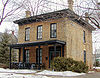
| David Luckert House
David Luckert House
The David Luckert House is a 1858 limestone house; one of the oldest homes in Saint Paul, Minnesota. It is listed on the National Register of Historic Places....
|
|
| 480 Iglehart Street
44°56′57.5"N 93°7′13"W
| Saint Paul
Saint Paul, Minnesota
Saint Paul is the capital and second-most populous city of the U.S. state of Minnesota. The city lies mostly on the east bank of the Mississippi River in the area surrounding its point of confluence with the Minnesota River, and adjoins Minneapolis, the state's largest city...
| 1858 limestone
Limestone
Limestone is a sedimentary rock composed largely of the minerals calcite and aragonite, which are different crystal forms of calcium carbonate . Many limestones are composed from skeletal fragments of marine organisms such as coral or foraminifera....
house; one of the oldest homes in Saint Paul
|--
!
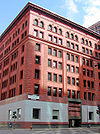
| Manhattan Building
Manhattan Building (Saint Paul, Minnesota)
The Manhattan Building is a Renaissance Revival office and banking building also known as Empire Building in Saint Paul, Minnesota, designed by Clarence H. Johnston, Sr., 1889. It is listed on the National Register of Historic Places....
|
|
| 360 Robert Street North
44°56′51"N 93°5′24"W
| Saint Paul
Saint Paul, Minnesota
Saint Paul is the capital and second-most populous city of the U.S. state of Minnesota. The city lies mostly on the east bank of the Mississippi River in the area surrounding its point of confluence with the Minnesota River, and adjoins Minneapolis, the state's largest city...
| Renaissance Revival office and banking building also known as Empire Building; designed by Clarence H. Johnston, Sr.
Clarence H. Johnston, Sr.
Clarence H. Johnston Sr. was an American architect, active in Saint Paul and in Morris, Minnesota. In 1877, Johnston entered the Massachusetts Institute of Technology as a special architectural student. Four years later, he went abroad, traveling in Europe and Asia Minor...
, 1889
|--
!
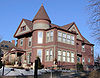
| Andrew R. McGill House
Andrew R. McGill House
The Andrew R. McGill House is a house listed on the National Register of Historic Places in Saint Paul, Minnesota. It is the Queen Anne style home of Governor Andrew R. McGill ; designed in 1888 by W. A. Hunt....
|
|
| 2203 Scudder Avenue
44°58′37"N 93°11′31"W
| Saint Paul
Saint Paul, Minnesota
Saint Paul is the capital and second-most populous city of the U.S. state of Minnesota. The city lies mostly on the east bank of the Mississippi River in the area surrounding its point of confluence with the Minnesota River, and adjoins Minneapolis, the state's largest city...
| Queen Anne style home of Governor Andrew R. McGill (served 1887-1889); designed in 1888 by W. A. Hunt
|--
!
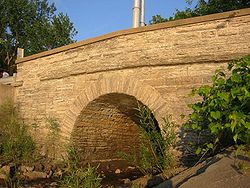
| Mendota Road Bridge
Mendota Road Bridge
Mendota Road Bridge is a stone arch bridge that spans the outlet of Pickerel Lake where it meets the Mississippi River just south of downtown St. Paul, Minnesota. It was built in 1894 by the city of St. Paul and was designed by the St. Paul City Engineer's Office.The bridge is historically...
|
|
| Water Street over Pickerel Lake Outlet
44°55′31"N 93°6′41"W
| Saint Paul
Saint Paul, Minnesota
Saint Paul is the capital and second-most populous city of the U.S. state of Minnesota. The city lies mostly on the east bank of the Mississippi River in the area surrounding its point of confluence with the Minnesota River, and adjoins Minneapolis, the state's largest city...
| historically significant as an example of a small-scale 19th century stone arch highway bridge; the bridge resembles other stone arch bridges built in Minnesota townships during the late 19th century and early 20th century, but its ornamentation is unique
|--
!
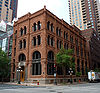
| Merchants National Bank
Merchants National Bank (Saint Paul)
The Merchants National Bank or Brooks Building is a commercial building in Saint Paul, Minnesota built in 1892 as a financial center.The structure, designed by Edward P. Bassford, uses sandstone in a Richardsonian Romanesque style. It is listed on the National Register of Historic Places....
|
|
| 366-368 Jackson Street
44°56′54"N 93°5′20"W
| Saint Paul
Saint Paul, Minnesota
Saint Paul is the capital and second-most populous city of the U.S. state of Minnesota. The city lies mostly on the east bank of the Mississippi River in the area surrounding its point of confluence with the Minnesota River, and adjoins Minneapolis, the state's largest city...
| 1892 financial center, also known as Brooks Building
|--
!
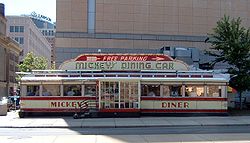
| Mickey's Diner
Mickey's Diner
Mickey's Diner is a 50' x 10' classic Art Deco diner car restaurant in Saint Paul, Minnesota. It was prefabricated in New Jersey by the Jerry O'Mahony Diner Company of Elizabeth, New Jersey, in 1937 serial # 1067, shipped to Saint Paul by rail, and installed downtown just before World War II...
|
|
| 36 7th Street West
44°56′51"N 93°5′52"W
| Saint Paul
Saint Paul, Minnesota
Saint Paul is the capital and second-most populous city of the U.S. state of Minnesota. The city lies mostly on the east bank of the Mississippi River in the area surrounding its point of confluence with the Minnesota River, and adjoins Minneapolis, the state's largest city...
| a classic Art Deco
Art Deco
Art deco , or deco, is an eclectic artistic and design style that began in Paris in the 1920s and flourished internationally throughout the 1930s, into the World War II era. The style influenced all areas of design, including architecture and interior design, industrial design, fashion and...
diner
Diner
A diner, also spelled dinor in western Pennsylvania is a prefabricated restaurant building characteristic of North America, especially in the Midwest, in New York City, in Pennsylvania and in New Jersey, and in other areas of the Northeastern United States, although examples can be found throughout...
car restaurant
Restaurant
A restaurant is an establishment which prepares and serves food and drink to customers in return for money. Meals are generally served and eaten on premises, but many restaurants also offer take-out and food delivery services...
; it was prefabricated in New Jersey
New Jersey
New Jersey is a state in the Northeastern and Middle Atlantic regions of the United States. , its population was 8,791,894. It is bordered on the north and east by the state of New York, on the southeast and south by the Atlantic Ocean, on the west by Pennsylvania and on the southwest by Delaware...
, shipped to Saint Paul by rail
Rail transport
Rail transport is a means of conveyance of passengers and goods by way of wheeled vehicles running on rail tracks. In contrast to road transport, where vehicles merely run on a prepared surface, rail vehicles are also directionally guided by the tracks they run on...
|--
!
| Minnesota Boat Club Boathouse on Raspberry Island
Minnesota Boat Club Boathouse on Raspberry Island
The Minnesota Boat Club Boathouse on Raspberry Island is the home of the Minnesota Boat Club, a rowing club founded in 1870. It is Minnesota's oldest athletic organization. The building was listed on the National Register of Historic Places in 1982 and is located in Saint Paul, Minnesota....
|
|
| 1 Wabasha Street South
44°56′31"N 93°5′29"W
| Saint Paul
Saint Paul, Minnesota
Saint Paul is the capital and second-most populous city of the U.S. state of Minnesota. The city lies mostly on the east bank of the Mississippi River in the area surrounding its point of confluence with the Minnesota River, and adjoins Minneapolis, the state's largest city...
| home of the Minnesota Boat Club, a rowing club founded in 1870; it is the Minnesota's oldest athletic organization
|--
!
| Minnesota Building
Minnesota Building
The Minnesota Building is a historic office building in Saint Paul, Minnesota. The structure was placed on the National Register of Historic Places on June 10, 2009...
|
|
| 46 E. 4th St.
44°56′44.28"N 93°5′31.21"W
| Saint Paul
Saint Paul, Minnesota
Saint Paul is the capital and second-most populous city of the U.S. state of Minnesota. The city lies mostly on the east bank of the Mississippi River in the area surrounding its point of confluence with the Minnesota River, and adjoins Minneapolis, the state's largest city...
| 1929 art deco building
|--
!
| Minnesota Historical Society Building
Minnesota Historical Society Building
The Minnesota Judicial Center, adjacent to the State Capitol, houses the state's Supreme Court and Court of Appeals, as well as the state law library. Its address is 25 Rev. Dr. Martin Luther King, Jr., Blvd., Saint Paul, Minnesota....
|
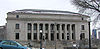
|
| 690 Cedar Street
44°57′17"N 93°6′0"W
| Saint Paul
Saint Paul, Minnesota
Saint Paul is the capital and second-most populous city of the U.S. state of Minnesota. The city lies mostly on the east bank of the Mississippi River in the area surrounding its point of confluence with the Minnesota River, and adjoins Minneapolis, the state's largest city...
| 1917 building housed the state's oldest institution, founded in 1849. (The building is now the Minnesota Judicial Center.)
|--
!
| Minnesota State Capitol
Minnesota State Capitol
The Minnesota State Capitol is located in Minnesota's capital city, Saint Paul, and houses the Minnesota Senate, Minnesota House of Representatives, the Office of the Attorney General and the Office of the Governor...
|
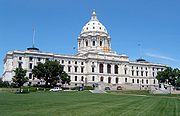
|
| Aurora Between Cedar and Park Sts.
44°57′19"N 93°6′6"W
| Saint Paul
Saint Paul, Minnesota
Saint Paul is the capital and second-most populous city of the U.S. state of Minnesota. The city lies mostly on the east bank of the Mississippi River in the area surrounding its point of confluence with the Minnesota River, and adjoins Minneapolis, the state's largest city...
| designed by Cass Gilbert
Cass Gilbert
- Historical impact :Gilbert is considered a skyscraper pioneer; when designing the Woolworth Building he moved into unproven ground — though he certainly was aware of the ground-breaking work done by Chicago architects on skyscrapers and once discussed merging firms with the legendary Daniel...
and modeled after Saint Peter's Basilica in Rome
Rome
Rome is the capital of Italy and the country's largest and most populated city and comune, with over 2.7 million residents in . The city is located in the central-western portion of the Italian Peninsula, on the Tiber River within the Lazio region of Italy.Rome's history spans two and a half...
- the unsupported marble
Marble
Marble is a metamorphic rock composed of recrystallized carbonate minerals, most commonly calcite or dolomite.Geologists use the term "marble" to refer to metamorphosed limestone; however stonemasons use the term more broadly to encompass unmetamorphosed limestone.Marble is commonly used for...
dome
Dome
A dome is a structural element of architecture that resembles the hollow upper half of a sphere. Dome structures made of various materials have a long architectural lineage extending into prehistory....
is the second largest in the world, after Saint Peter's
|--
!
| Adolf Muench House
Adolf Muench House
The Adolf Muench House is listed on the National Register of Historic Places in Saint Paul, Minnesota. The 1884 house designed by Emil W. Ulrici overlooks Saint Paul from the bluffs east of downtown....
|
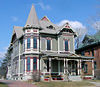
|
| 653 5th Street East
44°57′21"N 93°4′23"W
| Saint Paul
Saint Paul, Minnesota
Saint Paul is the capital and second-most populous city of the U.S. state of Minnesota. The city lies mostly on the east bank of the Mississippi River in the area surrounding its point of confluence with the Minnesota River, and adjoins Minneapolis, the state's largest city...
| 1884 house designed by Emil W. Ulrici overlooks Saint Paul from the bluffs east of downtown
|--
! | 66
| Northern Pacific Railway Company Como Shops Historic District
Bandana Square
Bandana Square is now an office center but was originally designed to be an enclosed shopping center in Energy Park in Saint Paul, Minnesota...
|
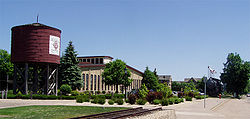
|
| Energy Park Dr. and Bandanna Boulevard
44°58′21"N 93°9′16"W
| Saint Paul
Saint Paul, Minnesota
Saint Paul is the capital and second-most populous city of the U.S. state of Minnesota. The city lies mostly on the east bank of the Mississippi River in the area surrounding its point of confluence with the Minnesota River, and adjoins Minneapolis, the state's largest city...
| early 20th century railroad buildings of the Northern Pacific Railway
Northern Pacific Railway
The Northern Pacific Railway was a railway that operated in the west along the Canadian border of the United States. Construction began in 1870 and the main line opened all the way from the Great Lakes to the Pacific when former president Ulysses S. Grant drove in the final "golden spike" in...
, converted to a vacant shopping complex
|--
!
| Norway Lutheran Church
Norway Lutheran Church
The Norway Lutheran Church or Muskego Church stands on the edge of the campus of Luther Seminary, in Saint Paul, Minnesota.-History:Old Muskego Church was erected by Norwegian-American Lutherans near Waterford in the Wind Lake area of Racine County, Wisconsin in 1844, four years before Wisconsin...
|
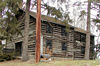
|
| 2375 Como Avenue West
44°59′3.5"N 93°11′42"W
| Saint Paul
Saint Paul, Minnesota
Saint Paul is the capital and second-most populous city of the U.S. state of Minnesota. The city lies mostly on the east bank of the Mississippi River in the area surrounding its point of confluence with the Minnesota River, and adjoins Minneapolis, the state's largest city...
| erected in 1844 by early Norwegian Lutheran immigrants in Waterford, Wisconsin
Waterford, Wisconsin
Waterford is a village in Racine County, Wisconsin, United States. The population was 4,048 at the 2000 census. The village is located mostly within the Town of Waterford...
; moved to Ramsey County in 1904
|--
!
| Charles P. Noyes Cottage
Charles P. Noyes Cottage
The Charles P. Noyes Cottage, also known as the Fillebrown House, was a summer home of Saint Paul pharmacist, Charles P. Noyes. He came to St. Paul in 1868. The cottage is listed on the National Register of Historic Places...
|
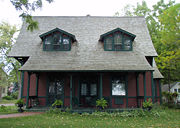
|
| 4735 Lake Avenue
45°5′7"N 93°0′9"W
| White Bear Lake
White Bear Lake, Minnesota
White Bear Lake is a city in Ramsey and Washington counties in the U.S. state of Minnesota. The population was 23,797 at the 2010 census. The city is located on White Bear Lake, one of the largest lakes in the Minneapolis-St...
| cottage of Saint Paul pharmacist, Charles P. Noyes
|--
!
| O'Donnell Shoe Company Building
|
|
| 509 Sibley Street
44°57′9"N 93°5′29"W
| Saint Paul
Saint Paul, Minnesota
Saint Paul is the capital and second-most populous city of the U.S. state of Minnesota. The city lies mostly on the east bank of the Mississippi River in the area surrounding its point of confluence with the Minnesota River, and adjoins Minneapolis, the state's largest city...
| Shoe factory built in 1914 by a company that became the largest shoe manufacturer in Minnesota
|--
!
| Old Federal Courts Building
|
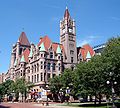
|
| 109 5th Street West
44°56′44"N 93°5′50"W
| Saint Paul
Saint Paul, Minnesota
Saint Paul is the capital and second-most populous city of the U.S. state of Minnesota. The city lies mostly on the east bank of the Mississippi River in the area surrounding its point of confluence with the Minnesota River, and adjoins Minneapolis, the state's largest city...
| built in 1902, it originally served as the Federal Court House and Post office for the Upper Midwest
Upper Midwest
The Upper Midwest is a region in the northern portion of the U.S. Census Bureau's Midwestern United States. It is largely a sub-region of the midwest. Although there are no uniformly agreed-upon boundaries, the region is most commonly used to refer to the states of Minnesota, Wisconsin, and...
|--
!
| Old Main, Macalester College
Macalester College
Macalester College is a private, coeducational liberal arts college located in Saint Paul, Minnesota. It was founded in 1874 as a Presbyterian-affiliated but nonsectarian college. Its first class entered September 15, 1885. The college is located on a campus in a historic residential neighborhood...
|
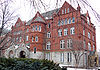
|
| 1600 Grand Avenue
44°56′19"N 93°10′6"W
| Saint Paul
Saint Paul, Minnesota
Saint Paul is the capital and second-most populous city of the U.S. state of Minnesota. The city lies mostly on the east bank of the Mississippi River in the area surrounding its point of confluence with the Minnesota River, and adjoins Minneapolis, the state's largest city...
| 1886 college building designed by William H. Wilcox
|--
!
| Payne Avenue State Bank
Payne Avenue State Bank
The Payne Avenue State Bank was designed in the Beaux-Arts style by W. L. Alban in 1923. Located in a predominantly new immigrant area of Saint Paul, Minnesota, the bank initially served Irish, Swedish, German, and Italian immigrants in Saint Paul's East Side neighborhood. The formidable brick...
|
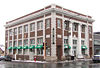
|
| 965 Payne Avenue
44°58′13.5"N 93°4′26"W
| Saint Paul
Saint Paul, Minnesota
Saint Paul is the capital and second-most populous city of the U.S. state of Minnesota. The city lies mostly on the east bank of the Mississippi River in the area surrounding its point of confluence with the Minnesota River, and adjoins Minneapolis, the state's largest city...
| also known as the Swedish Bank Building, the 1923 Beaux Arts bank served Scandinavia
Scandinavia
Scandinavia is a cultural, historical and ethno-linguistic region in northern Europe that includes the three kingdoms of Denmark, Norway and Sweden, characterized by their common ethno-cultural heritage and language. Modern Norway and Sweden proper are situated on the Scandinavian Peninsula,...
n, German, Italian
Italian people
The Italian people are an ethnic group that share a common Italian culture, ancestry and speak the Italian language as a mother tongue. Within Italy, Italians are defined by citizenship, regardless of ancestry or country of residence , and are distinguished from people...
, and other European settlers who lived in the area; 07000426
|--
!
| Pilgrim Baptist Church
Pilgrim Baptist Church (Saint Paul, Minnesota)
The Pilgrim Baptist Church located at 732 Central Avenue West in Saint Paul in the U.S. state of Minnesota is the building that houses the first Black Baptist congregation in Saint Paul. The congregation was founded on November 15, 1866 by Reverend Robert Hickman and a group of escaped slaves from...
|
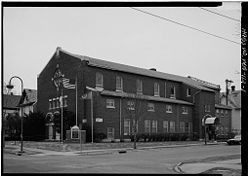
|
| 732 Central Avenue West
44°57′10"N 93°7′52"W
| Saint Paul
Saint Paul, Minnesota
Saint Paul is the capital and second-most populous city of the U.S. state of Minnesota. The city lies mostly on the east bank of the Mississippi River in the area surrounding its point of confluence with the Minnesota River, and adjoins Minneapolis, the state's largest city...
| church building that houses the first Black
African American
African Americans are citizens or residents of the United States who have at least partial ancestry from any of the native populations of Sub-Saharan Africa and are the direct descendants of enslaved Africans within the boundaries of the present United States...
Baptist
Baptist
Baptists comprise a group of Christian denominations and churches that subscribe to a doctrine that baptism should be performed only for professing believers , and that it must be done by immersion...
congregation in Saint Paul; the congregation was founded on November 15, 1866 by Reverend Robert Hickman and a group of escaped slaves from Boone County, Missouri
Boone County, Missouri
Boone County is a county centrally located in the U.S. state of Missouri. It is the eighth most populous county in Missouri. In 2010, the population was 162,642. Its county seat, Columbia, is the fifth largest city in Missouri and the anchor city of the Columbia Metropolitan Area.-History:Boone...
; they were smuggled up the Mississippi River
Mississippi River
The Mississippi River is the largest river system in North America. Flowing entirely in the United States, this river rises in western Minnesota and meanders slowly southwards for to the Mississippi River Delta at the Gulf of Mexico. With its many tributaries, the Mississippi's watershed drains...
on the steamer War Eagle with the help of Union Soldiers
Union (American Civil War)
During the American Civil War, the Union was a name used to refer to the federal government of the United States, which was supported by the twenty free states and five border slave states. It was opposed by 11 southern slave states that had declared a secession to join together to form the...
and the Underground Railroad
Underground Railroad
The Underground Railroad was an informal network of secret routes and safe houses used by 19th-century black slaves in the United States to escape to free states and Canada with the aid of abolitionists and allies who were sympathetic to their cause. The term is also applied to the abolitionists,...
; the current building was built in 1928
|--
!
| Pioneer and Endicott Buildings
Pioneer and Endicott Buildings
The Pioneer and Endicott Buildings are two buildings in Saint Paul, Minnesota. The 1890 Endicott building forms L-shape around 1889 Pioneer building. The Endicott building was designed by Cass Gilbert and James Knox Taylor; the Pioneer building was designed by Solon Spencer Beman in the Romanesque...
|
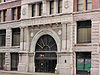
|
| 4th and Robert Streets
44°56′50"N 93°5′22"W
| Saint Paul
Saint Paul, Minnesota
Saint Paul is the capital and second-most populous city of the U.S. state of Minnesota. The city lies mostly on the east bank of the Mississippi River in the area surrounding its point of confluence with the Minnesota River, and adjoins Minneapolis, the state's largest city...
| 1890 Endicott building forms L-shape around 1889 Pioneer building; Endicott building was designed by Cass Gilbert
Cass Gilbert
- Historical impact :Gilbert is considered a skyscraper pioneer; when designing the Woolworth Building he moved into unproven ground — though he certainly was aware of the ground-breaking work done by Chicago architects on skyscrapers and once discussed merging firms with the legendary Daniel...
and James Knox Taylor
James Knox Taylor
James Knox Taylor was Supervising Architect of the United States Department of the Treasury from 1897 to 1912. His name is listed ex officio as supervising architect of hundreds of federal buildings built throughout the United States during the period.-Early career:The son of H...
; Pioneer building was designed by Solon Spencer Beman
Solon Spencer Beman
Solon Spencer Beman was an American architect who was based in Chicago, best known as the architect of the planned Pullman community and adjacent Pullman Company factory complex. Several of his other largest commissions, including the Pullman Office Building, Pabst Building, and Grand Central...
in the Romanesque
Romanesque architecture
Romanesque architecture is an architectural style of Medieval Europe characterised by semi-circular arches. There is no consensus for the beginning date of the Romanesque architecture, with proposals ranging from the 6th to the 10th century. It developed in the 12th century into the Gothic style,...
style; sported the first glass elevator in the nation
|--
!
| Ramsey County Poor Farm Barn
Ramsey County Poor Farm Barn
The Ramsey County Poor Farm Barn served as home and work for the indigent in Ramsey County, Minnesota. The barn is now used by the Ramsey County Cooperative extension service. It is listed on the National Register of Historic Places....
|
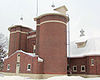
|
| 2020 White Bear Avenue
45°0′1"N 93°1′27"W
| Maplewood
Maplewood
Maplewood may refer to:Cities, towns, etc.* Maplewood, Indiana* Maplewood, Minnesota* Maplewood, Missouri* Maplewood, New Jersey* Maplewood, Ohio* Maplewood, Portland, Oregon, a neighborhood* Maplewood, Houston, Texas, a neighborhood...
| barn; now used for the Ramsey County Cooperative extension service
Cooperative extension service
The Cooperative Extension Service, also known as the Extension Service of the USDA, is a non-formal educational program implemented in the United States designed to help people use research-based knowledge to improve their lives. The service is provided by the state's designated land-grant...
|--
!
| Alexander Ramsey House
Alexander Ramsey House
The Alexander Ramsey House, located at 265 Exchange Street, South in Saint Paul, Minnesota is the former residence of Alexander Ramsey, who served as the first governor of Minnesota Territory and the second governor of the state of Minnesota....
|
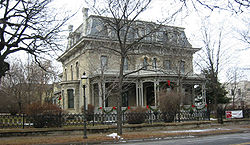
|
| 265 Exchange Street South
44°56′30"N 93°6′16"W
| Saint Paul
Saint Paul, Minnesota
Saint Paul is the capital and second-most populous city of the U.S. state of Minnesota. The city lies mostly on the east bank of the Mississippi River in the area surrounding its point of confluence with the Minnesota River, and adjoins Minneapolis, the state's largest city...
| residence of Alexander Ramsey
Alexander Ramsey
Alexander Ramsey was an American politician. He was born near Harrisburg, Pennsylvania.Alexander Ramsey was elected from Pennsylvania as a Whig to the U.S. House of Representatives and served in the 28th and 29th congresses from March 4, 1843 to March 4, 1847...
, who served as the first governor of Minnesota Territory
Minnesota Territory
The Territory of Minnesota was an organized incorporated territory of the United States that existed from March 3, 1849, until May 11, 1858, when the eastern portion of the territory was admitted to the Union as the State of Minnesota.-History:...
and the second governor of the state of Minnesota
Minnesota
Minnesota is a U.S. state located in the Midwestern United States. The twelfth largest state of the U.S., it is the twenty-first most populous, with 5.3 million residents. Minnesota was carved out of the eastern half of the Minnesota Territory and admitted to the Union as the thirty-second state...
|--
!
| Justus Ramsey Stone House
Justus Ramsey Stone House
The Justus Ramsey Stone House is the oldest known house still standing in Saint Paul in the U.S. state of Minnesota. The house, located at 252 West 7th Street is listed on the National Register of Historic Places...
|
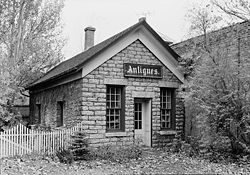
|
| 252 7th Street West
44°56′33"N 93°6′16.5"W
| Saint Paul
Saint Paul, Minnesota
Saint Paul is the capital and second-most populous city of the U.S. state of Minnesota. The city lies mostly on the east bank of the Mississippi River in the area surrounding its point of confluence with the Minnesota River, and adjoins Minneapolis, the state's largest city...
| built in 1851; the oldest known house still standing in Saint Paul; it is an example of a Saint Paul residence of a settler of some financial means
|--
!
| Rau/Strong House
Rau/Strong House
The Rau/Strong House is a house listed on the National Register of Historic Places in Saint Paul, Minnesota's West Side neighborhood. It is a residence built 1884-1886 in the French Second Empire style with mansard roof and hammered quoin blocks.-References:...
|
|
| 2 George Street
44°55′46"N 93°5′6"W
| Saint Paul
Saint Paul, Minnesota
Saint Paul is the capital and second-most populous city of the U.S. state of Minnesota. The city lies mostly on the east bank of the Mississippi River in the area surrounding its point of confluence with the Minnesota River, and adjoins Minneapolis, the state's largest city...
| West Side residence built 1884-1886 in the French Second Empire style with mansard roof and hammered quoin blocks
|--
!
| Riverside Hangar
Riverside Hangar
The Riverside Hangars are semi-cylindrical-shaped hangars for aircraft installed at Saint Paul Downtown Airport in 1942, immediately adjacent to the Mississippi River. Their important design features are their low-cost and that they were erectable quickly by unskilled workers...
|
|
| 690 Bayfield Street, Building 690-01-01
44°56′30"N 93°3′43"W
| Saint Paul
Saint Paul, Minnesota
Saint Paul is the capital and second-most populous city of the U.S. state of Minnesota. The city lies mostly on the east bank of the Mississippi River in the area surrounding its point of confluence with the Minnesota River, and adjoins Minneapolis, the state's largest city...
| 07001315
|--
!
| Riverview Branch Library
Riverview Branch Library
The Riverview Branch Library is a 1916 Beaux Arts library building designed by Cameron and Company; it is one of three Carnegie Libraries in Saint Paul, Minnesota. It is located in the West Side neighborhood. It is listed on the National Register of Historic Places....
|
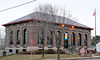
|
| 1 George Street East
44°55′48"N 93°5′5"W
| Saint Paul
Saint Paul, Minnesota
Saint Paul is the capital and second-most populous city of the U.S. state of Minnesota. The city lies mostly on the east bank of the Mississippi River in the area surrounding its point of confluence with the Minnesota River, and adjoins Minneapolis, the state's largest city...
| 1916 Carnegie Library
Carnegie Library
Carnegie Library, Carnegie Public Library, Carnegie Free Library, Carnegie Free Public Library, Andrew Carnegie Library, Andrew Carnegie Free Library or Carnegie Library Building may refer to any of the following Carnegie libraries:- California :*Carnegie Library , listed on the National Register...
designed by Charles A. Hausler in Saint Paul's West Side neighborhood
|--
!
| Robert Street Bridge
Robert Street Bridge
The Robert Street Bridge is a reinforced concrete multiple-arch bridge that spans the Mississippi River in downtown St. Paul, Minnesota. The bridge is notable for its complex design that was required to accommodate river traffic, the St. Paul Union Pacific Vertical-lift Rail Bridge crossing...
|
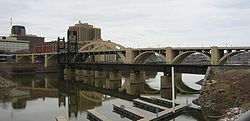
|
| Robert Street over Mississippi River
44°56′38"N 93°5′14.6"W
| Saint Paul
Saint Paul, Minnesota
Saint Paul is the capital and second-most populous city of the U.S. state of Minnesota. The city lies mostly on the east bank of the Mississippi River in the area surrounding its point of confluence with the Minnesota River, and adjoins Minneapolis, the state's largest city...
| a reinforced concrete multiple-arch bridge that spans the Mississippi River
Mississippi River
The Mississippi River is the largest river system in North America. Flowing entirely in the United States, this river rises in western Minnesota and meanders slowly southwards for to the Mississippi River Delta at the Gulf of Mexico. With its many tributaries, the Mississippi's watershed drains...
in downtown Saint Paul; the bridge is notable for its complex design that was required to accommodate river traffic, the St. Paul Union Pacific Vertical-lift Rail Bridge
St. Paul Union Pacific Vertical-lift Rail Bridge
The St. Paul Union Pacific Vertical-lift Rail Bridge is a vertical-lift bridge that spans the Mississippi River in downtown St. Paul, Minnesota. This is one of only three vertical-lift bridges along the Mississippi River, along with the Hastings Rail Bridge in Hastings, Minnesota and the Wabash...
crossing underneath it at an angle, and roadways on the downtown side of Saint Paul; the bridge is also notable for a monumental reinforced concrete rainbow arch
|--
!
| Rochat-Louise-Sauerwein Block
Rochat-Louise-Sauerwein Block
The Rochat-Louise-Sauerwein Block are a group of buildings that comprise one of the few remaining intact Victorian commercial blocks in Saint Paul, Minnesota; built 1885-1895 by Castner, Hermann Kretz, and Edward P. Bassford. It is listed on the National Register of Historic Places....
|
|
| 261-277 7th Street West
44°56′33"N 93°6′20"W
| Saint Paul
Saint Paul, Minnesota
Saint Paul is the capital and second-most populous city of the U.S. state of Minnesota. The city lies mostly on the east bank of the Mississippi River in the area surrounding its point of confluence with the Minnesota River, and adjoins Minneapolis, the state's largest city...
| the Sauerwein, Louise, and Rochat buildings comprise one of the few remaining intact Victorian
Victorian architecture
The term Victorian architecture refers collectively to several architectural styles employed predominantly during the middle and late 19th century. The period that it indicates may slightly overlap the actual reign, 20 June 1837 – 22 January 1901, of Queen Victoria. This represents the British and...
commercial blocks in the city; built 1885-1895 by Castner, Hermann Kretz, and Edward Payson Bassford
|--
!
| Otto W. Rohland Building
Otto W. Rohland Building
The Otto W. Rohland Building was a grocery store and meat market in Saint Paul, Minnesota. Rohland immigrated from Germany in 1867; this Victorian shop/residential building was built in 1891 and served as Rohland's grocery store and meat market into the 1950s; one source says the market was at 461...
|
|
| 455–459 Old Fort Road (West 7th Street)
44°56′17"N 93°6′41"W
| Saint Paul
Saint Paul, Minnesota
Saint Paul is the capital and second-most populous city of the U.S. state of Minnesota. The city lies mostly on the east bank of the Mississippi River in the area surrounding its point of confluence with the Minnesota River, and adjoins Minneapolis, the state's largest city...
| Rohland immigrated from Germany
Germany
Germany , officially the Federal Republic of Germany , is a federal parliamentary republic in Europe. The country consists of 16 states while the capital and largest city is Berlin. Germany covers an area of 357,021 km2 and has a largely temperate seasonal climate...
in 1867; this Victorian
Victorian architecture
The term Victorian architecture refers collectively to several architectural styles employed predominantly during the middle and late 19th century. The period that it indicates may slightly overlap the actual reign, 20 June 1837 – 22 January 1901, of Queen Victoria. This represents the British and...
shop/residential building was built in 1891 and served as Rohland's grocery store and meat market into the 1950s; one source says the market was at 461 Old Fort Road; 83004865
|--
!
| Saint Agatha's Conservatory of Music and Arts
Saint Agatha's Conservatory of Music and Arts
St. Agatha's Conservatory of Music and Arts or the Exchange Building, located on Exchange Street in Saint Paul, Minnesota was the state's first fine arts school, established by Ellen Ireland, Eliza Ireland, and Ellen Howard. This 1908-1910 building was designed by John H. Wheeler....
|
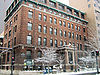
|
| 26 Exchange Street East
44°56′58"N 93°5′48"W
| Saint Paul
Saint Paul, Minnesota
Saint Paul is the capital and second-most populous city of the U.S. state of Minnesota. The city lies mostly on the east bank of the Mississippi River in the area surrounding its point of confluence with the Minnesota River, and adjoins Minneapolis, the state's largest city...
| Minnesota's first fine arts school, established by Ellen Ireland, Eliza Ireland, and Ellen Howard; also known as the Exchange Building, this 1908-1910 building was designed by John H. Wheeler; one source says it was a convent
Convent
A convent is either a community of priests, religious brothers, religious sisters, or nuns, or the building used by the community, particularly in the Roman Catholic Church and in the Anglican Communion...
|--
!
| Saint Anthony Park Branch Library
St. Anthony Park Branch Library
The St. Anthony Park Branch Library is a branch of the St. Paul Public Library. A Carnegie library built in 1917, it is on the National Register of Historic Places. In 1999 a rotunda was built on to the back of the building. This new section houses the branch’s children’s collection, one of the...
|
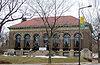
|
| 2245 Como Avenue West
44°58′52"N 93°11′37"W
| Saint Paul
Saint Paul, Minnesota
Saint Paul is the capital and second-most populous city of the U.S. state of Minnesota. The city lies mostly on the east bank of the Mississippi River in the area surrounding its point of confluence with the Minnesota River, and adjoins Minneapolis, the state's largest city...
| a Carnegie library
Carnegie library
A Carnegie library is a library built with money donated by Scottish-American businessman and philanthropist Andrew Carnegie. 2,509 Carnegie libraries were built between 1883 and 1929, including some belonging to public and university library systems...
built in 1917, the branch circulated 265,776 items in 2005
|--
!
| Saint Joseph's Academy
Saint Joseph's Academy (Saint Paul, Minnesota)
St. Joseph's Academy was a Catholic school for girls from 1851 to 1971, operated by the Sisters of St Joseph of Carondelet who also later founded the College of St. Catherine. In 1863 the institution was moved to the existing Marshall Avenue location. It is the oldest Catholic school building in...
|
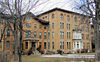
|
| 355 Marshall Avenue
44°56′57"N 93°6′54"W
| Saint Paul
Saint Paul, Minnesota
Saint Paul is the capital and second-most populous city of the U.S. state of Minnesota. The city lies mostly on the east bank of the Mississippi River in the area surrounding its point of confluence with the Minnesota River, and adjoins Minneapolis, the state's largest city...
| in 1863 the institution was moved to this location, the oldest Catholic
Catholicism
Catholicism is a broad term for the body of the Catholic faith, its theologies and doctrines, its liturgical, ethical, spiritual, and behavioral characteristics, as well as a religious people as a whole....
school building in Minnesota; construction is of local yellow limestone
Limestone
Limestone is a sedimentary rock composed largely of the minerals calcite and aragonite, which are different crystal forms of calcium carbonate . Many limestones are composed from skeletal fragments of marine organisms such as coral or foraminifera....
built in Italianate style
|--
!
| Saint Matthew's School
Saint Matthew's School
St. Matthew's School in the West Side neighborhood of Saint Paul, Minnesota is a 1902 school designed by John F. Fisher; it originally served German immigrants and now serves the local Hispanic community. It is listed on the National Register of Historic Places....
|
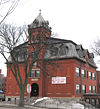
|
| 7 Robie Street West
44°55′51"N 93°5′8"W
| Saint Paul
Saint Paul, Minnesota
Saint Paul is the capital and second-most populous city of the U.S. state of Minnesota. The city lies mostly on the east bank of the Mississippi River in the area surrounding its point of confluence with the Minnesota River, and adjoins Minneapolis, the state's largest city...
| 1902 school designed by John F. Fisher located on Saint Paul's West Side; it originally served German immigrants and now serves the local Hispanic
Hispanic
Hispanic is a term that originally denoted a relationship to Hispania, which is to say the Iberian Peninsula: Andorra, Gibraltar, Portugal and Spain. During the Modern Era, Hispanic sometimes takes on a more limited meaning, particularly in the United States, where the term means a person of ...
community
|--
!
| Saint Paul Cathedral
|
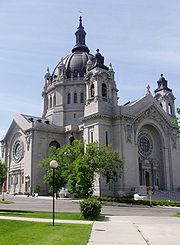
|
| Summit Avenue at Selby Avenue
44°56′49"N 93°6′32"W
| Saint Paul
Saint Paul, Minnesota
Saint Paul is the capital and second-most populous city of the U.S. state of Minnesota. The city lies mostly on the east bank of the Mississippi River in the area surrounding its point of confluence with the Minnesota River, and adjoins Minneapolis, the state's largest city...
| a Roman Catholic
Roman Catholic Church
The Catholic Church, also known as the Roman Catholic Church, is the world's largest Christian church, with over a billion members. Led by the Pope, it defines its mission as spreading the gospel of Jesus Christ, administering the sacraments and exercising charity...
cathedral
Cathedral
A cathedral is a Christian church that contains the seat of a bishop...
in Saint Paul; it is the cathedral of the Archdiocese of Saint Paul and Minneapolis
|--
!
| Saint Paul City Hall and Ramsey County Courthouse
Saint Paul City Hall and Ramsey County Courthouse
The Saint Paul City Hall and Ramsey County Courthouse, located at 15 Kellogg Boulevard West in Saint Paul, Ramsey County in the U.S. state of Minnesota is a twenty-story Art Deco skyscraper built during the Great Depression era of high unemployment and falling prices...
|

|
| 15 Kellogg Boulevard West
44°56′39"N 93°5′37"W
| Saint Paul
Saint Paul, Minnesota
Saint Paul is the capital and second-most populous city of the U.S. state of Minnesota. The city lies mostly on the east bank of the Mississippi River in the area surrounding its point of confluence with the Minnesota River, and adjoins Minneapolis, the state's largest city...
| a twenty-story Art Deco
Art Deco
Art deco , or deco, is an eclectic artistic and design style that began in Paris in the 1920s and flourished internationally throughout the 1930s, into the World War II era. The style influenced all areas of design, including architecture and interior design, industrial design, fashion and...
skyscraper
Skyscraper
A skyscraper is a tall, continuously habitable building of many stories, often designed for office and commercial use. There is no official definition or height above which a building may be classified as a skyscraper...
built during the Great Depression
Great Depression
The Great Depression was a severe worldwide economic depression in the decade preceding World War II. The timing of the Great Depression varied across nations, but in most countries it started in about 1929 and lasted until the late 1930s or early 1940s...
|--
! | 90
| Saint Paul, Minneapolis, & Manitoba Railway Company Shops Historic District
Saint Paul, Minneapolis, & Manitoba Railway Company Shops Historic District
St. Paul, Minneapolis, & Manitoba Railway Company Shops Historic District is a group of 1882 limestone maintenance buildings in Saint Paul, Minnesota...
|
|
| Jackson Street and Pennsylvania Avenue
44°57′45"N 93°5′47"W
| Saint Paul
Saint Paul, Minnesota
Saint Paul is the capital and second-most populous city of the U.S. state of Minnesota. The city lies mostly on the east bank of the Mississippi River in the area surrounding its point of confluence with the Minnesota River, and adjoins Minneapolis, the state's largest city...
| 1882 limestone maintenance building served the Saint Paul, Minneapolis, & Manitoba Railway, and then the Great Northern Railway
|--
!
| Saint Paul Municipal Grain Terminal
Saint Paul Municipal Grain Terminal
The Saint Paul Municipal Grain Terminal, also known as the head house and sack house, sits on piers over the Mississippi River in Saint Paul, Minnesota. It was built between 1927 and 1931 as part of the Equity Cooperative Exchange and is a remnant of Saint Paul's early history as a Mississippi...
|
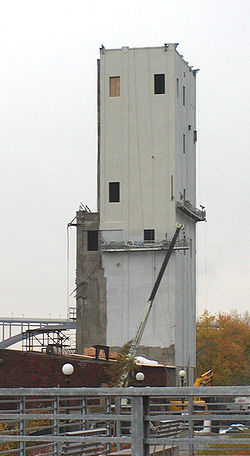
|
| 266 Old Shepard Rd.
44°56′20"N 93°6′0"W
| Saint Paul
Saint Paul, Minnesota
Saint Paul is the capital and second-most populous city of the U.S. state of Minnesota. The city lies mostly on the east bank of the Mississippi River in the area surrounding its point of confluence with the Minnesota River, and adjoins Minneapolis, the state's largest city...
| built between 1927 and 1931 as part of the Equity Cooperative Exchange and is a remnant of Saint Paul's early history as a Mississippi River port city
|--
!
| Saint Paul Public Library
St. Paul Public Library
The Saint Paul Public Library is a library system serving the residents of Saint Paul, Minnesota, in the United States. The library system includes a Central Library, twelve branch locations, and a bookmobile....
/James J. Hill Reference Library
James J. Hill Reference Library
James J. Hill, The Empire Builder's civic legacy is the in downtown Saint Paul, Minnesota. This public business research library is open to the public and its resources can be used for free on site...
|

|
| 80-90 4th Street West
44°56′38"N 93°5′48"W
| Saint Paul
Saint Paul, Minnesota
Saint Paul is the capital and second-most populous city of the U.S. state of Minnesota. The city lies mostly on the east bank of the Mississippi River in the area surrounding its point of confluence with the Minnesota River, and adjoins Minneapolis, the state's largest city...
| James J. Hill
James J. Hill
James Jerome Hill , was a Canadian-American railroad executive. He was the chief executive officer of a family of lines headed by the Great Northern Railway, which served a substantial area of the Upper Midwest, the northern Great Plains, and Pacific Northwest...
, the Empire Builder's civic legacy is the library in downtown Saint Paul
|--
!
| Saint Paul Seminary Historic District
Saint Paul Seminary School of Divinity
The Saint Paul Seminary School of Divinity, located in Saint Paul, Minnesota, was founded by Archbishop John Ireland in 1894, to provide ordained priests for the ever-increasing Catholic population of the Upper Midwest. The seminary now sits on the south campus of the University of St. Thomas,...
|
|
| 2260 Summit Avenue
44°56′26"N 93°11′44"W
| Saint Paul
Saint Paul, Minnesota
Saint Paul is the capital and second-most populous city of the U.S. state of Minnesota. The city lies mostly on the east bank of the Mississippi River in the area surrounding its point of confluence with the Minnesota River, and adjoins Minneapolis, the state's largest city...
| now part of the University of Saint Thomas
University of St. Thomas (Minnesota)
The University of St. Thomas is a private, Catholic, liberal arts, and archdiocesan university located in St. Paul and Minneapolis, Minnesota, United States...
, the first six buildings were built and endowed by the Methodist millionaire, James J. Hill
James J. Hill
James Jerome Hill , was a Canadian-American railroad executive. He was the chief executive officer of a family of lines headed by the Great Northern Railway, which served a substantial area of the Upper Midwest, the northern Great Plains, and Pacific Northwest...
, who gave the school to the Archdiocese of Saint Paul and Minneapolis to honor his Catholic
Catholicism
Catholicism is a broad term for the body of the Catholic faith, its theologies and doctrines, its liturgical, ethical, spiritual, and behavioral characteristics, as well as a religious people as a whole....
wife, Mary Mehegan Hill; 86003818
|--
!
| Saint Paul Union Depot
Saint Paul Union Depot
The Saint Paul Union Depot was the main train station in the city of Saint Paul, Minnesota. The Saint Paul Union Depot Company controlled of St. Paul trackage and terminal facilities, including the depot building...
|
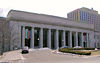
|
| 214 4th Street East
44°56′52"N 93°5′10"W
| Saint Paul
Saint Paul, Minnesota
Saint Paul is the capital and second-most populous city of the U.S. state of Minnesota. The city lies mostly on the east bank of the Mississippi River in the area surrounding its point of confluence with the Minnesota River, and adjoins Minneapolis, the state's largest city...
| the main train station
Train station
A train station, also called a railroad station or railway station and often shortened to just station,"Station" is commonly understood to mean "train station" unless otherwise qualified. This is evident from dictionary entries e.g...
in the city of Saint Paul until passenger rail service in the region was restructured in the 1960s and 1970s
|--
!
| Saint Paul Women's City Club
Saint Paul Women's City Club
The St. Paul Women's City Club is a 1931 Art Deco Streamline Moderne-style Mankato limestone clubhouse which provided a dining room, assembly rooms, dressing rooms, and bedrooms for members and guests of the club, in Saint Paul, Minnesota...
|
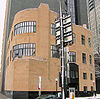
|
| 305 Saint Peter Street
44°56′38"N 93°5′40"W
| Saint Paul
Saint Paul, Minnesota
Saint Paul is the capital and second-most populous city of the U.S. state of Minnesota. The city lies mostly on the east bank of the Mississippi River in the area surrounding its point of confluence with the Minnesota River, and adjoins Minneapolis, the state's largest city...
| 1931 Art Deco
Art Deco
Art deco , or deco, is an eclectic artistic and design style that began in Paris in the 1920s and flourished internationally throughout the 1930s, into the World War II era. The style influenced all areas of design, including architecture and interior design, industrial design, fashion and...
Moderne-style Mankato
Mankato, Minnesota
Mankato is a city in Blue Earth, Nicollet, and Le Sueur counties in the U.S. state of Minnesota. The population was 39,309 at the 2010 census, making it the fourth largest city in Minnesota outside of the Minneapolis-St. Paul metropolitan area. The county seat of Blue Earth County, it is located...
limestone
Limestone
Limestone is a sedimentary rock composed largely of the minerals calcite and aragonite, which are different crystal forms of calcium carbonate . Many limestones are composed from skeletal fragments of marine organisms such as coral or foraminifera....
clubhouse provided a dining room, assembly rooms, dressing rooms, and bedrooms for members and guests; when this building was built, the club had over 1000 members with the goal of providing a "center for organized work and for social and intellectual intercourse;" architect was Magnus Jemne (1882–1964); the building was sold to the Minnesota Museum of Art in 1972 and now houses an architectural firm
|--
!
| Salvation Army Women's Home and Hospital
Salvation Army Women's Home and Hospital
The Salvation Army Women's Home and Hospital is a 1912 brick Tudor Revival style building designed by Clarence H. Johnston, Sr. in Saint Paul, Minnesota. It was home for unwed mothers and their children until 1971; now its focus is on young women with behavioral or emotional issues. It is listed...
|
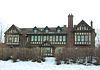
|
| 1471 Como Avenue West
44°58′41"N 93°9′46"W
| Saint Paul
Saint Paul, Minnesota
Saint Paul is the capital and second-most populous city of the U.S. state of Minnesota. The city lies mostly on the east bank of the Mississippi River in the area surrounding its point of confluence with the Minnesota River, and adjoins Minneapolis, the state's largest city...
| 1912 brick Tudor Revival style building designed by Clarence H. Johnston, Sr.
Clarence H. Johnston, Sr.
Clarence H. Johnston Sr. was an American architect, active in Saint Paul and in Morris, Minnesota. In 1877, Johnston entered the Massachusetts Institute of Technology as a special architectural student. Four years later, he went abroad, traveling in Europe and Asia Minor...
; was home for unwed mothers and their children until 1971; now its focus is on young women with behavioral or emotional issues
|--
!
| Charles W. Schneider House
Charles W. Schneider House
The Charles W. Schneider House is listed on the National Register of Historic Places in Saint Paul. The home was built in 1890....
|
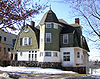
|
| 1750 Ames Place East
44°58′16"N 93°1′36"W
| Saint Paul
Saint Paul, Minnesota
Saint Paul is the capital and second-most populous city of the U.S. state of Minnesota. The city lies mostly on the east bank of the Mississippi River in the area surrounding its point of confluence with the Minnesota River, and adjoins Minneapolis, the state's largest city...
| built 1890; 84001677
|--
!
| Schornstein Grocery and Saloon
Schornstein Grocery and Saloon
The Schornstein Grocery and Saloon is a commercial/residential building in Saint Paul, Minnesota; it was built in 1884 for $5,000 in the French Second Empire style, this Dayton's Bluff business was designed by architect Augustus F. Gauger . It is listed on the National Register of Historic Places....
|
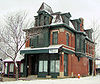
|
| 707 Wilson Avenue East and 223 Bates Avenue North
44°57′12"N 93°3′59"W
| Saint Paul
Saint Paul, Minnesota
Saint Paul is the capital and second-most populous city of the U.S. state of Minnesota. The city lies mostly on the east bank of the Mississippi River in the area surrounding its point of confluence with the Minnesota River, and adjoins Minneapolis, the state's largest city...
| built in 1884 for $5,000 in the French Second Empire style, this Dayton's Bluff
Dayton's Bluff
Dayton's Bluff is a neighborhood located on the east side of the Mississippi in the southeast part of the city of Saint Paul, Minnesota, which has a large residential district on the plateau extending backward from its top. The name of the bluff commemorates Lyman Dayton, for whom a village and a...
business was designed by architect August F. Gauger (1852–1929)
|--
!
| Seventh Street Improvement Arches
Seventh Street Improvement Arches
The Seventh Street Improvement Arches are a double-arched masonry highway bridge that formerly spanned the St. Paul and Duluth Railroad tracks in St. Paul, Minnesota. The Seventh Street Improvement Arches are historically significant for its rarity and the technically demanding nature of its...
|
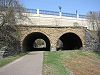
|
| East 7th Street over Burlington Northern right-of-way
44°57′24"N 93°4′37"W
| Saint Paul
Saint Paul, Minnesota
Saint Paul is the capital and second-most populous city of the U.S. state of Minnesota. The city lies mostly on the east bank of the Mississippi River in the area surrounding its point of confluence with the Minnesota River, and adjoins Minneapolis, the state's largest city...
| A double-arched
Arch bridge
An arch bridge is a bridge with abutments at each end shaped as a curved arch. Arch bridges work by transferring the weight of the bridge and its loads partially into a horizontal thrust restrained by the abutments at either side...
masonry highway bridge that formerly spanned the St. Paul and Duluth Railroad
St. Paul and Duluth Railroad
The St. Paul and Duluth Railroad was reorganized from the Lake Superior and Mississippi Railroad in 1877. It was bought by the Northern Pacific in 1900...
tracks in Saint Paul; they are historically significant for their rarity and the technically demanding nature of their skewed, helicoidal spiral, stone-arch design
|--
!
| Sam S. Shubert Theatre and Shubert Building
Fitzgerald Theater
The Fitzgerald Theater is the oldest existing stage venue in the city of Saint Paul, Minnesota, and the home of American Public Media's A Prairie Home Companion. It was one of many theaters built by the Shubert Theatre Corporation, and was initially named the Sam S. Shubert Theater...
|
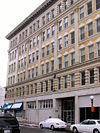
|
| 488—494 Wabasha Street North
44°56′56"N 93°5′51"W
| Saint Paul
Saint Paul, Minnesota
Saint Paul is the capital and second-most populous city of the U.S. state of Minnesota. The city lies mostly on the east bank of the Mississippi River in the area surrounding its point of confluence with the Minnesota River, and adjoins Minneapolis, the state's largest city...
| Now known as the Fitzgerald Theater and Fitzgerald Condominiums, the 1910 building was modeled after the Maxine Elliott Theatre
Maxine Elliott Theatre
The Maxine Elliott Theatre was a Broadway theater located at 109 West 39th Street in New York City. Built in 1908, it was demolished in 1960. The theater was designed by architect Benjamin Marshall of the Chicago firm Marshall and Fox....
of New York
New York City
New York is the most populous city in the United States and the center of the New York Metropolitan Area, one of the most populous metropolitan areas in the world. New York exerts a significant impact upon global commerce, finance, media, art, fashion, research, technology, education, and...
http://query.nytimes.com/gst/abstract.html?res=9505E2D91239E433A2575AC2A96E9C946196D6CF
|--
!
| Frederick Spangenberg House
Frederick Spangenberg House
The Frederick Spangenberg House is the oldest limestone farmhouse still standing in Saint Paul in the U.S. state of Minnesota; its yellow limestone walls came from banks of the Mississippi River and hauled by stoneboat over snow to the building site. The house, located at 375 Mount Curve Avenue is...
|
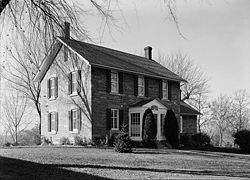
|
| 375 Mt. Curve Boulevard
44°55′49"N 93°11′39"W
| Saint Paul
Saint Paul, Minnesota
Saint Paul is the capital and second-most populous city of the U.S. state of Minnesota. The city lies mostly on the east bank of the Mississippi River in the area surrounding its point of confluence with the Minnesota River, and adjoins Minneapolis, the state's largest city...
| Built in 1864, it is the oldest limestone farmhouse still standing in Saint Paul; its yellow limestone
Limestone
Limestone is a sedimentary rock composed largely of the minerals calcite and aragonite, which are different crystal forms of calcium carbonate . Many limestones are composed from skeletal fragments of marine organisms such as coral or foraminifera....
walls came from banks of the Mississippi River
Mississippi River
The Mississippi River is the largest river system in North America. Flowing entirely in the United States, this river rises in western Minnesota and meanders slowly southwards for to the Mississippi River Delta at the Gulf of Mexico. With its many tributaries, the Mississippi's watershed drains...
and hauled by stoneboat over snow to the building site
|--
!
| Triune Masonic Temple
Triune Masonic Temple
The Triune Masonic Temple is a meetinghouse of Freemasonry in Saint Paul, Minnesota, built in 1910 in the Neo-Classical Revival style, designed by Henry C. Struchen . It was listed on the National Register of Historic Places on November 13, 1980. Triune Temple is the last remaining historic Masonic...
|
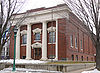
|
| 1898 Iglehart Avenue
44°56′57"N 93°10′50"W
| Saint Paul
Saint Paul, Minnesota
Saint Paul is the capital and second-most populous city of the U.S. state of Minnesota. The city lies mostly on the east bank of the Mississippi River in the area surrounding its point of confluence with the Minnesota River, and adjoins Minneapolis, the state's largest city...
| 1911 Neo-Classical Revival
Neo-Grec
Neo-Grec is a term referring to late manifestations of Neoclassicism, early Neo-Renaissance now called the Greek Revival style, which was popularized in architecture, the decorative arts, and in painting during France's Second Empire, or the reign of Napoleon III, a period that lasted...
Masonic
Freemasonry
Freemasonry is a fraternal organisation that arose from obscure origins in the late 16th to early 17th century. Freemasonry now exists in various forms all over the world, with a membership estimated at around six million, including approximately 150,000 under the jurisdictions of the Grand Lodge...
temple designed by Henry C. Struchen (1871–1947)
|--
!
| United Church Seminary
Luther Seminary
Luther Seminary is the largest seminary of the Evangelical Lutheran Church in America . Located in the Saint Anthony Park neighborhood of St...
|
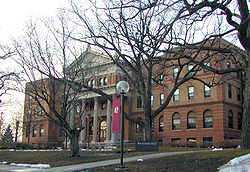
|
| 2481 Como Avenue
44°59′5"N 93°11′47"W
| Saint Paul
Saint Paul, Minnesota
Saint Paul is the capital and second-most populous city of the U.S. state of Minnesota. The city lies mostly on the east bank of the Mississippi River in the area surrounding its point of confluence with the Minnesota River, and adjoins Minneapolis, the state's largest city...
| conglomerate including 1876 Luther Theological Seminary
|--
!
| University Hall-Old Main, Hamline University
Hamline University
-Red Wing location :Hamline was named in honor of Leonidas Lent Hamline, a bishop of the Methodist Church whose interest in the frontier led him to donate $25,000 toward the building of an institution of higher learning in what was then the territory of Minnesota. Today, a statue of Bishop Hamline...
|
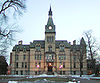
|
| 1536 Hewitt Avenue
44°57′57"N 93°9′56"W
| Saint Paul
Saint Paul, Minnesota
Saint Paul is the capital and second-most populous city of the U.S. state of Minnesota. The city lies mostly on the east bank of the Mississippi River in the area surrounding its point of confluence with the Minnesota River, and adjoins Minneapolis, the state's largest city...
| 1884 college building, part of Hamline University
Hamline University
-Red Wing location :Hamline was named in honor of Leonidas Lent Hamline, a bishop of the Methodist Church whose interest in the frontier led him to donate $25,000 toward the building of an institution of higher learning in what was then the territory of Minnesota. Today, a statue of Bishop Hamline...
|--
!
| Vienna and Earl Apartment Buildings
Vienna and Earl Apartment Buildings
The Vienna and Earl Apartment Buildings are 1907 Neo-Classical Revival residences, designed by Carl P. Waldon, located in Saint Paul, Minnesota. They are Registered Historic Places.-References:...
|
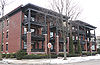
|
| 682-688 Holly Avenue
44°56′35"N 93°7′45"W
| Saint Paul
Saint Paul, Minnesota
Saint Paul is the capital and second-most populous city of the U.S. state of Minnesota. The city lies mostly on the east bank of the Mississippi River in the area surrounding its point of confluence with the Minnesota River, and adjoins Minneapolis, the state's largest city...
| 1907 Neo-Classical Revival
Neo-Grec
Neo-Grec is a term referring to late manifestations of Neoclassicism, early Neo-Renaissance now called the Greek Revival style, which was popularized in architecture, the decorative arts, and in painting during France's Second Empire, or the reign of Napoleon III, a period that lasted...
residences, designed by Carl P. Waldon
|--
!
| Anthony Waldman House
Anthony Waldman House
Until recently, the limestone building at 445 Smith Avenue North, St. Paul, Minnesota was known in surveys and local architectural history books as the Anthony Waldman House. However, recent research and analysis of the building has revealed that the Waldman House was not in fact built by Waldman,...
|
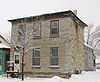
|
| 445 Smith Avenue North
44°56′18"N 93°6′34"W
| Saint Paul
Saint Paul, Minnesota
Saint Paul is the capital and second-most populous city of the U.S. state of Minnesota. The city lies mostly on the east bank of the Mississippi River in the area surrounding its point of confluence with the Minnesota River, and adjoins Minneapolis, the state's largest city...
| 1864 home of Anthony Waldman a Czech immigrant and his German-born wife
|--
!
| Walsh Building
Walsh Building
The Walsh Building in Saint Paul, Minnesota was designed by Edward Payson Bassford, in 1888. The Romanesque building has been used as a residence, school, and manufacturing facility. It is listed on the National Register of Historic Places....
|
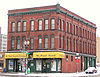
|
| 189-191 7th Street East
44°57′3"N 93°5′27"W
| Saint Paul
Saint Paul, Minnesota
Saint Paul is the capital and second-most populous city of the U.S. state of Minnesota. The city lies mostly on the east bank of the Mississippi River in the area surrounding its point of confluence with the Minnesota River, and adjoins Minneapolis, the state's largest city...
| designed by Edward Payson Bassford, in 1888, the Romanesque
Romanesque Revival architecture
Romanesque Revival is a style of building employed beginning in the mid 19th century inspired by the 11th and 12th century Romanesque architecture...
building has been used as a residence, school, and manufacturing facility
|--
!
| Martin Weber House
Martin Weber House
The Martin Weber House in Saint Paul, Minnesota may be listed on the National Register of Historic Places.The house was built in 1867 of rough-cut limestone. It was the home of Catherin and Martin Weber; built by German immigrant stonemasons, Jacob Amos and Christian RhinehardtIt was listed with...
|
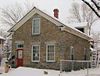
|
| 202 McBoal Street
44°56′20"N 93°6′31"W
| Saint Paul
Saint Paul, Minnesota
Saint Paul is the capital and second-most populous city of the U.S. state of Minnesota. The city lies mostly on the east bank of the Mississippi River in the area surrounding its point of confluence with the Minnesota River, and adjoins Minneapolis, the state's largest city...
| 1867 home of Catherin and Martin Weber; built by German immigrant stonemasons, Jacob Amos and Christian Rhinehardt
|--
! | 109
| West Summit Avenue Historic District
|
|
| Summit Avenue between Lexington Parkway and Mississippi River Boulevard
44°56′29"N 93°10′37"W
| Saint Paul
Saint Paul, Minnesota
Saint Paul is the capital and second-most populous city of the U.S. state of Minnesota. The city lies mostly on the east bank of the Mississippi River in the area surrounding its point of confluence with the Minnesota River, and adjoins Minneapolis, the state's largest city...
| from the Historic Hill District, this district continues west along Summit Avenue to the Mississippi River
Mississippi River
The Mississippi River is the largest river system in North America. Flowing entirely in the United States, this river rises in western Minnesota and meanders slowly southwards for to the Mississippi River Delta at the Gulf of Mexico. With its many tributaries, the Mississippi's watershed drains...
|--
! | 110
| Woodland Park District
Woodland Park District
The Woodland Park District includes several blocks of historic single-family houses and multi-family dwellings in Saint Paul, Minnesota. It is roughly bounded by Marshall and Selby Avenues and Arundel and Dale Streets. The area is an island within the Historic Hill District....
|
|
| Roughly bounded by Marshall and Selby Avenues, Arundel and Dale Streets
44°56′52"N 93°07′21"W
| Saint Paul
Saint Paul, Minnesota
Saint Paul is the capital and second-most populous city of the U.S. state of Minnesota. The city lies mostly on the east bank of the Mississippi River in the area surrounding its point of confluence with the Minnesota River, and adjoins Minneapolis, the state's largest city...
| several blocks of historic single-family houses and multi-family dwellings; 78001559
|--
!
| Anthony Yoerg, Sr. House
Anthony Yoerg, Sr. House
The Anthony Yoerg Sr. House was the home of Anthony Yoerg , a Bavarian immigrant who constructed Minnesota's first brewery; the house is located high on the bluffs and the brewery was located just below the house on the lowlands in Saint Paul, Minnesota's West Side neighborhood. It is listed on...
|
|
| 215 Isabel Street West
44°56′0"N 93°5′41"W
| Saint Paul
Saint Paul, Minnesota
Saint Paul is the capital and second-most populous city of the U.S. state of Minnesota. The city lies mostly on the east bank of the Mississippi River in the area surrounding its point of confluence with the Minnesota River, and adjoins Minneapolis, the state's largest city...
| home of Anthony Yoerg (1816–1896), a Bavaria
Bavaria
Bavaria, formally the Free State of Bavaria is a state of Germany, located in the southeast of Germany. With an area of , it is the largest state by area, forming almost 20% of the total land area of Germany...
n immigrant who constructed Minnesota's first brewery
|}
Related sites
|--! 1
| William Dahl House
William Dahl House
The William Dahl House was built by William Dahl and his Irish wife, Catherine Margaret Murphy in 1858, the home was moved from 136 13th Street in 1997....
|

|
| 508 Jefferson Avenue
44°55′49.5"N 93°7′16.5"W
| Saint Paul
Saint Paul, Minnesota
Saint Paul is the capital and second-most populous city of the U.S. state of Minnesota. The city lies mostly on the east bank of the Mississippi River in the area surrounding its point of confluence with the Minnesota River, and adjoins Minneapolis, the state's largest city...
| Built by William Dahl and his Irish
Irish people
The Irish people are an ethnic group who originate in Ireland, an island in northwestern Europe. Ireland has been populated for around 9,000 years , with the Irish people's earliest ancestors recorded having legends of being descended from groups such as the Nemedians, Fomorians, Fir Bolg, Tuatha...
wife, Catherine Margaret Murphy in 1858, the home was moved from 136 13th Street in 1997; 78001557. The house was apparently de-listed at some point.
|--
!
| Salvation Army Headquarters
|
| Deemed eligible for listing in February 1983
| 57 10th Street West
| Saint Paul
Saint Paul, Minnesota
Saint Paul is the capital and second-most populous city of the U.S. state of Minnesota. The city lies mostly on the east bank of the Mississippi River in the area surrounding its point of confluence with the Minnesota River, and adjoins Minneapolis, the state's largest city...
| Later known as the Seton Center, this building was deemed eligible for listing on the NRHP by U.S. Department of the Interior, however owner opposition prevented from being listed. The building was razed in January 1998.
|--
! | 3
| Fort Snelling
|
|
| Pike Island
Pike Island
Pike Island is an island at the confluence of the Mississippi and Minnesota Rivers in the southwestern part of St. Paul in the Twin Cities metropolitan area of Minnesota. It is a portion of the 100,000 acres of land purchased from the Mdewakanton Sioux Indians by Zebulon Pike in September 1805,...
44°53′32"N 93°09′55"W
| Ramsey County
Ramsey County, Minnesota
Ramsey County is a county located in the U.S. state of Minnesota, founded in 1849. As of 2010, the population was 508,640. Its county seat is St. Paul, which is also Minnesota's state capital. The county is named for Alexander Ramsey , the first governor of the Minnesota Territory...
| Although most of the fort is located in Hennepin County, Pike Island
Pike Island
Pike Island is an island at the confluence of the Mississippi and Minnesota Rivers in the southwestern part of St. Paul in the Twin Cities metropolitan area of Minnesota. It is a portion of the 100,000 acres of land purchased from the Mdewakanton Sioux Indians by Zebulon Pike in September 1805,...
is part of the fort's property and is in Ramsey County.
|}
Further reading
External links
- A list of the above sites, with street addresses and other information, is available at Ramsey County, MN listing of National Register of Historic Places.Com, a private site serving up NRHP information.