

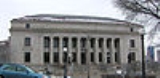
Minnesota Historical Society Building

Encyclopedia
The Minnesota Judicial Center, adjacent to the State Capitol
, houses the state's Supreme Court
and Court of Appeals
, as well as the state law library
. Its address is 25 Rev. Dr. Martin Luther King, Jr., Blvd., Saint Paul
, Minnesota
.
It is listed on the National Register of Historic Places
as the Minnesota Historical Society Building, as it was built for that institution. In 1992, the Minnesota Historical Society
moved to a new building nearby, the Minnesota History Center
.
The neoclassical
front of the building has eight two-story Ionic
columns of granite. Above them are Roman numerals
representing the establishment of the Minnesota Historical Society in 1849 and the year the building was completed, 1917. It was dedicated on May 11, 1918, the sixtieth anniversary of statehood.
Minnesota State Capitol
The Minnesota State Capitol is located in Minnesota's capital city, Saint Paul, and houses the Minnesota Senate, Minnesota House of Representatives, the Office of the Attorney General and the Office of the Governor...
, houses the state's Supreme Court
Minnesota Supreme Court
The Minnesota Supreme Court is the highest court in the U.S. state of Minnesota and consists of seven members. The court was first assembled as a three-judge panel in 1849 when Minnesota was still a territory. The first members were lawyers from outside of the region who were appointed by...
and Court of Appeals
Minnesota Court of Appeals
The Minnesota Court of Appeals is the intermediate appellate court for the state of Minnesota. It began operating on November 1, 1983. It is housed in the Minnesota Judicial Center in St...
, as well as the state law library
Minnesota State Law Library
The Minnesota State Law Library is a law library operated by the judicial branch of the U.S. state of Minnesota. It is currently housed in the ground level of the Minnesota Judicial Center, which was built in 1915. An expansion of the building was completed in 1990. The Minnesota Judicial Center is...
. Its address is 25 Rev. Dr. Martin Luther King, Jr., Blvd., Saint Paul
Saint Paul, Minnesota
Saint Paul is the capital and second-most populous city of the U.S. state of Minnesota. The city lies mostly on the east bank of the Mississippi River in the area surrounding its point of confluence with the Minnesota River, and adjoins Minneapolis, the state's largest city...
, Minnesota
Minnesota
Minnesota is a U.S. state located in the Midwestern United States. The twelfth largest state of the U.S., it is the twenty-first most populous, with 5.3 million residents. Minnesota was carved out of the eastern half of the Minnesota Territory and admitted to the Union as the thirty-second state...
.
It is listed on the National Register of Historic Places
National Register of Historic Places
The National Register of Historic Places is the United States government's official list of districts, sites, buildings, structures, and objects deemed worthy of preservation...
as the Minnesota Historical Society Building, as it was built for that institution. In 1992, the Minnesota Historical Society
Minnesota Historical Society
The Minnesota Historical Society is a private, non-profit educational and cultural institution dedicated to preserving the history of the U.S. state of Minnesota. It was founded by the territorial legislature in 1849, almost a decade before statehood. The Society is named in the Minnesota...
moved to a new building nearby, the Minnesota History Center
Minnesota History Center
The Minnesota History Center is a museum and library which serves as the headquarters for the Minnesota Historical Society. It is located near downtown Saint Paul, Minnesota and is considered one of the finest public buildings of Minnesota....
.
The neoclassical
Neoclassical architecture
Neoclassical architecture was an architectural style produced by the neoclassical movement that began in the mid-18th century, manifested both in its details as a reaction against the Rococo style of naturalistic ornament, and in its architectural formulas as an outgrowth of some classicizing...
front of the building has eight two-story Ionic
Ionic order
The Ionic order forms one of the three orders or organizational systems of classical architecture, the other two canonic orders being the Doric and the Corinthian...
columns of granite. Above them are Roman numerals
Roman numerals
The numeral system of ancient Rome, or Roman numerals, uses combinations of letters from the Latin alphabet to signify values. The numbers 1 to 10 can be expressed in Roman numerals as:...
representing the establishment of the Minnesota Historical Society in 1849 and the year the building was completed, 1917. It was dedicated on May 11, 1918, the sixtieth anniversary of statehood.