

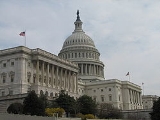

1794 First session of United States Senate open to the public.
1803 The United States Senate ratifies the Louisiana Purchase.
1804 The Democratic-Republican-controlled United States Senate begins an impeachment trial against Federalist-partisan Supreme Court of the United States Justice Samuel Chase.
1834 The United States Senate censures President Andrew Jackson for his actions in de-funding the Second Bank of the United States.
1837 Richard Johnson becomes the first Vice President of the United States chosen by the United States Senate.
1841 The first ongoing filibuster in the United States Senate begins and lasts until March 11.
1848 The Treaty of Guadalupe Hidalgo is ratified by the United States Senate, ending the Mexican-American War.
1850 Senator Daniel Webster gives his "Seventh of March" speech endorsing the Compromise of 1850 in order to prevent a possible civil war.
1856 Congressman Preston Brooks of South Carolina beats Senator Charles Sumner with a cane in the hall of the United States Senate for a speech Sumner had made attacking Southerners who sympathized with the pro-slavery violence in Kansas ("Bleeding Kansas").
1856 Congressman Preston Brooks of South Carolina beats Senator Charles Sumner with a cane in the hall of the United States Senate for a speech Sumner had made attacking Southerners who sympathized with the pro-slavery violence in Kansas ("Bleeding Kansas").
1861 American Civil War: Jefferson Davis resigns from the United States Senate.
1867 Alaska purchase: Passing by a single vote, the United States Senate ratifies a treaty with Russia for the purchase of Alaska.
1868 Andrew Johnson becomes the first President of the United States to be impeached by the United States House of Representatives. He is later acquitted in the Senate.
1868 A court of impeachment is organized in the United States Senate to hear charges against President Andrew Johnson.
1868 President Andrew Johnson is acquitted in his impeachment trial by one vote in the United States Senate.
1870 Hiram Rhodes Revels, a Republican from Mississippi, is sworn into the United States Senate, becoming the first African American ever to sit in the U.S. Congress.
1887 The United States Senate allows the Navy to lease Pearl Harbor as a naval base.
1899 Spanish-American War: The Treaty of Paris, a peace treaty between the United States and Spain, is ratified by the United States Senate.
1900 The United States Senate accepts the Anglo-German treaty of 1899 in which the United Kingdom renounces its claims to the Samoan islands.
1903 The Hay-Herran Treaty, granting the United States the right to build the Panama Canal, is ratified by the United States Senate. The Colombian Senate would later reject the treaty.
1907 Charles Curtis of Kansas becomes the first Native American U.S. Senator.
1911 United States Senate leaders agree to rotate the office of President pro tempore of the Senate among leading candidates to fill the vacancy left by William P. Frye's death.
1913 The 17th Amendment to the United States Constitution, requiring direct election of Senators, becomes law.
1920 The United States Senate votes against joining the League of Nations.
1920 The United States Senate rejects the Treaty of Versailles for the second time (the first time was on November 19, 1919).
1922 Rebecca Latimer Felton of Georgia takes the oath of office, becoming the first female United States Senator.
1932 Hattie W. Caraway becomes the first woman elected to the United States Senate.
1932 Bonus Army: around a thousand World War I veterans amass at the United States Capitol as the U.S. Senate considers a bill that would give them certain benefits.
1935 US Senator from Louisiana, Huey Long, nicknamed "Kingfish", is fatally shot in the Louisiana capitol building.
1937 New Deal: the United States Senate votes down President Franklin D. Roosevelt's proposal to add more justices to the Supreme Court of the United States.
1945 By a vote of 65 to 7, the United States Senate approves United States participation in the United Nations (the UN was established on October 24, 1945).
1947 The United States Senate follows the United States House of Representatives in overriding U.S. President Harry Truman's veto of the Taft-Hartley Act.
1948 Margaret Chase Smith is elected senator, and becomes the first woman to serve in both the U.S. House of Representatives and the United States Senate.
1948 Margaret Chase Smith of Maine becomes the first woman elected to the US Senate without completing another senator's term, when she defeats Democratic opponent Adrian Scolten.
1949 The United States Senate ratifies the North Atlantic Treaty.
1950 Second Red Scare: Senator Joseph McCarthy accuses the United States Department of State of being filled with Communists.
1951 The United States Senate Armed Services and Foreign Relations Committees begin their closed door hearings into the dismissal of General Douglas MacArthur by U.S. President Harry Truman.
1952 The United States Senate ratifies a peace treaty with Japan.
1954 McCarthyism: Joseph Welch, special counsel for the United States Army, lashes out at Senator Joseph McCarthy during hearings on whether Communism has infiltrated the Army giving McCarthy the famous rebuke, "You've done enough. Have you no sense of decency, sir, at long last? Have you left no sense of decency?"
1954 Red Scare: The United States Senate votes 65 to 22 to condemn Joseph McCarthy for "conduct that tends to bring the Senate into dishonor and disrepute".
1966 Former Massachusetts Attorney General Edward Brooke becomes the first African American elected to the United States Senate.
1968 Senator Robert F. Kennedy dies from his wounds after he was shot the previous night.
1972 The United States Senate ratifies the Anti-Ballistic Missile Treaty.
1973 Watergate scandal: Televised hearings begin in the United States Senate.
1973 The United States Senate votes to cut off funding for the bombing of Khmer Rouge targets within Cambodia, hastening the end of the Cambodian Civil War.
1973 Alexander Butterfield reveals the existence of the Nixon tapes to the special Senate committee investigating the Watergate break in.
1973 Watergate Scandal: former White House aide Alexander P. Butterfield informs the United States Senate that President Richard Nixon had secretly recorded potentially incriminating conversations.
1973 The Twenty-fifth Amendment: The United States Senate votes 92 to 3 to confirm Gerald Ford as Vice President of the United States (on December 6, the House confirmed him 387 to 35).
1973 The Twenty-fifth Amendment: The United States House of Representatives votes 387 to 35 to confirm Gerald Ford as Vice President of the United States (on November 27, the Senate confirmed him 92 to 3).
1978 Proceedings of the United States Senate are broadcast on radio for the first time.
1986 The United States Senate allows its debates to be televised on a trial basis.
1993 Janet Reno is confirmed by the United States Senate and sworn-in the next day, becoming the first female Attorney General of the United States.
1993 Savings and loan crisis: The United States Senate Ethics Committee issues a stern censure of California senator Alan Cranston for his "dealings" with savings-and-loan executive Charles Keating.
1998 Lewinsky scandal: The United States House of Representatives forwards articles I and III of impeachment against President Bill Clinton to the Senate.
1999 President Bill Clinton is acquitted by the United States Senate in his impeachment trial.
1999 The United States Senate rejects ratification of the Comprehensive Test Ban Treaty (CTBT).
2000 Hillary Rodham Clinton is elected to the United States Senate, becoming the first former First Lady to win public office in the United States, although actually she still was the First Lady.
2005 United States Senate confirms John Roberts as Chief Justice of the United States.
2008 The Governor of Illinois, Rob Blagojevich, is arrested by federal officials for a number of alleged crimes including attempting to sell the United States Senate seat being vacated by President-elect Barack Obama's election to the Presidency.