


British soldiers in the eighteenth century

Encyclopedia
A redcoat
soldier in the British Army
during the 18th century
would have faced war in a number of theatres throughout the European continent, the Americas and the colonies; the Seven Years' War
raged from 1756–63, the American War of Independence from 1775–83, the French Revolutionary Wars
in 1792–1802 and the ensuing Napoleonic Wars
from 1803–15.
There were a number of names used to describe the variety of groups serving within the army, including the militia
, fencibles
, associations, volunteers, yeomanry
, rangers, local militia and provisional cavalry
. Although many of the men rarely saw active service abroad, the army were often used as a constabulary force within the British Isles and therefore it was often questioned whether a standing force was actually needed. However, the growth of the British Empire
in the 19th century demanded the use of an established imperial force.
Life for a redcoat soldier was often tough and challenging. Plenty of training was needed before a soldier could enter the battlefield; drills and exercises had to be strictly followed and punishments inflicted for even the most minor of mistakes. When on campaign, a soldier faced the prospect of restricted food supplies, a dirty camp with little in the way of comfort and ultimately the likelihood of not returning home from war.
to a death sentence. Yet, many men volunteered to join the army to escape the bleak conditions of life in the cities; for a chance to travel the world and earn a regular wage.
, were to be…subjected to martial law in time of active service". There were also many part-time forces, often called volunteers, and they were not in short supply. Becoming a volunteer exempted you from the militia ballot and part-time service as a volunteer was certainly easier than disciplined life with the militia or regular army.
Motivations behind the volunteering nature were not solely patriotic, but commonly economic and profitable. Many men who joined as volunteers and went on to serve with the regular army were unemployed urban dwellers, and prospects of a standard income were better than none at all. Tradesmen could be sure to make a tidy profit from selling their wares to the soldiers, and sutler
s often became camp follower
s, following a regiment whilst on campaign. Certainly more applicable to the landed and wealthy gentlemen, fears of invasion also persuaded many to serve; not so much to support the nation as a whole, but to preserve their own interests, money and property which may be lost if the enemy succeeded.
 During the 18th century, the weapon of choice was the Brown Bess
musket which had been used by the army since the 1730s. The pike
had been replaced by the use of the musket in the early 1700s. There were many different patterns of musket fired during the 18th century, but the weapon normally favoured a flintlock mechanism
which was more reliable than the preceding matchlock
system used during the civil war
in the 17th century.
Bayonet
s were used in conjunction with the musket for close range fighting; the bayonet would be screwed into the musket barrel and effectively turned the musket into a sword-like instrument.
A well trained soldier could fire up to four rounds per minute, and the use of the platoon formation by the British army meant that a constant volley of fire could be employed. There was much that could go wrong with the musket, from misfires in wet weather to the gun firing at random due to sparks which set the powder off. In the heat of war a ramrod
may be forgotten to be removed from the barrel before firing and the inaccuracy of the flintlock (even though it was more reliable than the matchlock) meant that the enemy had to be within at least 30 paces distance for an accurate shot to be fired.
set up by a regiment would have been extremely simplistic in terms of possessions and comforts. Only the very basic necessities would have been taken owing to the fact that everything a regiment needed had to be carried whilst on the move.
A traditional regiment of foot made up of ten companies of approximately 79 men, would have carried a set of camp equipment that included 160 tents, 160 tin kettles with bags, 160 hand hatchets, 12 bell tents, 12 camp colours, 20 drum cases, 10 powder bags, 792 water flasks with strings, 792 haversacks and 792 knapsacks.
The proportion of tents and equipment would have varied depending on the size of the companies and the baggage itself would have differed according to the type of regiment: a regiment of Dragoon
s for example would have needed to carry extra equipment for their horses including nose bags and horse pickets.
Conditions in camp were normally inadequate as a site had to be set up wherever space was available – basic amenities such as fresh, running water would have to be collected from nearby sources and latrine
s often had to be dug once camp had been set up. Personal space would have been limited, but this commonly created a sense of camaraderie between the soldiers who lived amongst each other on a daily basis.
When a regiment was not on the battlefield, they would have been settled in an established barrack
or billet. However, life was usually not any more comfortable; a mess group of 5–6 men, led by a corporal
, could be expected to share living quarters and necessities, and sometimes men would share a blanket for sleeping.
.
The main crimes normally concerned drunkenness, theft and general misbehaviour; the wrong-doer may have received the punishment of running the gauntlet
which involved being flogged by one's own regiment as he passed between two lines of soldiers. In 1765 a soldier was picquet
ted without shoes for drunken misconduct.
One of the more common offences that required excessive punishment was desertion
. A man could be branded with a "D" if captured, and if he re-offended could face execution. Death sentences were not all that common, with hanging normally reserved for murderers and death by shot employed for those who were repeat offenders. One such case involved Joseph Stoakes who, between 1728 and 1730, deserted his regiment three times, and upon being captured for the third time was sentenced by court martial to death.
The criminals were punished in front of their peers and officers and the utter humiliation suffered was meant to deter from any further wrong-doing. Punishments were often painful and disgraceful, discouraging those who witnessed them from undergoing the same fate. However, it was customary for a soldier to be accepted back into his regiment without any discredit once he had been punished.
Only 6 women per 100 men on service were allowed to follow a regiment, but they were expected to work and carry out any of the services required by the soldiers: cooking and washing were common domestic duties but these women often doubled up as nurses and carers. Receiving a wage from the army meant that they could earn a decent living as a camp follower. The sutlers could also make a profit by selling their wares – coffee, liquor, beer etc. – to the men they followed.
The camp followers were usually subject to the same military law as the men themselves: a sutler could be flogged or even killed if found to be trading with a licence and common offences included stealing and disobeying of direct orders.
There were many complaints about the presence of women and children in camp, who distracted the men from their duties or made a general nuisance of themselves with one such protest made to Whitehall
on 23 January 1720: "Complaint having been made, that you permit women and children to lye in the barracks…take care that the Master Gunner meets with no discouragement or interruptions in the execution of his duty".
s provided were often uncomfortable, poorly produced and could restrict movement and although soldiers received a daily wage, once equipment and food had been purchased, they were left with little in the way of luxuries. Food supplies were limited and supplies impeded during times of war.
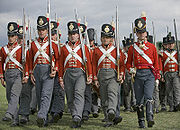 When marching into war, a soldier would have worn the traditional redcoat uniform, consisting of the distinctive regimental coat, a white shirt, grey trousers to be held up by a pair of braces, shoes and a cap. The cap may have differed depending on the regiment, but a traditional pattern was the Belgic shako
, as displayed by the 33rd Regiment of Foot
. A greatcoat
, fashioned in grey wool, would be worn and was normally tied on top of the haversack or knapsack which was carried by the men whilst on the move.
In some cases, it was the bright colours and flamboyant nature of the uniform that attracted men to the army. The chance to wear something as distinctive as the regimental red could be extremely tempting; a new and vivid uniform would have been a welcome change from the drab colours worn by most men in everyday society and soldiers frequently drew interest from admiring women.
A white dress, consisting of a shirt, trousers and a forage cap
would be worn when the men were based in camp. This uniform was much lighter than the one worn for war, being made from linen and the caps from wool, and therefore allowing the men to work in comfort during encampment.
To identify the numerous regiments from one another, the colours of the facings on the dress would have differed to reflect the regimental colours; for example the 24th Regiment of Foot used "Willow Green" facings "lined with white" whilst the 33rd Regiment of Foot used red facings with a "white lining". Another way the units were distinguished from one another was the use of flags (colours). As the War Office
document wo26/21 stated "The Camp Colours to be the Colour of the Facing of the Reg with the Rank of the Reg in the center, those of the Horse to be square, and those of the Dragoon Guards, or Dragoons, to be swallow-tailed".
 Drummer
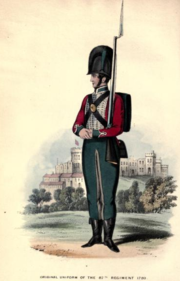
s of a regiment would be dressed with "the colour of the Facings of their Reg, lined, faced, & lapelled on the breast with Red", but would be laced "in such manner as the Colonel shall think fit for distinction sake".
There were also stipulations as to the way the men wore their hair. At a time when most of the troops would have had long hair, the regulation was to wear it queued. It was to be "tied a little below the upper part of the collar of the coat, and to be ten inches in length" with one inch of hair below the tie. Soldiers were not allowed to cut their hair as it prevented the queued appearance.
A common recipe for feeding the troops was beef broth and potatoes; a hardy, warm and filling meal that could normally feed up to eight men. Stews and meat pies were regularly cooked and small beer
– for which a man received around five pints per diem
– and rum were watered down in order to last and deter the men from drunken behaviour. Small beer was often brewed to kill the germs that were present in the water, and therefore was one way in which to reduce the spread and rates of disease. Drinking was used as a method to relax at the end of the day and was a leisurely activity that allowed the men to unwind; it was believed that this would boost morale and enhance the sense of camaraderie between the soldiers.
Food was often shipped out to the troops, but shortages owing to problems with shipping became a common occurrence, and it was therefore much easier to live off the land on which they were stationed. Vegetables may have been grown and livestock procured to help feed the troops, but there were many reports of soldiers sickening due to a lack of proper nourishment.
Out of his wage, a soldier would have to pay for food and forage
– and any other extras such as beer – out of his wage. A loaf of bread usually cost around 5d (and would have lasted for four days) whilst a dragoon soldier (who earned 1s 6d daily) would have paid 6d for a ration of forage consisting of 18 pounds of hay and one peck of oats.
Considering the prices of camp necessaries during this period, many items cost a few shillings: a haversack could be purchased for 3s 6d whilst leather powder bags
could be found for 7s. The Dragoons regiments could have bought a nose bag for the sum of 2s and a drum case would be worth 10s. The larger items such as tents would obviously cost more; it cost approximately £4 10s for a complete round tent and £2 12s for a bell tent for arms. Normally, the tents would be provided by the Board of Ordnance
, but other necessities may have been purchased by the colonel of the regiment who would later be reimbursed.
Dictionary of the English Language, the term "redcoat" was a derogatory one, used as a "name of contempt for a soldier" with the word "soldier" itself being described as "one who serves for pay". In the American colonies the term "lobster" was applied to the redcoat soldier. This does not give across an image of the heroic military man as may be expected today, and suggests that soldiers were commonly seen as subservient and destitute individuals.
However, in times of victory and war, the army was widely commemorated. Patriotic parades and celebrations often included regular army units, the militia or local volunteer regiments, and were an important component of civic ceremony and pride. It must be recognised that although questions did arise as to the need for a standing force, when fears of an invasion were widespread, the speed with which the government was able to utilise its militia and volunteer forces suggests how "the unreformed British state rested on the active consent of substantial numbers of its inhabitants".
Red coat (British army)
Red coat or Redcoat is a historical term used to refer to soldiers of the British Army because of the red uniforms formerly worn by the majority of regiments. From the late 17th century to the early 20th century, the uniform of most British soldiers, , included a madder red coat or coatee...
soldier in the British Army
British Army
The British Army is the land warfare branch of Her Majesty's Armed Forces in the United Kingdom. It came into being with the unification of the Kingdom of England and Scotland into the Kingdom of Great Britain in 1707. The new British Army incorporated Regiments that had already existed in England...
during the 18th century
18th century
The 18th century lasted from 1701 to 1800 in the Gregorian calendar.During the 18th century, the Enlightenment culminated in the French and American revolutions. Philosophy and science increased in prominence. Philosophers were dreaming about a better age without the Christian fundamentalism of...
would have faced war in a number of theatres throughout the European continent, the Americas and the colonies; the Seven Years' War
Seven Years' War
The Seven Years' War was a global military war between 1756 and 1763, involving most of the great powers of the time and affecting Europe, North America, Central America, the West African coast, India, and the Philippines...
raged from 1756–63, the American War of Independence from 1775–83, the French Revolutionary Wars
French Revolutionary Wars
The French Revolutionary Wars were a series of major conflicts, from 1792 until 1802, fought between the French Revolutionary government and several European states...
in 1792–1802 and the ensuing Napoleonic Wars
Napoleonic Wars
The Napoleonic Wars were a series of wars declared against Napoleon's French Empire by opposing coalitions that ran from 1803 to 1815. As a continuation of the wars sparked by the French Revolution of 1789, they revolutionised European armies and played out on an unprecedented scale, mainly due to...
from 1803–15.
There were a number of names used to describe the variety of groups serving within the army, including the militia
Militia
The term militia is commonly used today to refer to a military force composed of ordinary citizens to provide defense, emergency law enforcement, or paramilitary service, in times of emergency without being paid a regular salary or committed to a fixed term of service. It is a polyseme with...
, fencibles
Fencibles
The Fencibles were army regiments raised in the United Kingdom and in the colonies for defence against the threat of invasion during the American War of Independence and French Revolutionary Wars in the late 18th century...
, associations, volunteers, yeomanry
Yeomanry
Yeomanry is a designation used by a number of units or sub-units of the British Territorial Army, descended from volunteer cavalry regiments. Today, Yeomanry units may serve in a variety of different military roles.-History:...
, rangers, local militia and provisional cavalry
Cavalry
Cavalry or horsemen were soldiers or warriors who fought mounted on horseback. Cavalry were historically the third oldest and the most mobile of the combat arms...
. Although many of the men rarely saw active service abroad, the army were often used as a constabulary force within the British Isles and therefore it was often questioned whether a standing force was actually needed. However, the growth of the British Empire
British Empire
The British Empire comprised the dominions, colonies, protectorates, mandates and other territories ruled or administered by the United Kingdom. It originated with the overseas colonies and trading posts established by England in the late 16th and early 17th centuries. At its height, it was the...
in the 19th century demanded the use of an established imperial force.
Life for a redcoat soldier was often tough and challenging. Plenty of training was needed before a soldier could enter the battlefield; drills and exercises had to be strictly followed and punishments inflicted for even the most minor of mistakes. When on campaign, a soldier faced the prospect of restricted food supplies, a dirty camp with little in the way of comfort and ultimately the likelihood of not returning home from war.
Army life
The British Army was commonly seen as disciplined, regimented and harsh. Camp life was dirty and cramped with rapid spread of disease, and punishments could be anything from a floggingFlagellation
Flagellation or flogging is the act of methodically beating or whipping the human body. Specialised implements for it include rods, switches, the cat o' nine tails and the sjambok...
to a death sentence. Yet, many men volunteered to join the army to escape the bleak conditions of life in the cities; for a chance to travel the world and earn a regular wage.
The nature of recruitment
During the 18th century, the men who joined the army were recruited in a number of ways. The regular army used recruitment parties and occasionally press gangs to enlist men, whilst the militia regiments were raised by a ballot, a process that was established in the Militia Act of 1757: "Thirty-two thousand men, all of them good ProtestantsProtestantism
Protestantism is one of the three major groupings within Christianity. It is a movement that began in Germany in the early 16th century as a reaction against medieval Roman Catholic doctrines and practices, especially in regards to salvation, justification, and ecclesiology.The doctrines of the...
, were to be…subjected to martial law in time of active service". There were also many part-time forces, often called volunteers, and they were not in short supply. Becoming a volunteer exempted you from the militia ballot and part-time service as a volunteer was certainly easier than disciplined life with the militia or regular army.
Motivations behind the volunteering nature were not solely patriotic, but commonly economic and profitable. Many men who joined as volunteers and went on to serve with the regular army were unemployed urban dwellers, and prospects of a standard income were better than none at all. Tradesmen could be sure to make a tidy profit from selling their wares to the soldiers, and sutler
Sutler
A sutler or victualer is a civilian merchant who sells provisions to an army in the field, in camp or in quarters. The sutler sold wares from the back of a wagon or a temporary tent, allowing them to travel along with an army or to remote military outposts...
s often became camp follower
Camp follower
Camp-follower is a term used to identify civilians and their children who follow armies. There are two common types of camp followers; first, the wives and children of soldiers, who follow their spouse or parent's army from place to place; the second type of camp followers have historically been...
s, following a regiment whilst on campaign. Certainly more applicable to the landed and wealthy gentlemen, fears of invasion also persuaded many to serve; not so much to support the nation as a whole, but to preserve their own interests, money and property which may be lost if the enemy succeeded.
Officers
Many men who wished to become Officers had to purchase their commission. This was often seen as a "proof of gentlemanly status" as commissions were expensive – at approximately £450 – and usually only the wealthy could afford them, with landed families purchasing commissions for their sons. John Cookson suggests that serving with the army did command a certain respect, and those men that became the holder of an office "could lay claim to the title of [being a] gentleman". Therefore self interest, respect and status were enticing prospects for many who were to join the army.Equipment and weaponry
Brown Bess
Brown Bess is a nickname of uncertain origin for the British Army's Land Pattern Musket and its derivatives. This musket was used in the era of the expansion of the British Empire and acquired symbolic importance at least as significant as its physical importance. It was in use for over a hundred...
musket which had been used by the army since the 1730s. The pike
Pike (weapon)
A pike is a pole weapon, a very long thrusting spear used extensively by infantry both for attacks on enemy foot soldiers and as a counter-measure against cavalry assaults. Unlike many similar weapons, the pike is not intended to be thrown. Pikes were used regularly in European warfare from the...
had been replaced by the use of the musket in the early 1700s. There were many different patterns of musket fired during the 18th century, but the weapon normally favoured a flintlock mechanism
Flintlock mechanism
The flintlock mechanism was a firing mechanism used on muskets and rifles in the 17th, 18th, and 19th centuries. It is commonly referred to as a "flintlock" , though that term is also commonly used for the weapons themselves as a whole, and not just the lock mechanism.The flintlock was developed in...
which was more reliable than the preceding matchlock
Matchlock
The matchlock was the first mechanism, or "lock" invented to facilitate the firing of a hand-held firearm. This design removed the need to lower by hand a lit match into the weapon's flash pan and made it possible to have both hands free to keep a firm grip on the weapon at the moment of firing,...
system used during the civil war
English Civil War
The English Civil War was a series of armed conflicts and political machinations between Parliamentarians and Royalists...
in the 17th century.
Bayonet
Bayonet
A bayonet is a knife, dagger, sword, or spike-shaped weapon designed to fit in, on, over or underneath the muzzle of a rifle, musket or similar weapon, effectively turning the gun into a spear...
s were used in conjunction with the musket for close range fighting; the bayonet would be screwed into the musket barrel and effectively turned the musket into a sword-like instrument.
A well trained soldier could fire up to four rounds per minute, and the use of the platoon formation by the British army meant that a constant volley of fire could be employed. There was much that could go wrong with the musket, from misfires in wet weather to the gun firing at random due to sparks which set the powder off. In the heat of war a ramrod
Ramrod
A ramrod is a device used with early firearms to push the projectile up against the propellant . It is also commonly referred to as a "scouring stick"...
may be forgotten to be removed from the barrel before firing and the inaccuracy of the flintlock (even though it was more reliable than the matchlock) meant that the enemy had to be within at least 30 paces distance for an accurate shot to be fired.
Camp
On an 18th century battlefield, the campMilitary camp
A military camp or bivouac is a semi-permanent facility for the lodging of an army. Camps are erected when a military force travels away from a major installation or fort during training or operations, and often have the form of large campsites. In the Roman era the military camp had highly...
set up by a regiment would have been extremely simplistic in terms of possessions and comforts. Only the very basic necessities would have been taken owing to the fact that everything a regiment needed had to be carried whilst on the move.
A traditional regiment of foot made up of ten companies of approximately 79 men, would have carried a set of camp equipment that included 160 tents, 160 tin kettles with bags, 160 hand hatchets, 12 bell tents, 12 camp colours, 20 drum cases, 10 powder bags, 792 water flasks with strings, 792 haversacks and 792 knapsacks.
The proportion of tents and equipment would have varied depending on the size of the companies and the baggage itself would have differed according to the type of regiment: a regiment of Dragoon
Dragoon
The word dragoon originally meant mounted infantry, who were trained in horse riding as well as infantry fighting skills. However, usage altered over time and during the 18th century, dragoons evolved into conventional light cavalry units and personnel...
s for example would have needed to carry extra equipment for their horses including nose bags and horse pickets.
Conditions in camp were normally inadequate as a site had to be set up wherever space was available – basic amenities such as fresh, running water would have to be collected from nearby sources and latrine
Latrine
A latrine is a communal facility containing one or more commonly many toilets which may be simple pit toilets or in the case of the United States Armed Forces any toilet including modern flush toilets...
s often had to be dug once camp had been set up. Personal space would have been limited, but this commonly created a sense of camaraderie between the soldiers who lived amongst each other on a daily basis.
When a regiment was not on the battlefield, they would have been settled in an established barrack
Barracks
Barracks are specialised buildings for permanent military accommodation; the word may apply to separate housing blocks or to complete complexes. Their main object is to separate soldiers from the civilian population and reinforce discipline, training and esprit de corps. They were sometimes called...
or billet. However, life was usually not any more comfortable; a mess group of 5–6 men, led by a corporal
Corporal
Corporal is a rank in use in some form by most militaries and by some police forces or other uniformed organizations. It is usually equivalent to NATO Rank Code OR-4....
, could be expected to share living quarters and necessities, and sometimes men would share a blanket for sleeping.
Discipline and punishment
Life in the army was extremely disciplined and even minor matters of misconduct did not go unpunished. The courts – either regimental, district or general – were advised by a military lawyer and made up of panels of officers, with some sentences even being determined by the commander-in-chiefCommander-in-Chief
A commander-in-chief is the commander of a nation's military forces or significant element of those forces. In the latter case, the force element may be defined as those forces within a particular region or those forces which are associated by function. As a practical term it refers to the military...
.
The main crimes normally concerned drunkenness, theft and general misbehaviour; the wrong-doer may have received the punishment of running the gauntlet
Running the gauntlet
Running the gauntlet is a form of physical punishment wherein a captive is compelled to run between two rows—a gauntlet—of soldiers who strike him as he passes.-Etymology:...
which involved being flogged by one's own regiment as he passed between two lines of soldiers. In 1765 a soldier was picquet
Picquet
The picquet was a method of torture used as military punishment in vogue in late medieval Europe.The punishment of the picquet required placing a stake in the ground with the exposed end facing upward. The exposed end had a rounded point. The malefactor was typically a junior officer who had...
ted without shoes for drunken misconduct.
One of the more common offences that required excessive punishment was desertion
Desertion
In military terminology, desertion is the abandonment of a "duty" or post without permission and is done with the intention of not returning...
. A man could be branded with a "D" if captured, and if he re-offended could face execution. Death sentences were not all that common, with hanging normally reserved for murderers and death by shot employed for those who were repeat offenders. One such case involved Joseph Stoakes who, between 1728 and 1730, deserted his regiment three times, and upon being captured for the third time was sentenced by court martial to death.
The criminals were punished in front of their peers and officers and the utter humiliation suffered was meant to deter from any further wrong-doing. Punishments were often painful and disgraceful, discouraging those who witnessed them from undergoing the same fate. However, it was customary for a soldier to be accepted back into his regiment without any discredit once he had been punished.
Camp followers
Whilst on campaign, the army would have gathered a large group of followers, ranging from the sutlers who would sell commodities to the soldiers, to the wives and women who chose to follow their men into war.Only 6 women per 100 men on service were allowed to follow a regiment, but they were expected to work and carry out any of the services required by the soldiers: cooking and washing were common domestic duties but these women often doubled up as nurses and carers. Receiving a wage from the army meant that they could earn a decent living as a camp follower. The sutlers could also make a profit by selling their wares – coffee, liquor, beer etc. – to the men they followed.
The camp followers were usually subject to the same military law as the men themselves: a sutler could be flogged or even killed if found to be trading with a licence and common offences included stealing and disobeying of direct orders.
There were many complaints about the presence of women and children in camp, who distracted the men from their duties or made a general nuisance of themselves with one such protest made to Whitehall
Whitehall
Whitehall is a road in Westminster, in London, England. It is the main artery running north from Parliament Square, towards Charing Cross at the southern end of Trafalgar Square...
on 23 January 1720: "Complaint having been made, that you permit women and children to lye in the barracks…take care that the Master Gunner meets with no discouragement or interruptions in the execution of his duty".
Life as a redcoat soldier
An existence as a redcoat soldier could be extremely challenging. The uniformUniform
A uniform is a set of standard clothing worn by members of an organization while participating in that organization's activity. Modern uniforms are worn by armed forces and paramilitary organizations such as police, emergency services, security guards, in some workplaces and schools and by inmates...
s provided were often uncomfortable, poorly produced and could restrict movement and although soldiers received a daily wage, once equipment and food had been purchased, they were left with little in the way of luxuries. Food supplies were limited and supplies impeded during times of war.
Clothing
Shako
A shako is a tall, cylindrical military cap, usually with a peak or visor and sometimes tapered at the top...
, as displayed by the 33rd Regiment of Foot
Duke of Wellington's Regiment
The Duke of Wellington's Regiment was an infantry regiment of the British Army, forming part of the King's Division.In 1702 Colonel George Hastings, 8th Earl of Huntingdon, was authorised to raise a new regiment, which he did in and around the city of Gloucester. As was the custom in those days...
. A greatcoat
Greatcoat
A greatcoat, also known as a watchcoat, is a large overcoat typically made of wool designed for warmth and protection against the weather. Its collar and cuffs can be turned out to protect the face and hands from cold and rain, and the short cape around the shoulders provides extra warmth and...
, fashioned in grey wool, would be worn and was normally tied on top of the haversack or knapsack which was carried by the men whilst on the move.
In some cases, it was the bright colours and flamboyant nature of the uniform that attracted men to the army. The chance to wear something as distinctive as the regimental red could be extremely tempting; a new and vivid uniform would have been a welcome change from the drab colours worn by most men in everyday society and soldiers frequently drew interest from admiring women.
A white dress, consisting of a shirt, trousers and a forage cap
Forage cap
Forage cap is the designation given to various types of military undress, fatigue or working headresses. These varied widely in form, according to country or period...
would be worn when the men were based in camp. This uniform was much lighter than the one worn for war, being made from linen and the caps from wool, and therefore allowing the men to work in comfort during encampment.
To identify the numerous regiments from one another, the colours of the facings on the dress would have differed to reflect the regimental colours; for example the 24th Regiment of Foot used "Willow Green" facings "lined with white" whilst the 33rd Regiment of Foot used red facings with a "white lining". Another way the units were distinguished from one another was the use of flags (colours). As the War Office
War Office
The War Office was a department of the British Government, responsible for the administration of the British Army between the 17th century and 1964, when its functions were transferred to the Ministry of Defence...
document wo26/21 stated "The Camp Colours to be the Colour of the Facing of the Reg with the Rank of the Reg in the center, those of the Horse to be square, and those of the Dragoon Guards, or Dragoons, to be swallow-tailed".
Drummer
A drummer is a musician who is capable of playing drums, which includes but is not limited to a drum kit and accessory based hardware which includes an assortment of pedals and standing support mechanisms, marching percussion and/or any musical instrument that is struck within the context of a...
s of a regiment would be dressed with "the colour of the Facings of their Reg, lined, faced, & lapelled on the breast with Red", but would be laced "in such manner as the Colonel shall think fit for distinction sake".
There were also stipulations as to the way the men wore their hair. At a time when most of the troops would have had long hair, the regulation was to wear it queued. It was to be "tied a little below the upper part of the collar of the coat, and to be ten inches in length" with one inch of hair below the tie. Soldiers were not allowed to cut their hair as it prevented the queued appearance.
Food
When on campaign, soldiers would normally be supplied with an allowance of bread, meat, oatmeal or rice and either beer or rum to wash it down with. A typical daily allowance for a group of up to six men consisted of 6 lb of bread or flour, 10lb of beef, 1lb of rice or oatmeal and 8 gills of rum. A soldier in camp could expect to be provided with a loaf of bread for which he would pay about five pence.A common recipe for feeding the troops was beef broth and potatoes; a hardy, warm and filling meal that could normally feed up to eight men. Stews and meat pies were regularly cooked and small beer
Low alcohol beer
Low-alcohol beer is beer with very low or no alcohol content...
– for which a man received around five pints per diem
Per diem
Per diem refers to a specific amount of money that an organization allows an individual to spend per day, to cover living and traveling expenses in connection with work...
– and rum were watered down in order to last and deter the men from drunken behaviour. Small beer was often brewed to kill the germs that were present in the water, and therefore was one way in which to reduce the spread and rates of disease. Drinking was used as a method to relax at the end of the day and was a leisurely activity that allowed the men to unwind; it was believed that this would boost morale and enhance the sense of camaraderie between the soldiers.
Food was often shipped out to the troops, but shortages owing to problems with shipping became a common occurrence, and it was therefore much easier to live off the land on which they were stationed. Vegetables may have been grown and livestock procured to help feed the troops, but there were many reports of soldiers sickening due to a lack of proper nourishment.
Pay
The daily pay of a British soldier differed with respect to their position within the army. A sergeant could expect to be paid between 1s 6d and 2s 6d depending on whether he served with a foot regiment or the dragoons respectively. A trumpeter could be paid up to 2s 8d whilst a drummer may have been paid 3s if he served with the cavalry. A normal private soldier may have been paid 8d if serving with a Regiment of Foot but received almost 2s 6d if enlisted with the cavalry. In comparison, a labourer in the mid-18th century would have earned a daily wage of 2s and a collier a weekly salary of 13s 6d.Out of his wage, a soldier would have to pay for food and forage
Forage
Forage is plant material eaten by grazing livestock.Historically the term forage has meant only plants eaten by the animals directly as pasture, crop residue, or immature cereal crops, but it is also used more loosely to include similar plants cut for fodder and carried to the animals, especially...
– and any other extras such as beer – out of his wage. A loaf of bread usually cost around 5d (and would have lasted for four days) whilst a dragoon soldier (who earned 1s 6d daily) would have paid 6d for a ration of forage consisting of 18 pounds of hay and one peck of oats.
Considering the prices of camp necessaries during this period, many items cost a few shillings: a haversack could be purchased for 3s 6d whilst leather powder bags
Powder box
Powder box was a small device used to carry gunpowder. Used for many centuries, they ranged from simple and functional to quite ornate and decorative....
could be found for 7s. The Dragoons regiments could have bought a nose bag for the sum of 2s and a drum case would be worth 10s. The larger items such as tents would obviously cost more; it cost approximately £4 10s for a complete round tent and £2 12s for a bell tent for arms. Normally, the tents would be provided by the Board of Ordnance
Board of Ordnance
The Board of Ordnance was a British government body responsible for the supply of armaments and munitions to the Royal Navy and British Army. It was also responsible for providing artillery trains for armies and maintaining coastal fortresses and, later, management of the artillery and engineer...
, but other necessities may have been purchased by the colonel of the regiment who would later be reimbursed.
Perception of the army
According to Samuel Johnson'sSamuel Johnson
Samuel Johnson , often referred to as Dr. Johnson, was an English author who made lasting contributions to English literature as a poet, essayist, moralist, literary critic, biographer, editor and lexicographer...
Dictionary of the English Language, the term "redcoat" was a derogatory one, used as a "name of contempt for a soldier" with the word "soldier" itself being described as "one who serves for pay". In the American colonies the term "lobster" was applied to the redcoat soldier. This does not give across an image of the heroic military man as may be expected today, and suggests that soldiers were commonly seen as subservient and destitute individuals.
However, in times of victory and war, the army was widely commemorated. Patriotic parades and celebrations often included regular army units, the militia or local volunteer regiments, and were an important component of civic ceremony and pride. It must be recognised that although questions did arise as to the need for a standing force, when fears of an invasion were widespread, the speed with which the government was able to utilise its militia and volunteer forces suggests how "the unreformed British state rested on the active consent of substantial numbers of its inhabitants".