


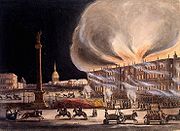
Fire in the Winter Palace

Encyclopedia
Saint Petersburg
Saint Petersburg is a city and a federal subject of Russia located on the Neva River at the head of the Gulf of Finland on the Baltic Sea...
, then the official residence of the Tsar
Tsar
Tsar is a title used to designate certain European Slavic monarchs or supreme rulers. As a system of government in the Tsardom of Russia and Russian Empire, it is known as Tsarist autocracy, or Tsarism...
s of the Russian Empire
Russian Empire
The Russian Empire was a state that existed from 1721 until the Russian Revolution of 1917. It was the successor to the Tsardom of Russia and the predecessor of the Soviet Union...
, occurred on December 17, 1837 and was caused by soot
Soot
Soot is a general term that refers to impure carbon particles resulting from the incomplete combustion of a hydrocarbon. It is more properly restricted to the product of the gas-phase combustion process but is commonly extended to include the residual pyrolyzed fuel particles such as cenospheres,...
inflammation.
The Palace burned for three days, during which time the glow was visible for 50-70 verstas (50–75 km / 30-45 mi). Thirty guardsmen died in the blaze, although nearly all the displays were saved (notably the imperial throne, guards banners, portraits of Russian generals from the Field Marshall's Hall
Field Marshall's Hall of the Winter Palace
The Field Marshals' Hall of the Winter Palace in Saint Petersburg was built to honor Imperial Russia's greatest military leaders—Russian generals who attained the rank of Field Marshal...
and Military Gallery and the utensils of the Grand Church
Grand Church of the Winter Palace
The Grand Church of the Winter Palace in Saint Petersburg, sometimes referred to as the Winter Palace's cathedral, was consecrated in 1763. It is located on the piano nobile in the eastern wing of the Winter Palace, and is the larger, and principal, of two churches within the Palace...
).
Events
The fire broke out after smoke from an unswept chimney had seeped through an unchoked vent in a partition between the wooden and main walls in the Field Marshal's Hall. The wall begun to smoulder and a fire broke out in the roof of the Peter the Great Hall. The dry waxed floors and the oil-painted fretwork caught fire immediately.The Court were at the Michael's Theatre when an aide-de-camp
Aide-de-camp
An aide-de-camp is a personal assistant, secretary, or adjutant to a person of high rank, usually a senior military officer or a head of state...
entered the imperial box and informed Prince Volkonsky, one of the ministers then present. The prince gave him orders and continued to look quietly on at the performance. Half-an-hour later the aide-de-camp returned, and this time the prince spoke to the Emperor Nicholas I
Nicholas I of Russia
Nicholas I , was the Emperor of Russia from 1825 until 1855, known as one of the most reactionary of the Russian monarchs. On the eve of his death, the Russian Empire reached its historical zenith spanning over 20 million square kilometers...
.
To prevent the fire from spreading to the Hermitage
Hermitage Museum
The State Hermitage is a museum of art and culture in Saint Petersburg, Russia. One of the largest and oldest museums of the world, it was founded in 1764 by Catherine the Great and has been opened to the public since 1852. Its collections, of which only a small part is on permanent display,...
, Nicholas I called for immediate dismantling of the galleries' roofs which joined the Hermitage with the main building. However, the fire fighting was hindered when the privy-councillor
Privy council
A privy council is a body that advises the head of state of a nation, typically, but not always, in the context of a monarchic government. The word "privy" means "private" or "secret"; thus, a privy council was originally a committee of the monarch's closest advisors to give confidential advice on...
of the Empress, Chambeau, stated:
The Preobrazhensky Lifeguard Regiment's battalion was first to come from the troops as being situated nearby. The retired Major-General Baranovich told later how the 10th Navy Crew's private Nestor Troyanov and the commissary department joiner Abram Dorofeev managed to save the image of the Christ the Saviour from the already burning iconostasis
Iconostasis
In Eastern Christianity an iconostasis is a wall of icons and religious paintings, separating the nave from the sanctuary in a church. Iconostasis also refers to a portable icon stand that can be placed anywhere within a church...
. Each man was awarded three hundred rubles with Troyanov being transferred to Guards.
The official reports stated that there were no casualties until an eyewitness, Kolokoltsov, exposed the figures in 1882.
The facade
Facade
A facade or façade is generally one exterior side of a building, usually, but not always, the front. The word comes from the French language, literally meaning "frontage" or "face"....
s and parade halls were restored by Vasily Stasov
Vasily Stasov
Vasily Petrovich Stasov was a Russian architect.-Biography:Stasov was born in Moscow....
and inner rooms by Alexander Briullov. In 1838-39 the fire wall
Firewall (construction)
A firewall is a fireproof barrier used to prevent the spread of fire between or through buildings, structures, electrical substation transformers, or within an aircraft or vehicle.- Applications :...
s, new stone and cast-iron staircases as well as new funnels were installed. All the wood was replaced by iron, cast-iron and brick. By the end of 1838 the expenses on these works had exceeded 100,000 rubles.