

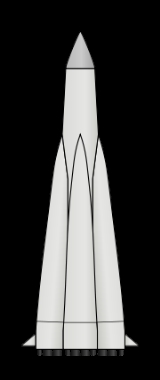
Sputnik rocket

Encyclopedia
The Sputnik rocket was an unmanned orbit
al carrier rocket designed by Sergey Korolyov
, derived from the R-7 Semyorka
ICBM. On 4 October 1957, it was used to perform the world's first satellite
launch, placing Sputnik 1
into a low Earth orbit
.
Two versions of the Sputnik were built, the Sputnik-PS (GRAU
index 8K71PS), which was used to launch Sputnik 1 and later Sputnik 2
, and the Sputnik (8A91), which failed to launch a satellite in April 1958, and subsequently launched Sputnik 3
on 15 May 1958.
A later member of the R-7 family
, the Polyot
, used the same configuration as the Sputnik rocket, but was constructed from Voskhod
components. Because of the similarity, the Polyot was sometimes known as the Sputnik 11A59.
.
Orbit
In physics, an orbit is the gravitationally curved path of an object around a point in space, for example the orbit of a planet around the center of a star system, such as the Solar System...
al carrier rocket designed by Sergey Korolyov
Sergey Korolyov
Sergei Pavlovich Korolev ; died 14 January 1966 in Moscow, Russia) was the lead Soviet rocket engineer and spacecraft designer in the Space Race between the United States and the Soviet Union during the 1950s and 1960s...
, derived from the R-7 Semyorka
R-7 Semyorka
The R-7 was a Soviet missile developed during the Cold War, and the world's first intercontinental ballistic missile. The R-7 made 28 launches between 1957 and 1961, but was never deployed operationally. A derivative, the R-7A, was deployed from 1960 to 1968...
ICBM. On 4 October 1957, it was used to perform the world's first satellite
Satellite
In the context of spaceflight, a satellite is an object which has been placed into orbit by human endeavour. Such objects are sometimes called artificial satellites to distinguish them from natural satellites such as the Moon....
launch, placing Sputnik 1
Sputnik 1
Sputnik 1 ) was the first artificial satellite to be put into Earth's orbit. It was launched into an elliptical low Earth orbit by the Soviet Union on 4 October 1957. The unanticipated announcement of Sputnik 1s success precipitated the Sputnik crisis in the United States and ignited the Space...
into a low Earth orbit
Low Earth orbit
A low Earth orbit is generally defined as an orbit within the locus extending from the Earth’s surface up to an altitude of 2,000 km...
.
Two versions of the Sputnik were built, the Sputnik-PS (GRAU
Grau
Grau is a German word meaning "gray" and a Catalan word meaning "grade". It may refer to:* BAP Almirante Grau , a De Zeven Provinciën class cruiser in service with the Peruvian Navy* Grau Käse, Tyrolean grey cheese...
index 8K71PS), which was used to launch Sputnik 1 and later Sputnik 2
Sputnik 2
Sputnik 2 , or Prosteyshiy Sputnik 2 ), was the second spacecraft launched into Earth orbit, on November 3, 1957, and the first to carry a living animal, a dog named Laika. Sputnik 2 was a 4-meter high cone-shaped capsule with a base diameter of 2 meters...
, and the Sputnik (8A91), which failed to launch a satellite in April 1958, and subsequently launched Sputnik 3
Sputnik 3
Sputnik 3 was a Soviet satellite launched on May 15, 1958 from Baikonur cosmodrome by a modified R-7/SS-6 ICBM. It was a research satellite to explore the upper atmosphere and the near space, and carried a large array of instruments for geophysical research....
on 15 May 1958.
A later member of the R-7 family
R-7 family
The R-7 family of rockets is a series of rockets, derived from the Soviet R-7 Semyorka, the world's first ICBM. More R-7 rockets have been launched than any other family of large rockets....
, the Polyot
Polyot (rocket)
The Polyot was an interim orbital carrier rocket, built to test ASAT spacecraft. It was required as a stopgap after the cancellation of the UR-200 programme, but before the Tsyklon could enter service. Only two were ever launched, the first on 1 November 1963, and the last on 12 April 1964...
, used the same configuration as the Sputnik rocket, but was constructed from Voskhod
Voskhod rocket
The Voskhod rocket was a derivative of the Soviet R-7 ICBM designed for the human spaceflight programme but later used for launching Zenit reconnaissance satellites. It combined the R-7 with an upper stage that had been originally designed to launch interplanetary probes.There was only one main...
components. Because of the similarity, the Polyot was sometimes known as the Sputnik 11A59.
Specifications
- Stage number: 0 - Strap-on boosters; 4 x 8K71PS-0
- Gross mass: 43.0 tons
- Empty mass: 3.400 tons
- Thrust (vac): 4 × 99,000 kgf = 396 Mgf (3.89 MN)
- IspSpecific impulseSpecific impulse is a way to describe the efficiency of rocket and jet engines. It represents the derivative of the impulse with respect to amount of propellant used, i.e., the thrust divided by the amount of propellant used per unit time. If the "amount" of propellant is given in terms of mass ,...
: 306 s (3,000 N·s/kg) - Burn time: 120 s (2 min)
- Isp(sl): 250 s (2,450 N·s/kg)
- Diameter: 2.7 metres (8.9 ft)
- Span: 2.7 metres (8.9 ft)
- Length: 19 metres (62.3 ft)
- Propellants: LOXLoxLox is salmon fillet that has been cured. In its most popular form, it is thinly sliced—less than in thickness—and, typically, served on a bagel, often with cream cheese, onion, tomato, cucumber and capers...
/RP-1RP-1RP-1 is a highly refined form of kerosene outwardly similar to jet fuel, used as a rocket fuel. Although having a lower specific impulse than liquid hydrogen , RP-1 is cheaper, can be stored at room temperature, is far less of an explosive hazard and is far denser... - Engines: 1 x RD-107RD-107The RD-107 is a type of rocket engine initially used to launch R-7 Semyorka missiles. RD-107 engines were later used on space launch vehicles based on the R-7...
-8D74PS per booster = 4
- Stage number: 1 - Core stage; 1 x 8K71PS-1
- Gross mass: 94.0 tons
- Empty mass: 7.495 tons
- Thrust (vac): 99,000 kgf (970 kN)
- Isp: 308 s (3,020 N·s/kg)
- Burn time: 310 s (5 min 10 s)
- Isp(sl): 241 s (2,360 N·s/kg)
- Diameter: 3 metres (9.8 ft)
- Span: 3 metres (9.8 ft)
- Length: 28 metres (91.9 ft)
- Propellants: Lox/RP-1
- Engine: 1 x RD-108-8D75PS
- Total mass: 267 tons (534,000 lb)
- LEOLow Earth orbitA low Earth orbit is generally defined as an orbit within the locus extending from the Earth’s surface up to an altitude of 2,000 km...
payload: 500 kg - Total liftoff thrust: 3.89 MN
Sputnik 8A91
The Sputnik 8A91 had more powerful 8D76 and 8D77 engines installed,, increasing its payload capacity, and allowing it to launch much heavier satellites than Sputnik 1 and Sputnik 2. It was launched two times, in 1958. The first launch, on 27 April, failed due to vibrations that unexpectedly occurred during the flight along the longitudinal axis of the rocket. On 5 May, it successfully launched Sputnik 3Sputnik 3
Sputnik 3 was a Soviet satellite launched on May 15, 1958 from Baikonur cosmodrome by a modified R-7/SS-6 ICBM. It was a research satellite to explore the upper atmosphere and the near space, and carried a large array of instruments for geophysical research....
.
Sputnik 8A91 specifications
- Stage number: 0 - Strap-on boosters; 4 x Sputnik 8A91-0
- Gross mass: 43.0 tons
- Empty mass: 3.400 tons
- Thrust (vac): 4 × 99,000 kgf = 396 Mgf (3.89 MN)
- IspSpecific impulseSpecific impulse is a way to describe the efficiency of rocket and jet engines. It represents the derivative of the impulse with respect to amount of propellant used, i.e., the thrust divided by the amount of propellant used per unit time. If the "amount" of propellant is given in terms of mass ,...
: 310 s (3,040 N·s/kg) - Burn time: 130 s (2 min 10 s)
- Isp(sl): 252 s (2,470 N·s/kg)
- Diameter: 2.7 metres (8.9 ft)
- Span: 2.7 metres (8.9 ft)
- Length: 19 metres (62.3 ft)
- Propellants: Lox/RP-1
- Engines: 1 x RD-107RD-107The RD-107 is a type of rocket engine initially used to launch R-7 Semyorka missiles. RD-107 engines were later used on space launch vehicles based on the R-7...
-8D76 per booster = 4
- Stage number: 1 - Core stage; 1 x Sputnik 8A91-1
- Gross mass: 95.0 tons
- Empty mass: 7.100 tons
- Thrust (vac): 82,000 kgf (804 kN)
- Isp: 315 s (3,090 N·s/kg)
- Burn time: 360 s (6 min)
- Isp(sl): 246 s (2,410 N·s/kg)
- Diameter: 2.99 metres (9.8 ft)
- Length:28 metres (91.9 ft)
- Propellants: LOX/RP-1
- Engine: 1 x RD-108-8D77
- Total mass: 269.3 tons
- LEOLow Earth orbitA low Earth orbit is generally defined as an orbit within the locus extending from the Earth’s surface up to an altitude of 2,000 km...
payload: 1,327 kg (2,925 lb) - Total liftoff thrust: 385,950 kgf (3.784 MN, 850,870 lbfPound-forceThe pound force is a unit of force in some systems of measurement including English engineering units and British gravitational units.- Definitions :...
)