

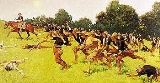

1895 Revolution breaks out in Baire, a town near Santiago de Cuba, beginning the second war for Cuban independence, that ends with the Spanish-American War in 1898.
1898 Spanish-American War: The {{USS|Maine|ACR-1|6}} explodes and sinks in Havana harbor in Cuba, killing more than 260. This event leads the United States to declare war on Spain.
1898 Spanish-American War: The U.S. Congress, on April 25, recognizes that a state of war exists between the United States and Spain as of this date.
1898 Spanish-American War: The United States Navy begins a blockade of Cuban ports and the {{USS|Nashville|PG-7|6}} captures a Spanish merchant ship.
1898 The Spanish-American War: The United States declares war on Spain.
1898 Spanish-American War: The United States declares war on Spain.
1898 Spanish-American War: The attle of Manila Bay (1898)|Battle of Manila Bay
1898 Spanish-American War: U.S. Marines land on the island of Cuba.
1898 Spanish-American War: U.S. war ships set sail for Cuba.
1898 Spanish-American War: United States Marines land in Cuba.
1898 Spanish-American War: the Battle of San Juan Hill is fought in Santiago de Cuba.
1898 Spanish-American War: The Spanish fleet, led by Pascual Cervera y Topete, is destroyed by the U.S. Navy in Santiago, Cuba.
1898 Spanish-American War: A boiler explodes on the {{USS|Iowa|BB-4|6}} off the coast of Santiago de Cuba.
1898 Spanish-American War: American troops enter the city of Mayagüez, Puerto Rico.
1898 An Armistice ends the Spanish-American War.
1898 Spanish-American War: The Treaty of Paris is signed, officially ending the conflict.
1899 Spanish-American War: The Treaty of Paris, a peace treaty between the United States and Spain, is ratified by the United States Senate.
1909 United States troops leave Cuba with the exception of Guantanamo Bay Naval Base after being there since the Spanish-American War.
2001 US President Bill Clinton awards former President Theodore Roosevelt a posthumous Medal of Honor for his service in the Spanish-American War.