


Historic Firehouses of Louisville

Encyclopedia
National Register of Historic Places
The National Register of Historic Places is the United States government's official list of districts, sites, buildings, structures, and objects deemed worthy of preservation...
. The submission represented seventeen historic fire station
Fire station
A fire station is a structure or other area set aside for storage of firefighting apparatus , personal protective equipment, fire hose, fire extinguishers, and other fire extinguishing equipment...
s, located in Louisville, Kentucky
Louisville, Kentucky
Louisville is the largest city in the U.S. state of Kentucky, and the county seat of Jefferson County. Since 2003, the city's borders have been coterminous with those of the county because of a city-county merger. The city's population at the 2010 census was 741,096...
, and these were added to the National Register due to their historical and architectural merits.
Louisville's first fire brigades were established in 1780, two years after the city's creation. The first firehouses were volunteer fire department
Volunteer fire department
See also the Firefighter article and its respective sections regarding VFDs in other countries.A volunteer fire department is a fire department composed of volunteers who perform fire suppression and other related emergency services for a local jurisdiction.The first organized force of...
s scattered throughout the city, but on June 1, 1858 the city of Louisville took control, and replaced the hand engines with five steam engines and volunteers with paid staff. There were initially three fire stations, 65 professional firefighters, and 23 horses.
Many of the early firehouses were demolished due to urban renewal
Urban renewal
Urban renewal is a program of land redevelopment in areas of moderate to high density urban land use. Renewal has had both successes and failures. Its modern incarnation began in the late 19th century in developed nations and experienced an intense phase in the late 1940s – under the rubric of...
; the oldest firehouse still standing was originally built as St. John's Church in 1848, but the city turned the two-story edifice of brick and cast iron
Cast iron
Cast iron is derived from pig iron, and while it usually refers to gray iron, it also identifies a large group of ferrous alloys which solidify with a eutectic. The color of a fractured surface can be used to identify an alloy. White cast iron is named after its white surface when fractured, due...
located in Phoenix Hill
Phoenix Hill
Phoenix Hill is a neighborhood just east of Downtown Louisville in Louisville, Kentucky, USA. Its boundaries are Market Street to the north, Preston Street to the west, Broadway to the south, and Baxter Avenue to the east. The area was originally known as Preston's Enlargement, part of the land...
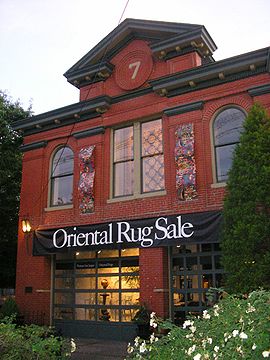
into a firehouse in 1869. Three additional remaining firehouses were built in the 1870s and 1880s (Steam Engine Co. #7 in Limerick
Limerick, Louisville
Limerick is a neighborhood one mile south of downtown Louisville, Kentucky USA. It was developed in the 1860s as a place of residence for employees of the Louisville and Nashville Railroad freight yard. It was named because nearly all of the residents were from the Irish county of Limerick. The St....
(1871), Steam Engine Co. #10 in Butchertown (1873), and the Rogers Street Firehouse in Irish Hill (1883)).
Formed on October 7, 1871, as the Louisville Steam Engine Co. 7, Engine Company 7, at 6th & York Streets, is the oldest continuously operated firehouse in the United States. Due to budget concerns, it is scheduled to close in January 2009, in hopes to save $543,000 from the city's budget.
The most prominent of the firehouses built in the 1890s was the Fire Department Headquarters built in Downtown Louisville
Downtown Louisville
Downtown Louisville is the largest central business district in the Commonwealth of Kentucky and the urban hub of the Louisville, Kentucky Metropolitan Area. Its boundaries are the Ohio River to the north, Hancock Street to the east, York and Jacob Streets to the south, and 9th Street to the west...
at 617 W. Jefferson Street in 1891. It is Richardsonian Romanesque
Richardsonian Romanesque
Richardsonian Romanesque is a style of Romanesque Revival architecture named after architect Henry Hobson Richardson, whose masterpiece is Trinity Church, Boston , designated a National Historic Landmark...
in style, as it was built by the McDonald Brothers, who also made the Kentucky National Bank and Norton's Warehouse buildings in downtown Louisville.
The current fire department headquarters, at 1135 W. Jefferson Street (just outside downtown Louisville), was built in 1936 by the WPA
Works Progress Administration
The Works Progress Administration was the largest and most ambitious New Deal agency, employing millions of unskilled workers to carry out public works projects, including the construction of public buildings and roads, and operated large arts, drama, media, and literacy projects...
. This limestone
Limestone
Limestone is a sedimentary rock composed largely of the minerals calcite and aragonite, which are different crystal forms of calcium carbonate . Many limestones are composed from skeletal fragments of marine organisms such as coral or foraminifera....
edifice is one of the few buildings in Louisville built in the Art Deco
Art Deco
Art deco , or deco, is an eclectic artistic and design style that began in Paris in the 1920s and flourished internationally throughout the 1930s, into the World War II era. The style influenced all areas of design, including architecture and interior design, industrial design, fashion and...
style.