

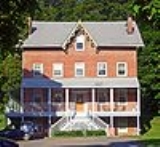
Dutchess Company Superintendent's House

Encyclopedia
The Dutchess Company Superintendent's House is located on Market Street in the western corner of the village of Wappingers Falls
, New York
, United States
. It is a large brick residence that was built as housing for the manager of the Dutchess Company, a large local printing works, shortly after the plant was built in 1848.
It is primarily in the Greek Revival
architectural style
, with some Gothic Revival decorative
touches. In 1984 it was added to the National Register of Historic Places
.
brick building with a symmetrical front facade. The front entrance and its sidelights are centrally located on a shed-roofed porch
built in the mid 20th-century. It replaced an original veranda that wrapped around all but the east side. A portion was left on the north side, along with its Gothic Revival posts, capitals
and other trim.
On the roofline, a steeply pitched
central gable
, decorated with Gothic Revival vergeboard, reinforces the entrance. There are two brick chimneys at either end of the roof.
The inside floor plan is the standard Greek Revival central-hall style. The entrance's sidelights and full transom
are also hallmarks of that style. There are no outbuildings.
. The first superintendent, a Mr. Radclift, was its first occupant.
It remained in company ownership until the company failed in the 20th century, at which point it was purchased by the then-superintendent, William Bogle. It has remained a private home ever since.
, echoing the superintendent's position distance from his subordinates. It was similar to the company owners' houses (none of which survive intact) in size, but unlike them it was located at the bottom of the hill, closer to the plant and the workers than they were.
Its decorative touches, such as the piazza-style original veranda, pointed gable and scroll-sawn
vergeboard, suggest an embrace of the Picturesque
mode then being popularized by Andrew Jackson Downing
of nearby Newburgh
. The house's placement in a wooded area near Wappingers Creek is also reflective of this ideal.
Wappingers Falls, New York
Wappingers Falls is a village in Dutchess County, New York, United States. The name is derived from the local Wappinger Indians. One half of the village is in the town of Wappinger and the other half is in the town of Poughkeepsie, with Wappinger Creek forming the dividing line between the...
, New York
New York
New York is a state in the Northeastern region of the United States. It is the nation's third most populous state. New York is bordered by New Jersey and Pennsylvania to the south, and by Connecticut, Massachusetts and Vermont to the east...
, United States
United States
The United States of America is a federal constitutional republic comprising fifty states and a federal district...
. It is a large brick residence that was built as housing for the manager of the Dutchess Company, a large local printing works, shortly after the plant was built in 1848.
It is primarily in the Greek Revival
Greek Revival architecture
The Greek Revival was an architectural movement of the late 18th and early 19th centuries, predominantly in Northern Europe and the United States. A product of Hellenism, it may be looked upon as the last phase in the development of Neoclassical architecture...
architectural style
Architectural style
Architectural styles classify architecture in terms of the use of form, techniques, materials, time period, region and other stylistic influences. It overlaps with, and emerges from the study of the evolution and history of architecture...
, with some Gothic Revival decorative
Ornament (architecture)
In architecture and decorative art, ornament is a decoration used to embellish parts of a building or object. Large figurative elements such as monumental sculpture and their equivalents in decorative art are excluded from the term; most ornament does not include human figures, and if present they...
touches. In 1984 it was added to the National Register of Historic Places
National Register of Historic Places
The National Register of Historic Places is the United States government's official list of districts, sites, buildings, structures, and objects deemed worthy of preservation...
.
Building
The house is a three-story, five-bayBay (architecture)
A bay is a unit of form in architecture. This unit is defined as the zone between the outer edges of an engaged column, pilaster, or post; or within a window frame, doorframe, or vertical 'bas relief' wall form.-Defining elements:...
brick building with a symmetrical front facade. The front entrance and its sidelights are centrally located on a shed-roofed porch
Porch
A porch is external to the walls of the main building proper, but may be enclosed by screen, latticework, broad windows, or other light frame walls extending from the main structure.There are various styles of porches, all of which depend on the architectural tradition of its location...
built in the mid 20th-century. It replaced an original veranda that wrapped around all but the east side. A portion was left on the north side, along with its Gothic Revival posts, capitals
Capital (architecture)
In architecture the capital forms the topmost member of a column . It mediates between the column and the load thrusting down upon it, broadening the area of the column's supporting surface...
and other trim.
On the roofline, a steeply pitched
Roof pitch
In building construction, roof pitch is a numerical measure of the steepness of a roof, and a pitched roof is a roof that is steep.The roof's pitch is the measured vertical rise divided by the measured horizontal span, the same thing as what is called "slope" in geometry. Roof pitch is typically...
central gable
Gable
A gable is the generally triangular portion of a wall between the edges of a sloping roof. The shape of the gable and how it is detailed depends on the structural system being used and aesthetic concerns. Thus the type of roof enclosing the volume dictates the shape of the gable...
, decorated with Gothic Revival vergeboard, reinforces the entrance. There are two brick chimneys at either end of the roof.
The inside floor plan is the standard Greek Revival central-hall style. The entrance's sidelights and full transom
Transom (architectural)
In architecture, a transom is the term given to a transverse beam or bar in a frame, or to the crosspiece separating a door or the like from a window or fanlight above it. Transom is also the customary U.S. word used for a transom light, the window over this crosspiece...
are also hallmarks of that style. There are no outbuildings.
History
The house was built in 1848, shortly after the Dutchess Company was incorporatedIncorporation (business)
Incorporation is the forming of a new corporation . The corporation may be a business, a non-profit organisation, sports club, or a government of a new city or town...
. The first superintendent, a Mr. Radclift, was its first occupant.
It remained in company ownership until the company failed in the 20th century, at which point it was purchased by the then-superintendent, William Bogle. It has remained a private home ever since.
Aesthetics
The house's design and location reflect some social considerations as well as aethetic ideals of its time. Its Greek Revival scale and mass reflect the factory superintendent's superior position within the community's industrial hierarchy, as well as its location some distance away from the plant and worker housing in the center of townWappingers Falls Historic District
The Wappingers Falls Historic District is in the center of that village in Dutchess County, New York, United States. It is a 90-acre area roughly centered along South Avenue and West Main Street NY 9D and Wappingers Creek...
, echoing the superintendent's position distance from his subordinates. It was similar to the company owners' houses (none of which survive intact) in size, but unlike them it was located at the bottom of the hill, closer to the plant and the workers than they were.
Its decorative touches, such as the piazza-style original veranda, pointed gable and scroll-sawn
Scroll saw
A scroll saw is a small electric or pedal-operated saw that is useful for cutting intricate curves in cases where a jigsaw or coping saw is not appropriate. It is capable of creating curves with edges...
vergeboard, suggest an embrace of the Picturesque
Picturesque
Picturesque is an aesthetic ideal introduced into English cultural debate in 1782 by William Gilpin in Observations on the River Wye, and Several Parts of South Wales, etc. Relative Chiefly to Picturesque Beauty; made in the Summer of the Year 1770, a practical book which instructed England's...
mode then being popularized by Andrew Jackson Downing
Andrew Jackson Downing
Andrew Jackson Downing was an American landscape designer, horticulturalist, and writer, a prominent advocate of the Gothic Revival style in the United States, and editor of The Horticulturist magazine...
of nearby Newburgh
Newburgh (city), New York
Newburgh is a city located in Orange County, New York, United States, north of New York City, and south of Albany, on the Hudson River. Newburgh is a principal city of the Poughkeepsie-Newburgh-Middletown metropolitan area, which includes all of Dutchess and Orange counties. The Newburgh area was...
. The house's placement in a wooded area near Wappingers Creek is also reflective of this ideal.