

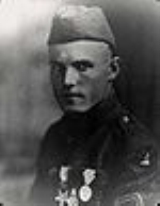
Charles D. Barger

Encyclopedia
Charles Denver Barger was a United States Army
soldier and a recipient of the United States military's highest decoration, the Medal of Honor
, for his actions in World War I
. He earned the medal while serving as a stretcher bearer during the Meuse-Argonne Offensive
, when he and another soldier, Jesse N. Funk
, entered no man's land
despite heavy fire and rescued two wounded officers.
, and grew up in nearby Stotts City
. After his father died when he was six, his mother turned him over to an orphanage. He was adopted and did not see his mother again until after World War I.
serving as a stretcher bearer in Company L of the 354th Infantry Regiment, 89th Division. On that day, near Bois-de-Bantheville, France
, Barger's division sent several patrols into no man's land to reconnoiter German
positions in preparation for an advance as part of the Meuse-Argonne Offensive. Unusually, the patrols had been sent out during daylight, rather than waiting for the cover of darkness. Two patrols from Barger's regiment became pinned down by heavy rifle and machine gun fire. Second Lieutenant John M. Millis was seriously wounded in the legs and ordered his men to leave without him. One man managed to crawl to the safety of the Allied
lines and brought news that Millis and another wounded officer were trapped in no man's land.
Upon hearing this, Barger and another stretcher bearer, Private First Class Jesse N. Funk, voluntarily ran 500 yards (457.2 m) through heavy machine gun fire with their stretcher and rescued Millis. They then returned to no man's land and rescued the other officer, First Lieutenant Ernest G. Rowell. For these actions, both Barger and Funk were awarded the Medal of Honor the next year. These were the only Medals of Honor received by Army medical personnel in World War I. Barger was awarded numerous other decorations for his service in the war, including the Distinguished Service Cross
, the Bronze Star, ten Purple Heart
s, and a number of foreign decorations such as the Médaille militaire
and Croix de guerre
from France and the Croce di Guerra
from Italy
.
After the war, Barger returned to the United States and left the military, having served only one year.
, and fellow veterans from that group helped him find work until "the general public and those who could give employment to veterans became apathetic to the appeals for help on the ground[s that] he was a national hero". He worked on his adoptive uncle's farm near Stotts City in 1920, as a construction worker in Waco, Missouri
, the next year, and then as a Kansas City
police officer. He remained with the police force for twelve years before moving to a farm four miles southwest of Oak Grove
, outside of Kansas City.
On the night of November 23, 1936, county police were called to Barger's home, where they found him wielding a large hunting knife and setting fire to his farmhouse. He had three self-inflicted wounds to his throat, and the deputies reported that "his clothing was torn and his body burned in a dozen places." When the officers attempted to arrest him for threatening to kill his wife, he lunged at them with the knife. Deputy Frank Ridenour fired in self defense, seriously wounding Barger. He was taken to the Kansas City General Hospital and died two days later. He was buried at Blue Springs Cemetery in Blue Springs
, not far from his Oak Grove home.
Citation:
United States Army
The United States Army is the main branch of the United States Armed Forces responsible for land-based military operations. It is the largest and oldest established branch of the U.S. military, and is one of seven U.S. uniformed services...
soldier and a recipient of the United States military's highest decoration, the Medal of Honor
Medal of Honor
The Medal of Honor is the highest military decoration awarded by the United States government. It is bestowed by the President, in the name of Congress, upon members of the United States Armed Forces who distinguish themselves through "conspicuous gallantry and intrepidity at the risk of his or her...
, for his actions in World War I
World War I
World War I , which was predominantly called the World War or the Great War from its occurrence until 1939, and the First World War or World War I thereafter, was a major war centred in Europe that began on 28 July 1914 and lasted until 11 November 1918...
. He earned the medal while serving as a stretcher bearer during the Meuse-Argonne Offensive
Meuse-Argonne Offensive
The Meuse-Argonne Offensive, or Maas-Argonne Offensive, also called the Battle of the Argonne Forest, was a part of the final Allied offensive of World War I that stretched along the entire western front.-Overview:...
, when he and another soldier, Jesse N. Funk
Jesse N. Funk
Jesse Nathaniel Funk was a United States Army soldier and a recipient of the United States military's highest decoration, the Medal of Honor, for his actions in World War I. He earned the medal while serving as a stretcher bearer during the Meuse-Argonne Offensive, when he and another soldier,...
, entered no man's land
No man's land
No man's land is a term for land that is unoccupied or is under dispute between parties that leave it unoccupied due to fear or uncertainty. The term was originally used to define a contested territory or a dumping ground for refuse between fiefdoms...
despite heavy fire and rescued two wounded officers.
Early life
Barger was born in Mount Vernon, MissouriMount Vernon, Missouri
Mount Vernon is a city in Lawrence County, Missouri, United States. The population was 4,017 at the 2000 census. It is the county seat of Lawrence County. It is regionally known for its annual Apple butter Makin' Days festival in October. The high school's athletic teams are known as the...
, and grew up in nearby Stotts City
Stotts City, Missouri
Stotts City is a city in Lawrence County, Missouri, United States. The population was 250 at the 2000 census.-Geography:Stotts City is located at ....
. After his father died when he was six, his mother turned him over to an orphanage. He was adopted and did not see his mother again until after World War I.
Military service
Barger joined the Army from Stotts City, and by October 31, 1918, was a private first classPrivate First Class
Private First Class is a military rank held by junior enlisted persons.- Singapore :The rank of Private First Class in the Singapore Armed Forces lies between the ranks of Private and Lance-Corporal . It is usually held by conscript soldiers midway through their national service term...
serving as a stretcher bearer in Company L of the 354th Infantry Regiment, 89th Division. On that day, near Bois-de-Bantheville, France
France
The French Republic , The French Republic , The French Republic , (commonly known as France , is a unitary semi-presidential republic in Western Europe with several overseas territories and islands located on other continents and in the Indian, Pacific, and Atlantic oceans. Metropolitan France...
, Barger's division sent several patrols into no man's land to reconnoiter German
Germany
Germany , officially the Federal Republic of Germany , is a federal parliamentary republic in Europe. The country consists of 16 states while the capital and largest city is Berlin. Germany covers an area of 357,021 km2 and has a largely temperate seasonal climate...
positions in preparation for an advance as part of the Meuse-Argonne Offensive. Unusually, the patrols had been sent out during daylight, rather than waiting for the cover of darkness. Two patrols from Barger's regiment became pinned down by heavy rifle and machine gun fire. Second Lieutenant John M. Millis was seriously wounded in the legs and ordered his men to leave without him. One man managed to crawl to the safety of the Allied
Allies of World War I
The Entente Powers were the countries at war with the Central Powers during World War I. The members of the Triple Entente were the United Kingdom, France, and the Russian Empire; Italy entered the war on their side in 1915...
lines and brought news that Millis and another wounded officer were trapped in no man's land.
Upon hearing this, Barger and another stretcher bearer, Private First Class Jesse N. Funk, voluntarily ran 500 yards (457.2 m) through heavy machine gun fire with their stretcher and rescued Millis. They then returned to no man's land and rescued the other officer, First Lieutenant Ernest G. Rowell. For these actions, both Barger and Funk were awarded the Medal of Honor the next year. These were the only Medals of Honor received by Army medical personnel in World War I. Barger was awarded numerous other decorations for his service in the war, including the Distinguished Service Cross
Distinguished Service Cross (United States)
The Distinguished Service Cross is the second highest military decoration that can be awarded to a member of the United States Army, for extreme gallantry and risk of life in actual combat with an armed enemy force. Actions that merit the Distinguished Service Cross must be of such a high degree...
, the Bronze Star, ten Purple Heart
Purple Heart
The Purple Heart is a United States military decoration awarded in the name of the President to those who have been wounded or killed while serving on or after April 5, 1917 with the U.S. military. The National Purple Heart Hall of Honor is located in New Windsor, New York...
s, and a number of foreign decorations such as the Médaille militaire
Médaille militaire
The Médaille militaire is a decoration of the French Republic which was first instituted in 1852.-History:The creator of the médaille was the emperor Napoléon III, who may have taken his inspiration in a medal issued by his father, Louis Bonaparte, King of Holland...
and Croix de guerre
Croix de guerre 1914-1918 (France)
The Croix de guerre 1914–1918 is a French military decoration.-Creation:Soon after the outbreak of World War I, French military officials felt that a new military award had to be created...
from France and the Croce di Guerra
Croce di Guerra
The Croce di Guerra al Valor Militare is an Italian decoration for military valour.- Past recipients :* Edouard Izac, Lieutenant, United States Navy* Douglas MacArthur, General, United States Army...
from Italy
Italy
Italy , officially the Italian Republic languages]] under the European Charter for Regional or Minority Languages. In each of these, Italy's official name is as follows:;;;;;;;;), is a unitary parliamentary republic in South-Central Europe. To the north it borders France, Switzerland, Austria and...
.
After the war, Barger returned to the United States and left the military, having served only one year.
Later years and death
Barger married Ruth Bailey and had three children: Charles D. Barger, Jr., born in 1923, Joseph Elmer Barger, born in 1924, and "Dodi" Mable Louise Barger, born in 1927. He had difficulty adjusting to civilian life and struggled to stay employed. He was a member of the American LegionAmerican Legion
The American Legion is a mutual-aid organization of veterans of the United States armed forces chartered by the United States Congress. It was founded to benefit those veterans who served during a wartime period as defined by Congress...
, and fellow veterans from that group helped him find work until "the general public and those who could give employment to veterans became apathetic to the appeals for help on the ground[s that] he was a national hero". He worked on his adoptive uncle's farm near Stotts City in 1920, as a construction worker in Waco, Missouri
Waco, Missouri
Waco is a city in Jasper County, Missouri, United States. The population was 87 at the 2010 census, at which time it was a town. It is part of the Joplin, Missouri Metropolitan Statistical Area.-Geography:Waco is located at ....
, the next year, and then as a Kansas City
Kansas City, Missouri
Kansas City, Missouri is the largest city in the U.S. state of Missouri and is the anchor city of the Kansas City Metropolitan Area, the second largest metropolitan area in Missouri. It encompasses in parts of Jackson, Clay, Cass, and Platte counties...
police officer. He remained with the police force for twelve years before moving to a farm four miles southwest of Oak Grove
Oak Grove, Jackson County, Missouri
Oak Grove is a city in Jackson and Lafayette counties in the U.S. state of Missouri. The population was 5,535 at the 2000 census.-Geography:Oak Grove is located at ....
, outside of Kansas City.
On the night of November 23, 1936, county police were called to Barger's home, where they found him wielding a large hunting knife and setting fire to his farmhouse. He had three self-inflicted wounds to his throat, and the deputies reported that "his clothing was torn and his body burned in a dozen places." When the officers attempted to arrest him for threatening to kill his wife, he lunged at them with the knife. Deputy Frank Ridenour fired in self defense, seriously wounding Barger. He was taken to the Kansas City General Hospital and died two days later. He was buried at Blue Springs Cemetery in Blue Springs
Blue Springs, Missouri
Blue Springs is a city in Jackson County, Missouri and is a satellite city of Kansas City, Missouri. As of the 2010 census the population at 52,575.- Geography :...
, not far from his Oak Grove home.
Medal of Honor citation
Rank and organization: Private First Class, U.S. Army, Company L, 354th Infantry, 89th Division. Place and date: Near Bois-deBantheville, France, 31 October 1918. Entered service at: Stotts City, Mo. Birth: Mount Vernon, Mo. G.O. No.: 20, W.D., 1919.Citation:
Learning that 2 daylight patrols had been caught out in No Man's Land and were unable to return, Pfc. Barger and another stretcher bearer upon their own initiative made 2 trips 500 yards beyond our lines, under constant machinegun fire, and rescued 2 wounded officers.
See also
- List of Medal of Honor recipients for World War I