

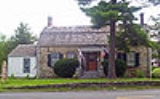
Bergh-Stoutenburgh House

Encyclopedia
The Bergh-Stoutenburgh House is located on US 9 opposite Mansion Drive in Hyde Park
, New York, United States. It is currently home to Edo Sushi, a Japanese restaurant
.
Built before the Revolutionary War
, it is one of only two remaining Dutch Colonial
stone houses in Hyde Park. It is a five-by-two-bay
one-story building with a slate-covered gambrel roof pierced by two brick chimneys at the gable ends. It is sided
in uncoursed
fieldstone
, with clapboard
on the gable ends.
Two small frame
wings project from the north and east (rear). An arched doorway on the south leads to the cellar. The main entrance has a flat-roofed wooden portico
.
John Bergh inherited the lands from his father Christian in the years before the Revolution, along with his brother-in-law Martin Dop. Both of them built houses on them sometime between 1771 and 1780, as they appear on a map of the Albany Post Road
(later to become Route 9 through Hyde Park) drawn by Robert Erskine
, Surveyor-General of the Continental Army
, in the last years of his life, between 1778 and 1780.
In 1788 Bergh sold a hundred acres (40 ha) to Jacobus Stoutenburgh II. His daughter Margaret, in turn, eventually inherited the property. It remained in use as a house throughout the 19th century and into much of the 20th. It was still a residence when it was listed on the National Register of Historic Places
in 1972, the first property in Hyde Park listed on the Register in its own right.
At some point since it was converted
into Edo Sushi. The restaurant heavily remodeled the interior in keeping with Japanese dining traditions, though it still retains some of the original furnishings, such as the fireplace.
Hyde Park, New York
Hyde Park is a town located in the northwest part of Dutchess County, New York, United States, just north of the city of Poughkeepsie. The town is most famous for being the hometown of U.S. President Franklin D. Roosevelt....
, New York, United States. It is currently home to Edo Sushi, a Japanese restaurant
Japanese cuisine
Japanese cuisine has developed over the centuries as a result of many political and social changes throughout Japan. The cuisine eventually changed with the advent of the Medieval age which ushered in a shedding of elitism with the age of shogun rule...
.
Built before the Revolutionary War
American Revolutionary War
The American Revolutionary War , the American War of Independence, or simply the Revolutionary War, began as a war between the Kingdom of Great Britain and thirteen British colonies in North America, and ended in a global war between several European great powers.The war was the result of the...
, it is one of only two remaining Dutch Colonial
Dutch colonization of the Americas
Dutch trading posts and plantations in the Americas precede the much wider known colonization activities of the Dutch in Asia. Whereas the first Dutch fort in Asia was built in 1600 , the first forts and settlements on the Essequibo river in Guyana and on the Amazon date from the 1590s...
stone houses in Hyde Park. It is a five-by-two-bay
Bay (architecture)
A bay is a unit of form in architecture. This unit is defined as the zone between the outer edges of an engaged column, pilaster, or post; or within a window frame, doorframe, or vertical 'bas relief' wall form.-Defining elements:...
one-story building with a slate-covered gambrel roof pierced by two brick chimneys at the gable ends. It is sided
Siding
Siding is the outer covering or cladding of a house meant to shed water and protect from the effects of weather. On a building that uses siding, it may act as a key element in the aesthetic beauty of the structure and directly influence its property value....
in uncoursed
Course (architecture)
A course is a continuous horizontal layer of similarly-sized building material one unit high, usually in a wall. The term is almost always used in conjunction with unit masonry such as brick, cut stone, or concrete masonry units .-Styles:...
fieldstone
Fieldstone
Fieldstone is a building construction material. Strictly speaking, it is stone collected from the surface of fields where it occurs naturally...
, with clapboard
Clapboard (architecture)
Clapboard, also known as bevel siding or lap siding or weather-board , is a board used typically for exterior horizontal siding that has one edge thicker than the other and where the board above laps over the one below...
on the gable ends.
Two small frame
Framing (construction)
Framing, in construction known as light-frame construction, is a building technique based around structural members, usually called studs, which provide a stable frame to which interior and exterior wall coverings are attached, and covered by a roof comprising horizontal ceiling joists and sloping...
wings project from the north and east (rear). An arched doorway on the south leads to the cellar. The main entrance has a flat-roofed wooden portico
Portico
A portico is a porch leading to the entrance of a building, or extended as a colonnade, with a roof structure over a walkway, supported by columns or enclosed by walls...
.
John Bergh inherited the lands from his father Christian in the years before the Revolution, along with his brother-in-law Martin Dop. Both of them built houses on them sometime between 1771 and 1780, as they appear on a map of the Albany Post Road
Albany Post Road
The Albany Post Road was a post road - a road used for mail delivery - in the U.S. state of New York. It connected the cities of New York and Albany along the east side of the Hudson River, a service now performed by US 9.The rough route was as follows:...
(later to become Route 9 through Hyde Park) drawn by Robert Erskine
Robert Erskine
Colonel Robert Erskine was a Scottish inventor and later an American officer in the Continental Army during the American Revolutionary War....
, Surveyor-General of the Continental Army
Continental Army
The Continental Army was formed after the outbreak of the American Revolutionary War by the colonies that became the United States of America. Established by a resolution of the Continental Congress on June 14, 1775, it was created to coordinate the military efforts of the Thirteen Colonies in...
, in the last years of his life, between 1778 and 1780.
In 1788 Bergh sold a hundred acres (40 ha) to Jacobus Stoutenburgh II. His daughter Margaret, in turn, eventually inherited the property. It remained in use as a house throughout the 19th century and into much of the 20th. It was still a residence when it was listed on the National Register of Historic Places
National Register of Historic Places
The National Register of Historic Places is the United States government's official list of districts, sites, buildings, structures, and objects deemed worthy of preservation...
in 1972, the first property in Hyde Park listed on the Register in its own right.
At some point since it was converted
Adaptive reuse
Adaptive reuse refers to the process of reusing an old site or building for a purpose other than which it was built or designed for. Along with brownfield reclamation, adaptive reuse is seen by many as a key factor in land conservation and the reduction of urban sprawl...
into Edo Sushi. The restaurant heavily remodeled the interior in keeping with Japanese dining traditions, though it still retains some of the original furnishings, such as the fireplace.