

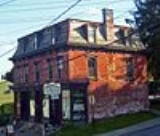
Bain Commercial Building

Encyclopedia
The Bain Commercial Building is located at the corner of Church and West Main (NY 9D
) streets in Wappingers Falls
, New York
, United States
. It is a late 19th-century brick
building that was listed on the National Register of Historic Places
in 1984.
It is the only intact Second Empire-style
building from that period in the village. It is also one of the few historic structures in the portion of the village west of Wappingers Creek in the Town of Poughkeepsie
that was once known as Channingville before it merged with Wappingers Falls in 1871. It has not been altered significantly since its construction and continues in use as multiple-dwelling residences above and business space at street level.
structure with the Second Empire's signature mansard roof
, surfaced in polychrome
slate
. Its foundation
is built into surface that slopes toward the creek, requiring steps to access the building through its front facade
, where a central entry to the upper floors is flanked by separate, three-part storefronts themselves consisting of doors flanked by large bay window
s.
The roofline is decorated with a bracketed
and panelled cornice
, echoed in smaller, less ornate scale above the storefronts. The five windows on the second story give way to three dormer windows on the roof, pierced by chimneys at the center of the north and south elevations. Cast iron
column
s support the structure where the facade elements intersect.
To better facilitate the building's conversion
into apartment
s, wooden stairs and shed
s have been added to the back. One original shed that remains is considered a contributing
outbuilding.
from the other storefront.
In the 20th century, after the village's industries declined, the upper residences were converted into apartments and the appropriate modifications made to the building by the Bain descendants who still owned the property. That mix of uses
continues today, with one of the storefronts home to a coffee shop
.
. Its detachment made possible the more sophisticated applications of the style, such as the roofline, skewed upper window placement and polychrome slate roof.
New York State Route 9D
New York State Route 9D , also known as the Bear Mountain – Beacon Highway, is a north–south state highway that runs along the eastern shore of the Hudson River in New York in the United States. It starts at the eastern end of the Bear Mountain Bridge at U.S...
) streets in Wappingers Falls
Wappingers Falls, New York
Wappingers Falls is a village in Dutchess County, New York, United States. The name is derived from the local Wappinger Indians. One half of the village is in the town of Wappinger and the other half is in the town of Poughkeepsie, with Wappinger Creek forming the dividing line between the...
, New York
New York
New York is a state in the Northeastern region of the United States. It is the nation's third most populous state. New York is bordered by New Jersey and Pennsylvania to the south, and by Connecticut, Massachusetts and Vermont to the east...
, United States
United States
The United States of America is a federal constitutional republic comprising fifty states and a federal district...
. It is a late 19th-century brick
Brick
A brick is a block of ceramic material used in masonry construction, usually laid using various kinds of mortar. It has been regarded as one of the longest lasting and strongest building materials used throughout history.-History:...
building that was listed on the National Register of Historic Places
National Register of Historic Places
The National Register of Historic Places is the United States government's official list of districts, sites, buildings, structures, and objects deemed worthy of preservation...
in 1984.
It is the only intact Second Empire-style
Architectural style
Architectural styles classify architecture in terms of the use of form, techniques, materials, time period, region and other stylistic influences. It overlaps with, and emerges from the study of the evolution and history of architecture...
building from that period in the village. It is also one of the few historic structures in the portion of the village west of Wappingers Creek in the Town of Poughkeepsie
Poughkeepsie (town), New York
Poughkeepsie is a town in Dutchess County, New York, United States. The population was 42,777 at the 2000 census. The name is derived from the native term, "Uppu-qui-ipis-in," which means "reed-covered hut by the water."...
that was once known as Channingville before it merged with Wappingers Falls in 1871. It has not been altered significantly since its construction and continues in use as multiple-dwelling residences above and business space at street level.
Building
The Bain building is a two-story five-by-five bayBay (architecture)
A bay is a unit of form in architecture. This unit is defined as the zone between the outer edges of an engaged column, pilaster, or post; or within a window frame, doorframe, or vertical 'bas relief' wall form.-Defining elements:...
structure with the Second Empire's signature mansard roof
Mansard roof
A mansard or mansard roof is a four-sided gambrel-style hip roof characterized by two slopes on each of its sides with the lower slope at a steeper angle than the upper that is punctured by dormer windows. The roof creates an additional floor of habitable space, such as a garret...
, surfaced in polychrome
Polychrome
Polychrome is one of the terms used to describe the use of multiple colors in one entity. It has also been defined as "The practice of decorating architectural elements, sculpture, etc., in a variety of colors." Polychromatic light is composed of a number of different wavelengths...
slate
Slate
Slate is a fine-grained, foliated, homogeneous metamorphic rock derived from an original shale-type sedimentary rock composed of clay or volcanic ash through low-grade regional metamorphism. The result is a foliated rock in which the foliation may not correspond to the original sedimentary layering...
. Its foundation
Foundation (architecture)
A foundation is the lowest and supporting layer of a structure. Foundations are generally divided into two categories: shallow foundations and deep foundations.-Shallow foundations:...
is built into surface that slopes toward the creek, requiring steps to access the building through its front facade
Facade
A facade or façade is generally one exterior side of a building, usually, but not always, the front. The word comes from the French language, literally meaning "frontage" or "face"....
, where a central entry to the upper floors is flanked by separate, three-part storefronts themselves consisting of doors flanked by large bay window
Bay window
A bay window is a window space projecting outward from the main walls of a building and forming a bay in a room, either square or polygonal in plan. The angles most commonly used on the inside corners of the bay are 90, 135 and 150 degrees. Bay windows are often associated with Victorian architecture...
s.
The roofline is decorated with a bracketed
Bracket (architecture)
A bracket is an architectural member made of wood, stone, or metal that overhangs a wall to support or carry weight. It may also support a statue, the spring of an arch, a beam, or a shelf. Brackets are often in the form of scrolls, and can be carved, cast, or molded. They can be entirely...
and panelled cornice
Cornice
Cornice molding is generally any horizontal decorative molding that crowns any building or furniture element: the cornice over a door or window, for instance, or the cornice around the edge of a pedestal. A simple cornice may be formed just with a crown molding.The function of the projecting...
, echoed in smaller, less ornate scale above the storefronts. The five windows on the second story give way to three dormer windows on the roof, pierced by chimneys at the center of the north and south elevations. Cast iron
Cast iron
Cast iron is derived from pig iron, and while it usually refers to gray iron, it also identifies a large group of ferrous alloys which solidify with a eutectic. The color of a fractured surface can be used to identify an alloy. White cast iron is named after its white surface when fractured, due...
column
Column
A column or pillar in architecture and structural engineering is a vertical structural element that transmits, through compression, the weight of the structure above to other structural elements below. For the purpose of wind or earthquake engineering, columns may be designed to resist lateral forces...
s support the structure where the facade elements intersect.
To better facilitate the building's conversion
Adaptive reuse
Adaptive reuse refers to the process of reusing an old site or building for a purpose other than which it was built or designed for. Along with brownfield reclamation, adaptive reuse is seen by many as a key factor in land conservation and the reduction of urban sprawl...
into apartment
Apartment
An apartment or flat is a self-contained housing unit that occupies only part of a building...
s, wooden stairs and shed
Shed
A shed is typically a simple, single-storey structure in a back garden or on an allotment that is used for storage, hobbies, or as a workshop....
s have been added to the back. One original shed that remains is considered a contributing
Contributing property
In the law regulating historic districts in the United States, a contributing resource or contributing property is any building, structure, or object which adds to the historical integrity or architectural qualities that make the historic district, listed locally or federally, significant...
outbuilding.
History
The Bain family is believed by most of Wappingers Falls to have built the building in 1875, shortly after Channingville became part of the village. It was both their residence and their place of business, with the possibility of rental incomeRenting
Renting is an agreement where a payment is made for the temporary use of a good, service or property owned by another. A gross lease is when the tenant pays a flat rental amount and the landlord pays for all property charges regularly incurred by the ownership from landowners...
from the other storefront.
In the 20th century, after the village's industries declined, the upper residences were converted into apartments and the appropriate modifications made to the building by the Bain descendants who still owned the property. That mix of uses
Mixed-use development
Mixed-use development is the use of a building, set of buildings, or neighborhood for more than one purpose. Since the 1920s, zoning in some countries has required uses to be separated. However, when jobs, housing, and commercial activities are located close together, a community's transportation...
continues today, with one of the storefronts home to a coffee shop
Café
A café , also spelled cafe, in most countries refers to an establishment which focuses on serving coffee, like an American coffeehouse. In the United States, it may refer to an informal restaurant, offering a range of hot meals and made-to-order sandwiches...
.
Aesthetics
Detached Second Empire commercial buildings are not common in urban or suburban settings; the Bain building's development as such testifies to the minimal development of the Channingville area, particularly as it is some distance from the creek and the village's downtownWappingers Falls Historic District
The Wappingers Falls Historic District is in the center of that village in Dutchess County, New York, United States. It is a 90-acre area roughly centered along South Avenue and West Main Street NY 9D and Wappingers Creek...
. Its detachment made possible the more sophisticated applications of the style, such as the roofline, skewed upper window placement and polychrome slate roof.