


Georg-Cantor-Gymnasium

Encyclopedia
The Georg-Cantor
-Gymnasium is a German gymnasium in Halle
(Saale) with a special focus on mathematics and the sciences (specialist school
). The all-day school was founded in 1989. It is attended by just over 500 students and has a staff of about 60 teachers.
The building where the school is now was constructed in 1905. After the renovation between the years 2005 – 2007 the school got new room setups, technical equipment and a new schoolyard, which is small, but nevertheless offers the students many seats and sports activities like basketball or table tennis.
Georg-Cantor-Gymnasium has a modified timetable which includes more lessons in the profile subjects (Mathematics, Physics, Chemistry, Biology, Information Technology and Astronomy). That way the students get the opportunity to learn more about additional topics which are not part of the normal curriculum. Students can also join special clubs or work on science projects after school.
Furthermore, the students take part in practical science training and have the chance to write a scientific paper on an extra-curricular topic of their choice in year 10.
The school has many language clubs where interested students can take languages like Spanish, Russian, Chinese or Latin as an extra-curricular activity.
’s school regulations an entrance exam for schools with special profiles is obligatory. The exam includes a general aptitude test and a mathematical test paper. Places are offered depending on these test results as well as the student’s last school report. Students sit for the exam in the second term of year 4.
There is a break after each lesson. In the breaks after the second and fourth lesson students are expected to go to the schoolyard. Breaks at 11.10 am and 1.10 pm are for eating lunch in the school canteen.
After school students can take part in different clubs where they can follow their special interests. Furthermore students get the chance to do their homework in a common room at school.
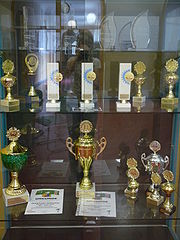 Year after year, students of Georg-Cantor-Gymnasium are successful in national and international competitions. They often win prizes in science and mathematics contests, e.g. the regional and national Mathematics Olympiad or the International Junior Science Olympiad
(IJSO). However, students do not only excel in scientific competitions, but are also successful in foreign language contests.
Georg Cantor
Georg Ferdinand Ludwig Philipp Cantor was a German mathematician, best known as the inventor of set theory, which has become a fundamental theory in mathematics. Cantor established the importance of one-to-one correspondence between the members of two sets, defined infinite and well-ordered sets,...
-Gymnasium is a German gymnasium in Halle
Halle, Saxony-Anhalt
Halle is the largest city in the German state of Saxony-Anhalt. It is also called Halle an der Saale in order to distinguish it from the town of Halle in North Rhine-Westphalia...
(Saale) with a special focus on mathematics and the sciences (specialist school
Specialist school
The specialist schools programme was a UK government initiative which encouraged secondary schools in England to specialise in certain areas of the curriculum to boost achievement. The Specialist Schools and Academies Trust was responsible for the delivery of the programme...
). The all-day school was founded in 1989. It is attended by just over 500 students and has a staff of about 60 teachers.
Location
Since 2007 the school has been located in the city centre of Halle (Saale). The school building had been used until 2005 by the Torgymnasium. The halls of residence are placed about 30 minutes (by tram) away from the school – next to the former school building, which was in use from 1989 to 2007. As its structural condition worsened, the school moved to its current location.The building where the school is now was constructed in 1905. After the renovation between the years 2005 – 2007 the school got new room setups, technical equipment and a new schoolyard, which is small, but nevertheless offers the students many seats and sports activities like basketball or table tennis.
Special Profile
The school’s main emphasis is on mathematics, the sciences and technical education. There are more lessons in these subjects and the students are also mostly well-informed about competitions in these fields.Georg-Cantor-Gymnasium has a modified timetable which includes more lessons in the profile subjects (Mathematics, Physics, Chemistry, Biology, Information Technology and Astronomy). That way the students get the opportunity to learn more about additional topics which are not part of the normal curriculum. Students can also join special clubs or work on science projects after school.
Furthermore, the students take part in practical science training and have the chance to write a scientific paper on an extra-curricular topic of their choice in year 10.
Foreign Languages
In year 5 the students continue English as their first foreign language, which they normally start in Primary School. In year 7 they take up a second one. They can choose between Latin and French. Additionally, students can take Spanish as their third foreign language in year 9. Students can choose any language for their A-levels.The school has many language clubs where interested students can take languages like Spanish, Russian, Chinese or Latin as an extra-curricular activity.
Admission
According to Saxony-AnhaltSaxony-Anhalt
Saxony-Anhalt is a landlocked state of Germany. Its capital is Magdeburg and it is surrounded by the German states of Lower Saxony, Brandenburg, Saxony, and Thuringia.Saxony-Anhalt covers an area of...
’s school regulations an entrance exam for schools with special profiles is obligatory. The exam includes a general aptitude test and a mathematical test paper. Places are offered depending on these test results as well as the student’s last school report. Students sit for the exam in the second term of year 4.
A typical school day
The school day starts at 7.30 am. Typically, years 5 and 6 have 6 lessons a day, with each lesson lasting 45 minutes. Their school day ends at 1.10 pm. At 1.40 pm the afternoon lessons start – mostly the older years take part in these and they finish at about 4 pm at the latest.There is a break after each lesson. In the breaks after the second and fourth lesson students are expected to go to the schoolyard. Breaks at 11.10 am and 1.10 pm are for eating lunch in the school canteen.
After school students can take part in different clubs where they can follow their special interests. Furthermore students get the chance to do their homework in a common room at school.
Archievments
International Junior Science Olympiad
The International Junior Science Olympiad is an international science competition for students not older than 15 years old. It was first held in 2004 in Jakarta, Indonesia and is held every year since then. Each country may send a team of up to 6 students and 3 team leaders. Some of the...
(IJSO). However, students do not only excel in scientific competitions, but are also successful in foreign language contests.