

System Policy Editor

Encyclopedia
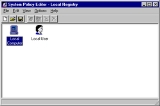
System Policy Editor is a graphical tool provided with Windows 95
, Windows NT 4.0
, and Windows 98
. System policies are made up from a set of registry entries that control the computer resources available to a user or group of users http://support.microsoft.com/kb/161334. These registry entries can be applied to individual users, groups of users, or to anybody logging on to a particular computer.
It works by manipulating Registry
and security settings. User-specific settings are stored in the HKEY_CURRENT_USER registry hive. Likewise, machine-specific settings are written under HKEY_LOCAL_MACHINE. ADM files are template files that are used by System Policy Editor to describe where registry-based policy settings are stored in the registry. They also describe the user interface presented to System Policy administrators.
In Windows 2000
, the System Policy Editor was replaced with the Group Policy
snap-in for Microsoft Management Console
(MMC) http://www.microsoft.com/technet/prodtechnol/windows2000serv/reskit/distrib/dsec_pol_nrqn.mspx?mfr=true.
Windows 95
Windows 95 is a consumer-oriented graphical user interface-based operating system. It was released on August 24, 1995 by Microsoft, and was a significant progression from the company's previous Windows products...
, Windows NT 4.0
Windows NT 4.0
Windows NT 4.0 is a preemptive, graphical and business-oriented operating system designed to work with either uniprocessor or symmetric multi-processor computers. It was the next release of Microsoft's Windows NT line of operating systems and was released to manufacturing on 31 July 1996...
, and Windows 98
Windows 98
Windows 98 is a graphical operating system by Microsoft. It is the second major release in the Windows 9x line of operating systems. It was released to manufacturing on 15 May 1998 and to retail on 25 June 1998. Windows 98 is the successor to Windows 95. Like its predecessor, it is a hybrid...
. System policies are made up from a set of registry entries that control the computer resources available to a user or group of users http://support.microsoft.com/kb/161334. These registry entries can be applied to individual users, groups of users, or to anybody logging on to a particular computer.
It works by manipulating Registry
Windows registry
The Windows Registry is a hierarchical database that stores configuration settings and options on Microsoft Windows operating systems. It contains settings for low-level operating system components as well as the applications running on the platform: the kernel, device drivers, services, SAM, user...
and security settings. User-specific settings are stored in the HKEY_CURRENT_USER registry hive. Likewise, machine-specific settings are written under HKEY_LOCAL_MACHINE. ADM files are template files that are used by System Policy Editor to describe where registry-based policy settings are stored in the registry. They also describe the user interface presented to System Policy administrators.
In Windows 2000
Windows 2000
Windows 2000 is a line of operating systems produced by Microsoft for use on personal computers, business desktops, laptops, and servers. Windows 2000 was released to manufacturing on 15 December 1999 and launched to retail on 17 February 2000. It is the successor to Windows NT 4.0, and is the...
, the System Policy Editor was replaced with the Group Policy
Group Policy
Group Policy is a feature of the Microsoft Windows NT family of operating systems. Group Policy is a set of rules that control the working environment of user accounts and computer accounts. Group Policy provides the centralized management and configuration of operating systems, applications, and...
snap-in for Microsoft Management Console
Microsoft Management Console
Microsoft Management Console is a component of Windows 2000 and its successors that provides system administrators and advanced users an interface for configuring and monitoring the system.- Snap-ins and consoles :...
(MMC) http://www.microsoft.com/technet/prodtechnol/windows2000serv/reskit/distrib/dsec_pol_nrqn.mspx?mfr=true.