


Society of Dependents

Encyclopedia
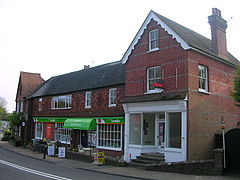
John Sirgood
John Sirgood was a Christian fundamentalist lay preacher, a London shoemaker, who founded the Society of Dependants in the 1850s. He had links with the Peculiar People a populist sect based in Southwark and founded by William Bridges, a Wesleyan lay preacher who had split from orthodox...
in the mid nineteenth century. Their stronghold was in West Sussex and Surrey where they formed co operatives in some villages.
They were widely known as "Cokelers". The nickname 'Cokeler' is of uncertain derivation but was applied from an early date.The derivation of the name may refer to Sirgood's teetotal habit of taking cocoa at meetings. It may perhaps have originated in a corruption of 'cuckholders' and a populist misconception that the sect was polygamous.A third plausible explanation is that Cokeler is derived from a Sussex dialect word 'Coke' meaning to pry or peep about' The sect disliked the name and would not use it.
History

Arminianism
Arminianism is a school of soteriological thought within Protestant Christianity based on the theological ideas of the Dutch Reformed theologian Jacobus Arminius and his historic followers, the Remonstrants...
. They believed in the people's ability to exercise free will and thereby achieve salvation rather than the Calvinistic
Calvinism
Calvinism is a Protestant theological system and an approach to the Christian life...
assertion of predestination
Predestination
Predestination, in theology is the doctrine that all events have been willed by God. John Calvin interpreted biblical predestination to mean that God willed eternal damnation for some people and salvation for others...
. They were conscientious objectors to the war and were encouraged but not required to remain unmarried. Beginning in the 1850s meetings were held on commons or in barns and faced great opposition from the landed gentry and the clergy. Both men and women preached, which was unusual at that time, seeking converts among the poor and humble.
They first established themselves at Loxwood
Loxwood
Loxwood is a small village and civil parish in the Chichester district of West Sussex, England, within the Low Weald. The Wey and Arun Canal passes to the East and South of the village....
because it was outside of the control of the large estates whose Anglican owners would have denied them land or premises. The first chapel was opened there in 1861. Seven more chapels were built in Norwood
Upper Norwood
Upper Norwood is an elevated area in south London, England within the postcode SE19. It is a residential district largely in the London Borough of Croydon although some parts extend into the London Borough of Lambeth, London Borough of Southwark and the London Borough of Bromley. Upper Norwood...
, Shamley Green
Shamley Green
Shamley Green is a small village in the county of Surrey, England. Neighbouring villages include Wonersh, Chilworth, Farncombe and Bramley. Nearby railway stations include Chilworth railway station and Farncombe railway station . Although Shalford Station is in fact closer as the route to...
, Warnham
Warnham
Warnham is a village and civil parish in the Horsham district of West Sussex, England. The village is some three kilometres north west of central Horsham to the west of the A24 road...
, Lords Hill, Northchapel
Northchapel
Northchapel is a village and civil parish in Chichester District in West Sussex, England.It stands on the A283 road just south of the Surrey border, around 9 km north of Petworth....
, Chichester
Chichester
Chichester is a cathedral city in West Sussex, within the historic County of Sussex, South-East England. It has a long history as a settlement; its Roman past and its subsequent importance in Anglo-Saxon times are only its beginnings...
and Hove
Hove
Hove is a town on the south coast of England, immediately to the west of its larger neighbour Brighton, with which it forms the unitary authority Brighton and Hove. It forms a single conurbation together with Brighton and some smaller towns and villages running along the coast...
. These were simple undecorated buildings, with a room where those who had walked long distances to attend could rest during the day-long Sunday worship.
They opened a number of combination stores around 1879 in Norwood, Lord's Hill, Northchapel, Warnham and Loxwood, where members lived communally, working in the business. Some followers disagreed with entering the world of commerce but they were successful, selling everything from soap to suspenders, bacon to bootlaces. They also grew their own produce to sell, living communally on tenanted farms. When there was a fashion for cycling
Cycling
Cycling, also called bicycling or biking, is the use of bicycles for transport, recreation, or for sport. Persons engaged in cycling are cyclists or bicyclists...
in the 1890s they opened bicycle shops at Northchapel, Loxwood and Warnham.
All profits were put back in the business or used to help the needy. They also made furniture to sell: attractive, sturdy pieces, some of which still survive.
The following verse comes from the Dependants' Hymn Book
- Christ's Combination Stores for me
- Where I can be so well supplied,
- Where I can one with brethren be,
- Where competition is defied..
External links
- Living Home page
- Pastfinders
- Society of Dependents (Cokelers): Loxwood (National Register of Archives)
- Loxwood, Sussex, England
- Adherents.com
- The Cokelers Society of Dependants