

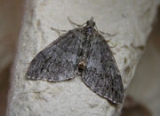
May Highflyer

Encyclopedia
The May Highflyer is a moth
of the family Geometridae. It is found across the Palearctic
region and the Near East
although its range is largely determined by the presence of its larva
l food plant.
The wingspan
is 30–34 mm and it is quite variable in markings, the best identification feature being four square spots along the costa
of each forewing, although these may not be visible in the frequent melanic
forms. The species flies at night from May to July and is attracted to light.
The larva feeds on the leaves of alder
, spinning 2 leaves together so it can feed undisturbed. The species overwinters as a pupa
under loose alder bark.
Moth
A moth is an insect closely related to the butterfly, both being of the order Lepidoptera. Moths form the majority of this order; there are thought to be 150,000 to 250,000 different species of moth , with thousands of species yet to be described...
of the family Geometridae. It is found across the Palearctic
Palearctic
The Palearctic or Palaearctic is one of the eight ecozones dividing the Earth's surface.Physically, the Palearctic is the largest ecozone...
region and the Near East
Near East
The Near East is a geographical term that covers different countries for geographers, archeologists, and historians, on the one hand, and for political scientists, economists, and journalists, on the other...
although its range is largely determined by the presence of its larva
Larva
A larva is a distinct juvenile form many animals undergo before metamorphosis into adults. Animals with indirect development such as insects, amphibians, or cnidarians typically have a larval phase of their life cycle...
l food plant.
The wingspan
Wingspan
The wingspan of an airplane or a bird, is the distance from one wingtip to the other wingtip. For example, the Boeing 777 has a wingspan of about ; and a Wandering Albatross caught in 1965 had a wingspan of , the official record for a living bird.The term wingspan, more technically extent, is...
is 30–34 mm and it is quite variable in markings, the best identification feature being four square spots along the costa
Glossary of Lepidopteran terms
This glossary describes the terms used in the formal descriptions of insect species, jargon used mostly by professionals or entomologist....
of each forewing, although these may not be visible in the frequent melanic
Melanism
Melanism is an undue development of dark-colored pigment in the skin or its appendages, and the opposite of albinism. It is also the medical term for black jaundice.The word is deduced from the , meaning black pigment....
forms. The species flies at night from May to July and is attracted to light.
The larva feeds on the leaves of alder
Alder
Alder is the common name of a genus of flowering plants belonging to the birch family . The genus comprises about 30 species of monoecious trees and shrubs, few reaching large size, distributed throughout the North Temperate Zone and in the Americas along the Andes southwards to...
, spinning 2 leaves together so it can feed undisturbed. The species overwinters as a pupa
Pupa
A pupa is the life stage of some insects undergoing transformation. The pupal stage is found only in holometabolous insects, those that undergo a complete metamorphosis, going through four life stages; embryo, larva, pupa and imago...
under loose alder bark.
- The flight season refers to the British IslesBritish IslesThe British Isles are a group of islands off the northwest coast of continental Europe that include the islands of Great Britain and Ireland and over six thousand smaller isles. There are two sovereign states located on the islands: the United Kingdom of Great Britain and Northern Ireland and...
. This may vary in other parts of the range.